
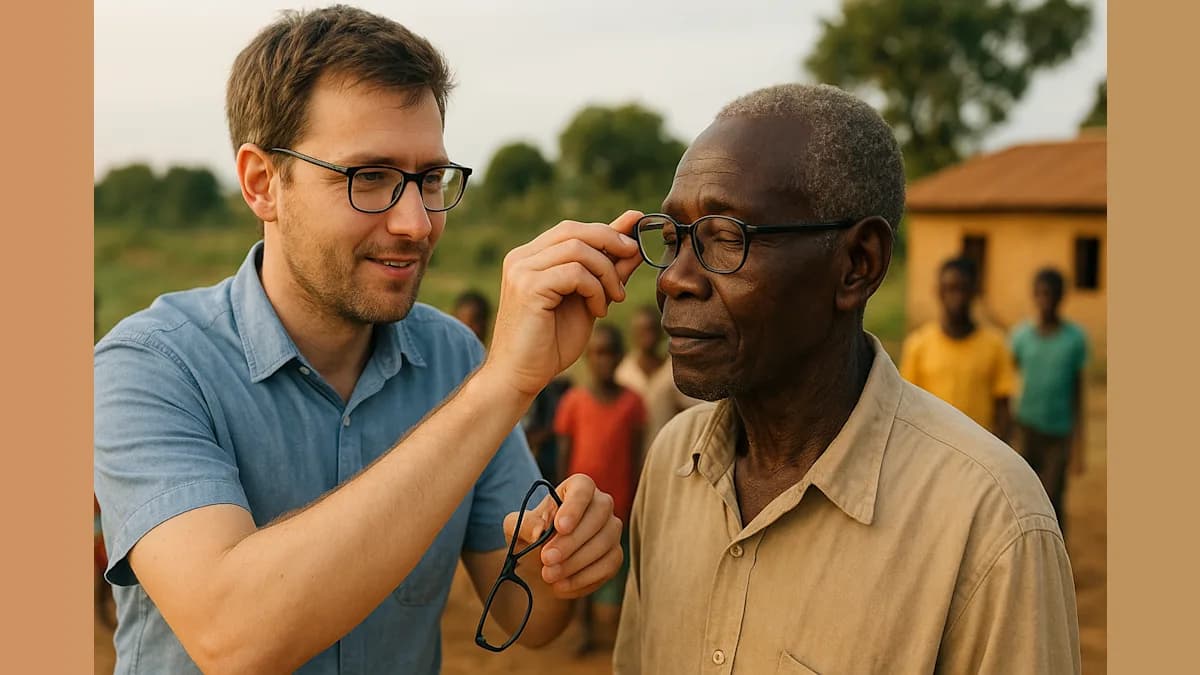
While most people take clear vision for granted, approximately one billion individuals worldwide struggle with correctable vision problems simply because they cannot afford glasses. This staggering reality haunted Martin Aufmuth, a German mathematics teacher, until he decided to do something about it.
Retreating to his basement workshop, Aufmuth emerged with an innovation that challenges conventional assumptions about eyewear manufacturing: spectacles that cost just one dollar to produce. The design eliminates the need for electricity in production and boasts remarkable durability. As Aufmuth describes it, "You could run a jeep over it and it would not break."
The human impact of this technological breakthrough extends far beyond mere statistics. In Brazil, a young boy saw his mother's face clearly for the first time. In Bolivia, a teacher gained the ability to read to her grandchild. In Malawi, a farmer discovered that improved vision could extend his productive season by an entire month before hunger sets in, demonstrating how vision correction directly affects food security and economic survival.
What began as one individual's refusal to accept global inequality has evolved into a distribution network spanning 11 countries. The initiative represents a fundamental rethinking of how essential medical devices can be manufactured and distributed in resource-limited settings. By eliminating electricity requirements and reducing production costs to a fraction of traditional eyewear, Aufmuth has created a scalable solution to a massive public health challenge.
Despite reaching the milestone of one million lives changed, Aufmuth maintains a perspective focused on the work remaining. His attention remains fixed not on past achievements, but on the billion people still waiting for access to vision correction. This forward-looking approach underscores a crucial reality: while the progress is significant, the majority of those suffering from correctable vision impairment have yet to receive help.
The project illustrates how individual innovation can address systemic global challenges. By combining engineering ingenuity with a commitment to accessibility, Aufmuth has demonstrated that solutions to poverty-related health issues need not wait for large-scale institutional intervention. His basement-born invention proves that transformative change can originate from unexpected places, driven by individuals who refuse to accept the status quo.