Renovation crews at St. Mary's Basilica in Minneapolis have made an extraordinary discovery while working high above the cathedral floor. Workers cleaning an arch near the ceiling uncovered elaborate gold stencil work that had been concealed beneath paint for approximately 75 years, revealing artwork that parishioners last saw in the 1950s.
The oldest basilica in the United States, St. Mary's was completed in 1914 and is currently undergoing its second major renovation—a $50 million project scheduled for completion by Easter Sunday 2027. The ambitious timeline has required workers to construct 15 floors of scaffolding to access the ornate ceiling of the nave.
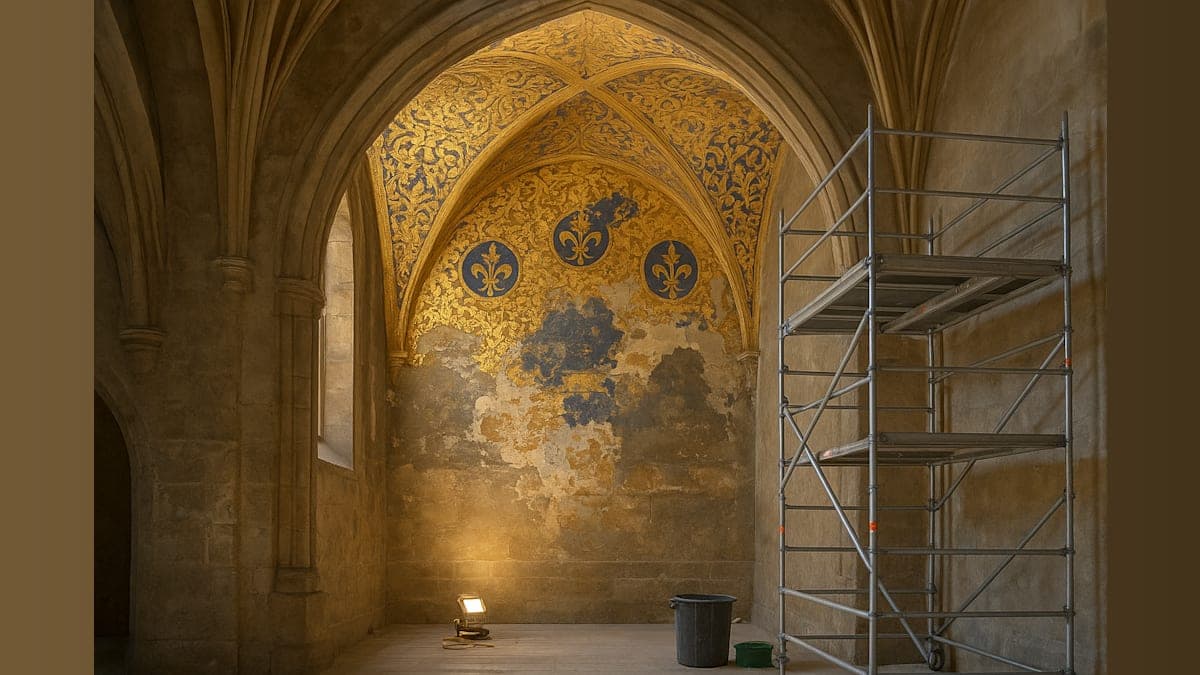
The discovery occurred in the section immediately preceding the altar. As workers washed a broad arch, a gleaming sheen of gold suddenly emerged from beneath what had appeared to be dull, tannish mauve paint. The entire archway proved to be decorated with intricate gold stenciling that had been deliberately covered over at some point in the basilica's history.
Johan van Parys, the basilica's managing director of ministries and director of liturgy and sacred art who serves as project leader for the renovation, explained that no records document why the original artwork was concealed. "We don't know why the stenciling that was originally here was covered over with flat paint. So whether it was an aesthetic choice or financial reason, all the stencil was covered up," van Parys told Good News Network. "When we came to this arch we had no idea we'd discover this."
The surprises continued as conservators examined medallion panels positioned in the corners of the ornate ceiling design. These panels revealed ultramarine blue fields adorned with gold fleur-de-lis patterns, adding another layer of historical artistry to the find.
The emotional significance of the discovery extends beyond its aesthetic value. "It was a supremely emotional moment because that which had been hidden for 75 years now could be revealed again," van Parys told Good News Network. "The people from 1914 who came here for the first Mass, this is what they saw—and that is what we will see again."
The revelation joins a long tradition of religious buildings yielding hidden treasures during restoration work. Such discoveries provide valuable insights into original artistic intentions and historical preservation practices, while reconnecting modern congregations with the vision of the structures' original creators.
The restoration team now faces the challenge of preserving and restoring the newly uncovered artwork while maintaining the aggressive timeline for the overall renovation project. The work represents a significant undertaking in architectural conservation, balancing historical authenticity with structural modernization needs.
When the renovation concludes next Easter, parishioners and visitors will experience St. Mary's Basilica much as it appeared to those who attended its inaugural Mass more than a century ago, with the golden artwork once again visible in its full splendor.