A Long Island man who lost all movement below his chest following a devastating pool accident has achieved remarkable recovery through experimental surgery that bypasses his damaged spinal cord entirely, connecting his brain directly to the nerves in his arms and hands via computer technology.
Keith Thomas from Massapequa can now perform tasks he never expected to accomplish again—feeding himself, scratching his nose, and feeling the fur of his dog—thanks to double neural bypass surgery performed by researchers at the Feinstein Institutes for Medical Research. The breakthrough procedure represents a significant advancement in paralysis treatment, with implications for millions of people worldwide living with spinal cord injuries.
Thomas sustained his injury during the summer of 2020 when what began as an ordinary day by the pool turned catastrophic. He dove into the water, as he had done countless times before, but this time broke his neck at the bottom of the swimming pool. Within moments, he found himself being airlifted to a hospital, his life permanently altered.
Just three months after the accident, the Feinstein Institutes contacted Thomas about participating in a three-year clinical trial testing revolutionary technology. The experimental procedure would attempt to restore both movement and sensation by routing signals around his paralyzed nervous system.
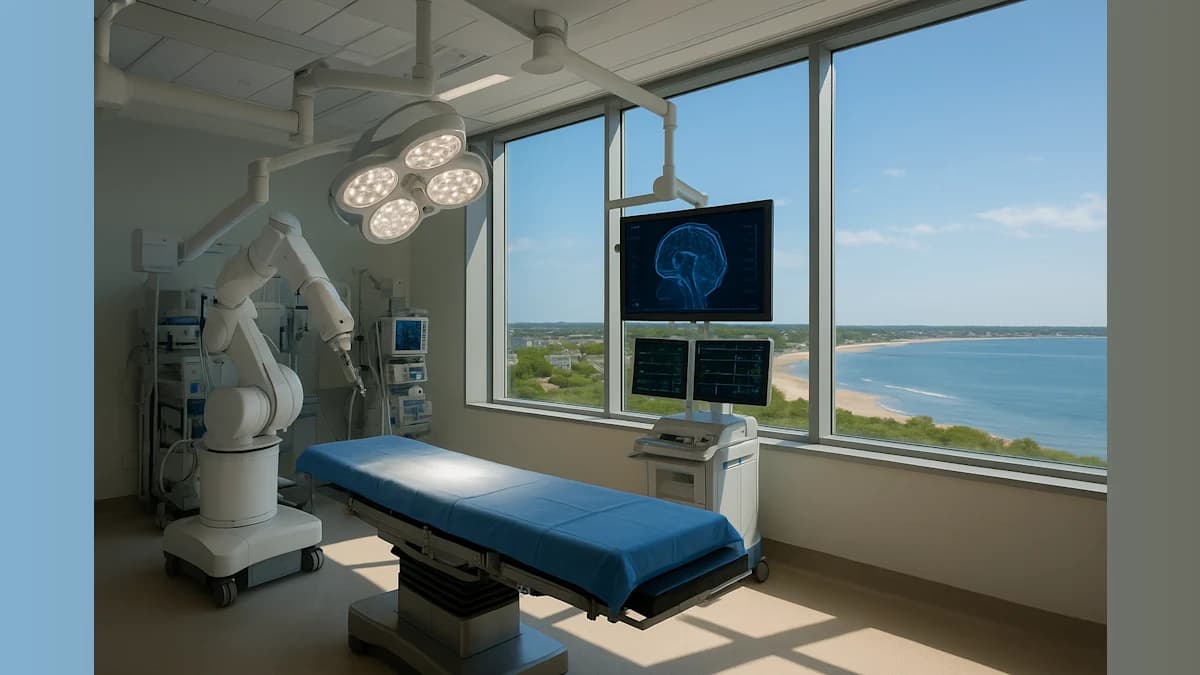
The surgery involves implanting electrodes into Thomas' brain that detect his intention to move his arms. Those neural signals are then transmitted directly to his arms and hands, bypassing the damaged spinal cord completely. The "double" aspect of the procedure refers to additional sensors embedded in his fingers, which detect objects he touches and relay that sensory information back to his brain through the same electrode system.
The technology enables Thomas not only to move his limbs but also to experience touch and distinguish between different objects. He can now feel his sister's hands, sense the texture of his dog's fur, and adjust his grip based on whether he is holding a ball, coffee cup, or fragile egg.
After 35 weeks of training with the system, Thomas has experienced dramatic improvements in strength and mobility. His right arm strength increased by 86 percent, while his left arm gained 62 percent. His range of motion has expanded considerably—he can now raise his hand above his neck to wipe his mouth and scratch his nose, movements that were previously impossible.
Perhaps most remarkably, Thomas continues to experience improved function and sensation even when the computer system is turned off, suggesting the technology may be facilitating genuine neurological recovery rather than simply providing temporary assistance. The findings were recently published in the scientific journal Nature.
Professor Chad Bouton, who leads the research team that developed the technology, expressed enthusiasm about the achievement and its broader implications. The team has spent years working toward combining movement restoration with sensory feedback while creating effects that persist beyond the immediate use of the device.
Researchers remain uncertain about the upper limits of Thomas' potential recovery. With another 35 weeks of training still ahead in the three-year trial, the extent of additional improvement remains an open and hopeful question. The success of this case could pave the way for similar treatments to become available to paralysis patients across the country and around the world.
The double neural bypass procedure represents the latest in a series of recent advances in paralysis treatment, including technologies that reconnect thoughts to spinal cords and treatments that have restored movement in laboratory animals with severed spinal cords. For Thomas and others living with paralysis, these developments offer tangible hope for regaining independence and reconnecting with the physical world.