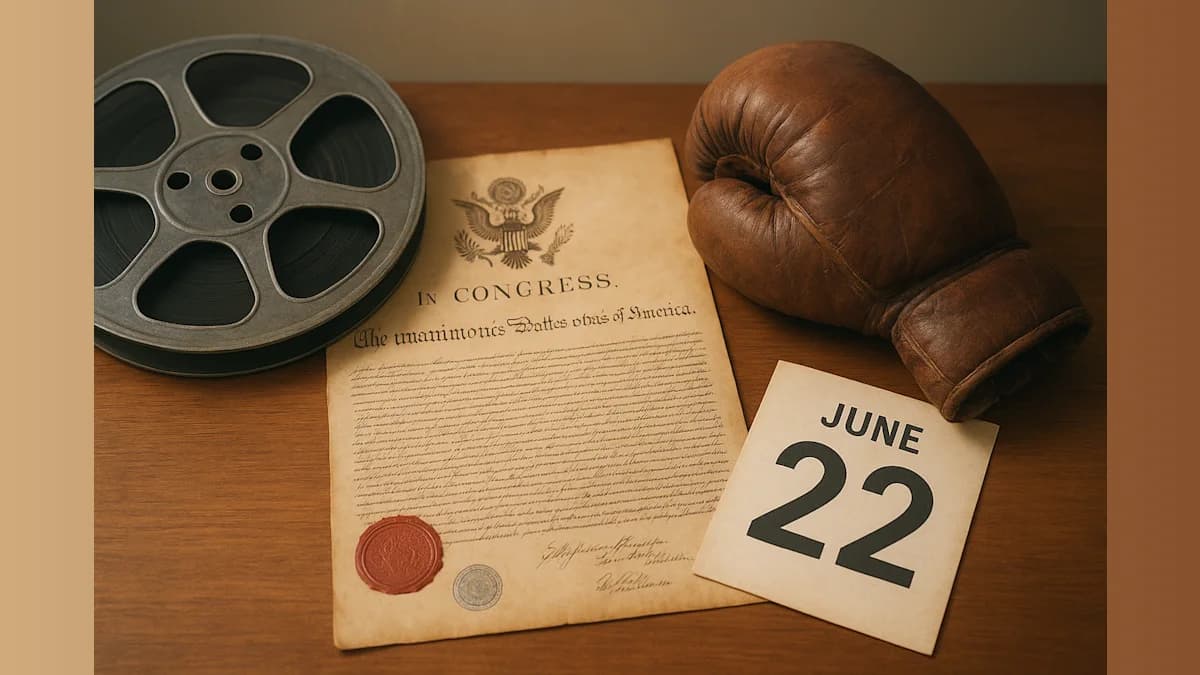
June 22 stands as a date marked by significant achievements in American culture, politics, and sports, with anniversaries spanning from Hollywood animation to civil rights legislation and international athletic competition.
Seventy-six years ago today, Walt Disney Productions released Lady and the Tramp, advertised at the time as Disney's "happiest motion picture yet." The animated feature follows Lady, a pampered cocker spaniel, as she matures from puppy to adult, navigates changes within her family, and develops a romance with Tramp, a homeless mutt. Walt Disney himself conceived the story alongside a friend, drawing inspiration from their experiences with dogs they had given as presents to their wives.
Initial critical reception proved mixed, but the film's reputation has improved substantially over the decades. The National Archives now recognizes Lady and the Tramp as historically and culturally significant to American society, protecting it as one of the greatest animated films ever produced. The iconic scene depicting Lady and Tramp sharing spaghetti by candlelight in an alley has become one of the most frequently reproduced images from any Disney film. Produced for four million dollars, the movie generated one hundred eighty-seven million dollars at the box office and inspired a series of spinoffs nearly five decades later.
Eighty-eight years ago today, Joe Louis delivered a knockout victory over Max Schmeling in a rematch that transcended boxing to become a symbolic confrontation in the months preceding World War II. The bout between Louis, a Black man born in Alabama, and Schmeling, a white German fighter, became a test of Adolf Hitler's ideology of Aryan supremacy on the world's most prominent athletic stage.
The initial encounter between the two fighters occurred on June 19, 1936, at Yankee Stadium in the Bronx, New York, before a sold-out crowd and fifty-seven million radio listeners. Schmeling handed Louis the first and only knockout loss of his career through effective use of his jab supported by a strategic right cross.
By the time of the 1938 rematch, Nazi Germany had annexed Austria in the Anschluss. While Schmeling maintained national support in Germany, he distanced himself from the Nazi regime, stating he was a fighter rather than a politician. Nevertheless, propaganda minister Joseph Goebbels orchestrated a campaign of racially charged propaganda based on Schmeling's boxing success. Schmeling's entourage included an official Nazi Party publicist who controlled the fighter's public statements and issued declarations that a Black man could not defeat Schmeling, claiming the fighter's purse would fund German tank production.
Weeks before the rematch, Louis visited President Franklin Delano Roosevelt at the White House. The New York Times reported Roosevelt telling the fighter that the country needed muscles like his to defeat Germany. Louis later documented in his autobiography that he felt compelled to win for the entire nation.
One hundred million people worldwide listened to the second fight. Boxing commentator Teddy Atlas described Louis stalking Schmeling with short, powerful punches. After Louis landed five left hooks and a body blow, the referee briefly intervened when Schmeling cried out in pain. During a quick resumption, Louis floored the German with a hook to the chin, knocked him down two additional times, and the referee stopped the fight.
Eighty-two years ago today, President Franklin Roosevelt signed the GI Bill of Rights, legislation guaranteeing unemployment benefits and college funding for all United States war veterans. The bill enabled many of the 2.2 million returning soldiers to become the first in their families to obtain college degrees.
Before the war, approximately ten percent of Americans attended college. After the war, that figure rose to roughly fifty percent. Contrary to expectations, grade-point averages at most colleges increased with the influx of veterans, and dropout rates declined significantly. Professors of the era characterized the veterans as the most serious and disciplined students they had encountered. The GI Bill cost taxpayers approximately 5.5 billion dollars but produced 450,000 engineers, 240,000 accountants, 238,000 teachers, 91,000 scientists, 67,000 doctors, 22,000 dentists, 17,000 writers and editors, and thousands of other professionals, helping to spur one of the greatest economic booms in American history.
Additional milestones on this date include American aviator Wiley Post becoming the first person to fly solo around the world in 1933, traveling 15,596 miles in seven days and eighteen hours before receiving a ticker tape parade in New York City. In 1970, President Richard Nixon signed legislation lowering the voting age in the United States to eighteen. The Canadian House of Commons abolished capital punishment in 1976.
Sixteen years ago today, Rotary International concluded its four-year Kick Polio Out of Africa campaign after contributing hundreds of millions of dollars and deploying countless volunteers. The effort eradicated ninety-nine percent of the disease across the continent. Nigeria, the final stronghold for the virus, reached three years without a case of wild polio in August following Rotary's commitment of 268 million dollars to the fight in partnership with the World Health Organization.
Notable birthdays on this date include Italian mountaineer and writer Walter Bonatti, born ninety-six years ago in Bergamo, who became one of the most accomplished Alpinists in history. Musical pioneer Todd Rundgren celebrates his seventy-eighth birthday today, having achieved success as both a singer-songwriter with hits including "Hello It's Me" and "I Saw the Light," and as a record producer for artists including Patti Smith, Hall & Oates, and Meat Loaf. Academy Award-winning actress Meryl Streep, born seventy-seven years ago in Summit, New Jersey, holds the record for most Academy Award nominations with twenty-one, having won three Oscars for her performances in Kramer vs. Kramer, Sophie's Choice, and The Iron Lady.