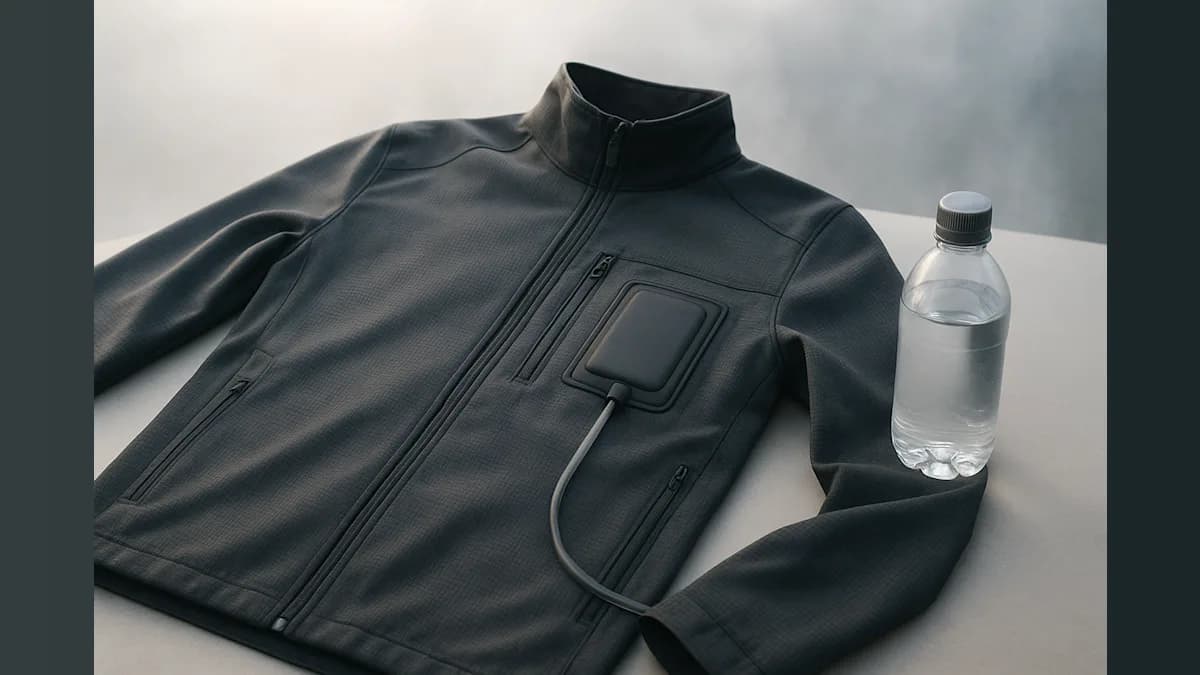
A breakthrough in wearable technology has emerged from the University of Texas-Austin, where engineers have created a jacket that transforms atmospheric moisture into potable water. The innovative garment can produce between 0.7 and 1.5 pints of drinking water per day, depending on humidity conditions, representing a significant advancement in portable water-harvesting technology.
The technology addresses a critical need for individuals operating in environments where clean drinking water remains scarce or inaccessible. Researchers envision applications for hikers, campers, runners, agricultural workers, and military personnel who frequently work in remote locations without reliable water infrastructure.
"Water harvesting from air is usually imagined as a stationary device such as a box, a panel. We wanted to rethink the form," research co-leader Professor Guihua Yu told Good News Network. By concentrating on fiber technology rather than constructing another bulky apparatus, the research team successfully addressed a persistent challenge in the atmospheric water harvesting field.
The jacket incorporates specialized textile that captures moisture from the surrounding air and channels it to detachable harvesting units. These units are subsequently placed in a foldable collector and heated to convert the captured moisture into liquid water. According to findings published in the journal Science Advances, the textile demonstrated a three- to ten-fold improvement over conventional water-harvesting materials when tested at scale.
"The important advance here is that the team did not simply make another material that absorbs water," study co-author Professor Keith Johnston told Good News Network. "They designed a pathway for water to move quickly, from vapor in the air to liquid on the fiber surface, and then into the interior of the textile."
The research team has identified numerous potential applications beyond wearable clothing. The technology could be integrated into backpacks, tents, emergency shelters, and other outdoor equipment, enabling everyday items to serve dual purposes as water collection devices. Additional applications under consideration include remote field operations, disaster response scenarios, and water access solutions for arid regions or areas with limited infrastructure.
The same research group previously developed a separate solar-powered device that achieved record-breaking water extraction from atmospheric sources. During testing in both the arid Chihuahuan Desert and the humid climate of Austin, Texas, the device captured 1.3 liters of clean water daily. This performance translated to 4.3 liters of water per kilogram of moisture-capturing materials per day, surpassing achievements by any other research group according to a paper published in the journal Nature Water.
"This is a big stride toward practical atmospheric water harvesting," study co-lead author Weixin Guan told Good News Network. The researcher noted that the accomplishment represents years of development, from molecular design through real-world operational testing, culminating in a field-ready system.
The University's research commercialization unit has filed a patent application for the technology, positioning the innovation for potential commercial development and widespread deployment in situations where access to clean drinking water remains a critical challenge.