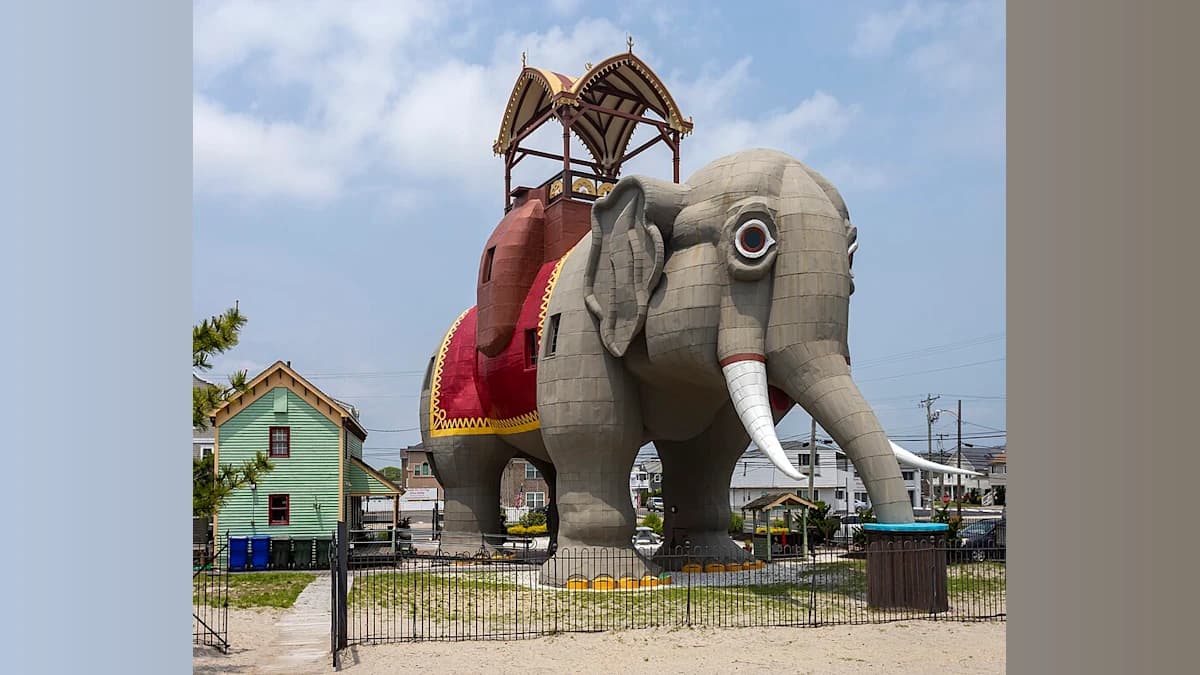
The historic landmark is planning a new visitor center, interior restoration and a replica of Margate's original Boardwalk, with construction expected to begin next spring.
MARGATE, N.J. — Lucy the Elephant is getting a multimillion-dollar boost from the State of New Jersey, paving the way for a major expansion that could transform one of the Jersey Shore's most recognizable landmarks into an even larger tourism and educational destination.
The New Jersey Economic Development Authority has unanimously approved a $5.4 million tax credit to support construction of a new visitor and interpretive center, additional restoration of Lucy's interior and improvements to the surrounding park.
The project also includes a half-block replica of Margate's historic Boardwalk, which would run along the bulkhead in front of Lucy and serve as an entrance to the new visitor center.
For the nonprofit organization responsible for preserving the 145-year-old attraction, the approval represents a major milestone following more than a year of uncertainty.
"This is an extraordinary day for Lucy," said Richard Helfant, executive director of the Save Lucy Committee. "After 17 months of uncertainty and perseverance, we have finally reached a turning point."
Helfant said the approval represents an important step toward ensuring that future generations can continue experiencing the landmark.
"This approval represents an enormous step forward in our efforts to preserve Lucy for future generations, enhance the visitor experience and create a destination worthy of one of New Jersey's most beloved and recognizable landmarks."
A Major Expansion for a Historic Landmark
The project will significantly improve the visitor experience at Lucy, which stands approximately six stories tall along Atlantic Avenue in Margate.
The planned visitor and interpretive center will include expanded educational exhibits, a larger gift shop and accessible restrooms.
The new facility is also designed to improve accessibility for visitors with disabilities, an objective Lucy's preservation organization has pursued for approximately two decades.
The existing gift shop, which had stood near Lucy for approximately 50 years, was demolished in June 2025 to make room for the new facility.
Gift shop operations have temporarily relocated across Atlantic Avenue while preparations for construction continue.
The improvements are intended to create a more comprehensive experience for visitors interested in Lucy's unusual architecture, history and significance to the Jersey Shore.
The project will also include additional interior restoration work, building on a major exterior rehabilitation completed in 2022.
That earlier project, costing approximately $2.4 million, included replacement of Lucy's deteriorating metal exterior.
The new work will focus on preserving the interior while creating additional opportunities to educate visitors about the landmark's history.
Historic Boardwalk Will Return in Miniature
One of the more distinctive elements of the project is a planned replica of Margate's historic Boardwalk.
The half-block structure will be built along the bulkhead in front of Lucy and will provide access to the new visitor center.
Margate once had a wooden Boardwalk similar to those in other South Jersey resort communities.
The proposed replica is intended to reconnect visitors with that part of the city's history while enhancing the surrounding park.
Together, the Boardwalk replica, new visitor center and landscaping improvements are expected to create a more inviting destination for tourists and local residents.
The project could also provide additional opportunities for educational programming and special events.
A 17-Month Effort to Secure Funding
The tax-credit approval follows a lengthy application process that required substantial financial and administrative commitments.
According to Helfant, the Save Lucy Committee spent more than $125,000 over 17 months pursuing the award.
The funding was approved through the New Jersey Economic Development Authority's Cultural Arts Facilities Expansion Program.
Helfant credited several individuals and organizations for helping secure the approval, including Gov. Mikie Sherrill, Margate Mayor Michael Collins and the city's Board of Commissioners.
He also recognized Lucy's director of education, Jeremy Bingaman, and grant consultant Jim Rutala for their work navigating the application process.
Following the board's approval, Helfant contacted Tom Sykes of WATG/SOSH Architects to begin advancing construction documents.
The project has not yet received its final administrative authorization.
According to information presented at the NJEDA meeting, the board's minutes must be submitted to the governor, who has a two-week period to veto any approved items.
The agency is then expected to issue a formal award letter outlining the conditions attached to the tax credit.
The distinction is important because the $5.4 million represents an approved tax-credit award, not an immediate cash payment to the organization.
The final financing arrangements and any remaining funding requirements have not been fully detailed publicly.
Construction Could Begin in April 2027
If the remaining approvals and preparations proceed as expected, the Save Lucy Committee hopes to break ground in April 2027.
Construction is expected to take approximately 12 to 16 months.
That timetable would place completion and a possible ribbon-cutting ceremony in the middle of 2028.
Lucy board President Jason Tell said the approval provides greater confidence that the organization can move forward with its plans.
"We are grateful to the NJEDA and everyone who believed in this vision, stood beside us through the difficult moments and helped make this achievement possible," Tell said.
The project comes after several years of financial challenges and fundraising efforts.
In 2025, the organization secured $800,000 in state and federal funding for site improvements, including $500,000 through the National Park Service's Save America's Treasures program.
That federal funding was subsequently revoked amid federal spending reductions.
Supporters responded by raising approximately $200,000 in private donations, and the organization later secured an additional $350,000 after reapplying for federal assistance.
The latest state tax-credit approval represents a substantially larger financial commitment toward the attraction's long-term future.
Lucy's Remarkable 145-Year History
Built in 1881 by Philadelphia real estate developer James V. Lafferty, Lucy was originally conceived as an unusual way to attract prospective property buyers to what was then known as South Atlantic City.
The elephant-shaped structure was designed to draw attention to the surrounding real estate.
Originally called the Elephant Bazaar, Lucy quickly became a curiosity for visitors traveling to the Jersey Shore.
Over the decades, she evolved into one of New Jersey's most recognizable attractions.
But Lucy nearly disappeared during the 1960s as deterioration threatened the structure.
Local residents organized a preservation campaign, forming the Save Lucy Committee in 1969.
In July 1970, the approximately 90-ton elephant was moved about 100 yards to her present location.
The unusual relocation became a defining moment in Margate history.
In 1976, Lucy was designated a National Historic Landmark, recognizing her architectural and historical significance.
She remains the oldest surviving roadside attraction in the United States and the last remaining example of three elephant-shaped structures designed by Lafferty.
Lucy has also been recognized by USA Today readers as the nation's top roadside attraction for two consecutive years.
This year marks both her 145th birthday and the 50th anniversary of her National Historic Landmark designation.
Earlier this month, the New Jersey Historical Commission and RevolutionNJ unveiled a new historical marker recognizing Lucy's role in the development of the Jersey Shore.
The marker was dedicated October 14 at Atlantic Avenue and Lucy Plaza.
An Investment in Margate's Tourism Future
Beyond preserving an important piece of local history, the planned expansion could strengthen Margate's appeal as a year-round tourism destination.
Lucy's location near the beach has made her a familiar attraction for generations of vacationers.
The new visitor center is expected to provide additional educational opportunities while improving access for families, school groups and visitors with mobility challenges.
The project also represents a significant investment in cultural tourism, an increasingly important component of the regional economy.
For Margate, the improvements could encourage visitors to spend more time in the community and support nearby restaurants, shops and other businesses.
Helfant emphasized that the effort extends beyond construction and financing.
"This is about so much more than a tax credit or a construction project," he said.
"It is about protecting an irreplaceable piece of our history, creating a better experience for the millions of people who have a connection to Lucy and ensuring that she continues to inspire generations to come."
For an attraction that survived deterioration, the threat of demolition and numerous financial challenges, the latest funding approval marks another important chapter.
And if construction proceeds as planned, visitors could be walking along a recreated piece of Margate's historic Boardwalk and exploring a new educational center by the summer of 2028.
For Lucy the Elephant, the future is looking considerably brighter.

About the Author
Karen Johnson
With over 30 years of news experience in major markets like Los Angeles, Denver, and Columbus, Karen now covers our area for South Jersey NewsBeat. She also brings her articulate and conversational news delivery to WOND radio listeners every weekday. Her background includes work with the NBC Radio Network, and she thrives in fast-paced news environments.