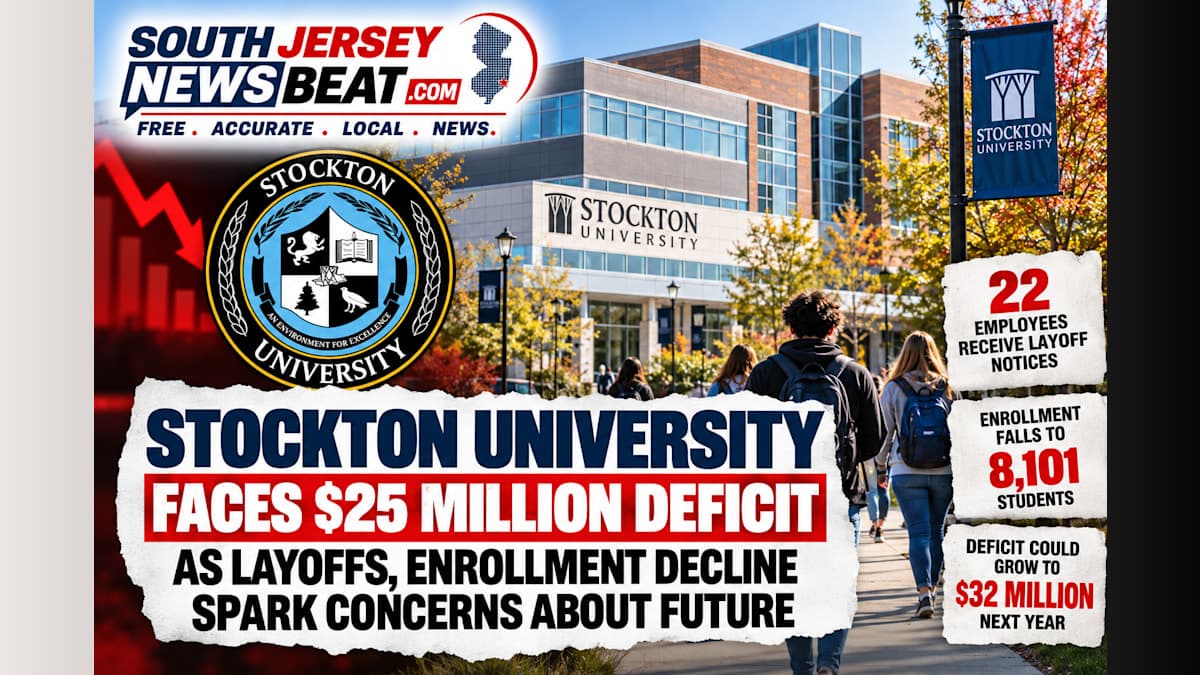
Twenty-two employees reportedly received layoff notices as faculty unions challenge the cuts, enrollment falls to 8,101 students and university leaders warn of a possible $32 million deficit next year.
GALLOWAY, N.J. — Stockton University is confronting one of its most serious financial challenges in recent years, with faculty and staff layoffs moving forward, enrollment continuing to decline and university leaders warning that the budget deficit could grow to approximately $32 million next year without additional corrective action.
The financial difficulties have sparked protests, opposition from labor unions and growing questions about the future of academic programs and student services at one of South Jersey's largest public universities.
President Joe Bertolino announced October 6 that Stockton intended to eliminate 21 faculty and professional staff positions at the conclusion of the 2026–27 academic year.
However, according to an October 15 report by Shore Local News, 22 employees received layoff notices on October 13.
The university did not explain to Shore Local why the number increased from the 21 positions originally announced.
The discrepancy remains unresolved publicly, as does the total number of employees represented by the Communications Workers of America who could be affected.
The cuts come as Stockton faces a structural budget deficit estimated at approximately $25 million, declining enrollment and increasing pressure to reduce expenses.
Enrollment Falls by More Than 500 Students in One Year
Stockton's financial problems are closely connected to a sustained decline in enrollment.
The university reported 8,101 undergraduate and graduate students for the fall 2026 semester, compared with 8,626 in fall 2025.
That represents a loss of 525 students, or approximately 6.1%, in one year.
Enrollment has declined approximately 10.8% since fall 2022, when Stockton reported 9,080 students.
The losses affect university finances because tuition, fees, housing and other student-related revenue are important components of the operating budget.
Stockton is also experiencing difficulties retaining students after their first year.
During his October 8 State of the University address, Bertolino said the first-year retention rate had fallen from 85% in 2019 to 74% in 2026, its lowest level in seven years.
The university's student newspaper, The Argo, reported that new undergraduate enrollment was down approximately 11%, while continuing undergraduate enrollment had fallen about 6%.
Those trends suggest Stockton is facing two simultaneous challenges: attracting new students and keeping existing students enrolled through graduation.
For a university serving thousands of South Jersey families, both issues carry implications beyond the campus.
Budget Deficit Could Reach $32 Million
Bertolino has described Stockton's financial difficulties as a structural problem rather than a temporary shortfall.
During his October 8 address, he discussed a deficit estimated at approximately $24.5 million.
Without additional spending reductions or revenue improvements, he warned, the deficit could grow to approximately $32 million in the following year.
The financial pressure is not entirely new.
Stockton's Board of Trustees approved a fiscal 2026 operating and capital budget in July 2025 that projected approximately $292.6 million in revenue against $311.9 million in expenses.
That budget anticipated a deficit of approximately $19.3 million before additional cost-saving measures.
The growing gap illustrates the difficulty university administrators have faced in bringing expenses into line with revenue.
Bertolino said the institution has already pursued voluntary separation programs, hiring restrictions, reductions in vacant positions and other personnel changes.
According to his October 8 address, approximately 135 positions have been eliminated through vacancies, voluntary separations and retirements since he became president in 2023.
Those reductions are separate from the newly announced layoffs.
Despite those efforts, Bertolino said the university still needs substantial additional personnel savings.
The administration has also discussed reducing operating expenses, reviewing academic programs, improving student retention and generating additional revenue.
Why Not Use the University's Reserves?
One question raised during the financial debate is whether Stockton could rely more heavily on its investment accounts rather than eliminating employees.
Bertolino addressed that issue during his State of the University speech.
He said the university's investment balance stood at approximately $140 million and could fall to about $78 million over two years if Stockton used reserves to cover the existing deficit, future shortfalls and costs associated with voluntary separation agreements.
That would represent a decline of approximately $62 million.
Bertolino argued that such a reduction would threaten the university's long-term financial stability.
The university's financial position also drew attention from Fitch Ratings earlier this year.
On July 31, Fitch revised Stockton's credit outlook from stable to negative while affirming its existing A credit rating.
The distinction is important: Stockton's credit rating was not downgraded.
However, the negative outlook signals concern about the university's future financial performance.
Fitch cited declining enrollment, operating deficits, reduced state support and competitive pressures in New Jersey's higher education market.
The agency also raised concerns about the university's debt burden and its ability to restore balanced operations.
A further decline in enrollment, continued deficits or substantial depletion of financial reserves could place additional pressure on Stockton's credit rating.
Faculty Union Says Layoffs Threaten Student Services
The Stockton Federation of Teachers, which represents faculty and professional staff, has strongly opposed the proposed layoffs.
Union President Tara Luke, a biology professor, said the reductions threaten the university's educational mission.
"Our faculty and staff are the heart of Stockton University, not line items to be erased," Luke said in an October 7 statement.
"Cutting 21 faculty and professional staff positions directly undermines Stockton University's core educational mission, reduces student support services, and shortchanges the students who rely on us for a high-quality college experience."
The union has also criticized the administration for not providing sufficient information about which academic programs, positions and services will be affected.
Luke warned that uncertainty about the reductions could undermine the educational experience students expect from Stockton.
The Stockton Federation of Teachers and the Council of New Jersey State College Locals organized a rally October 8 following Bertolino's State of the University address.
Approximately 100 protesters gathered outside the Campus Center, according to reporting by The Press of Atlantic City.
The demonstration included faculty members, staff and students concerned about the potential consequences of the cuts.
The unions have called for greater transparency, formal consultation and consideration of alternatives to involuntary layoffs.
Unions Seek Alternatives to Job Cuts
Emari DiGiorgio, president of the Council of New Jersey State College Locals, said the unions intend to use contractual protections to challenge the proposed reductions.
"We stand shoulder to shoulder with AFT Local 2275 in opposing these cuts," DiGiorgio said.
"Retrenchment is a drastic measure that jeopardizes the quality of education and support services our students deserve."
The unions have requested formal consultation with university officials and said they intend to pursue negotiations over the effects of the layoffs.
AFT New Jersey President Jennifer S. Higgins has also criticized past financial planning at the university.
Higgins argued that the institution's difficulties reflect problems extending beyond the employees now facing job losses and called for a more sustainable approach to funding higher education.
Following the October 8 protest, members of the Stockton community circulated a petition urging administrators to explore other cost-saving options.
Those proposals included examining administrative spending, outside consulting contracts and purchasing agreements, along with postponing nonessential projects.
Organizers requested a written response from university leadership by October 16.
As of October 19, South Jersey NewsBeat had not independently verified whether the administration had issued a formal response to that petition.
University Defends the Decision
Stockton administrators maintain that personnel reductions are necessary to protect the institution's long-term financial future.
In a statement provided to Shore Local News, the university described the layoffs as a difficult decision made after other efforts to address the budget problems.
"This is a difficult but necessary step to address our structural deficit, align our resources with the needs of the institution we are becoming, and position Stockton for long-term sustainability," the university said.
"We do not make this decision lightly."
The administration also emphasized its commitment to maintaining educational quality.
"Our students remain at the center of our decisions, and we will continue working to protect the core academic and student experience while preserving Stockton's ability to serve students for generations to come."
Bertolino has acknowledged the personal impact of the reductions on employees and their families.
During his October 8 address, he described the employees affected as people who teach students, support colleagues and perform essential work throughout the university.
He also acknowledged that the uncertainty surrounding the layoffs has affected the campus community.
The university has said the layoff process will be governed by the applicable collective bargaining agreements.
The announced faculty and professional staff reductions are expected to take effect at the end of the current academic year, rather than immediately.
What Could the Cuts Mean for Students?
One of the biggest unanswered questions is how the layoffs will affect academic programs, class availability, advising and student support services.
The administration has said it intends to protect the core student experience, while union leaders argue that reducing faculty and professional staff could make that goal more difficult.
Stockton serves a substantial population of students who may be particularly dependent on academic and financial support.
According to figures cited by the Stockton Federation of Teachers, more than half of Stockton students are the first in their families to attend college, and more than 48% receive federal Pell Grants.
Those students may face additional challenges if advising, academic support or other campus services become less accessible.
The university has not publicly identified a complete list of academic programs or student services that could be directly affected by the layoffs.
It also remains unclear whether students will encounter fewer course sections, larger classes or changes in graduation requirements.
Those questions are especially important given Stockton's declining first-year retention rate.
A Major South Jersey Institution Under Pressure
Stockton's financial challenges extend beyond its Galloway campus.
The university operates a residential campus in Atlantic City and serves students throughout Atlantic, Cape May, Cumberland, Ocean and surrounding counties.
It is a major employer, educational institution and community partner in the region.
The university offers more than 160 undergraduate and graduate programs and has invested significantly in expanding its educational presence in Atlantic City.
Its ability to maintain academic programs, attract students and stabilize its finances has implications for the regional workforce and South Jersey's broader economy.
The university is also competing in a changing higher education environment, where declining numbers of traditional college-age students, affordability concerns and changing career preferences are affecting institutions across the country.
Stockton administrators have discussed reaching more transfer students, graduate students, returning adult learners and veterans as part of a strategy to reverse enrollment declines.
Bertolino has also emphasized strengthening partnerships with regional high schools.
During his October 8 address, he said 3,671 high school students at 77 partner schools participated in Stockton dual-credit courses last year.
He suggested that encouraging more of those students to enroll at Stockton after graduation could help rebuild enrollment.
Critical Decisions Ahead
Stockton's Board of Trustees is scheduled to meet October 22, providing another opportunity for public scrutiny of the university's financial strategy.
Among the questions still facing university leaders are how much the proposed layoffs will save, whether additional job cuts could follow and what steps will be taken to reverse enrollment declines.
The university also faces pressure to explain the discrepancy between the 21 positions originally identified for elimination and the 22 employees reportedly notified October 13.
Union leaders are seeking greater transparency about the affected programs and alternatives to layoffs.
For students and their families, the central concern is whether Stockton can stabilize its finances while maintaining the academic opportunities and support services that have made it an important institution in South Jersey.
For employees, the uncertainty is more immediate.
And for university administrators, the challenge is balancing the need to reduce expenses with the equally important task of rebuilding enrollment and preserving the quality of education.
With a multimillion-dollar deficit, declining enrollment and opposition to the proposed layoffs, Stockton's financial recovery remains an unresolved issue.
South Jersey NewsBeat will continue following developments, including the October 22 Board of Trustees meeting, the university's response to faculty concerns and any additional announcements about affected positions or academic programs.

About the Author
Karen Johnson
With over 30 years of news experience in major markets like Los Angeles, Denver, and Columbus, Karen now covers our area for South Jersey NewsBeat. She also brings her articulate and conversational news delivery to WOND radio listeners every weekday. Her background includes work with the NBC Radio Network, and she thrives in fast-paced news environments.