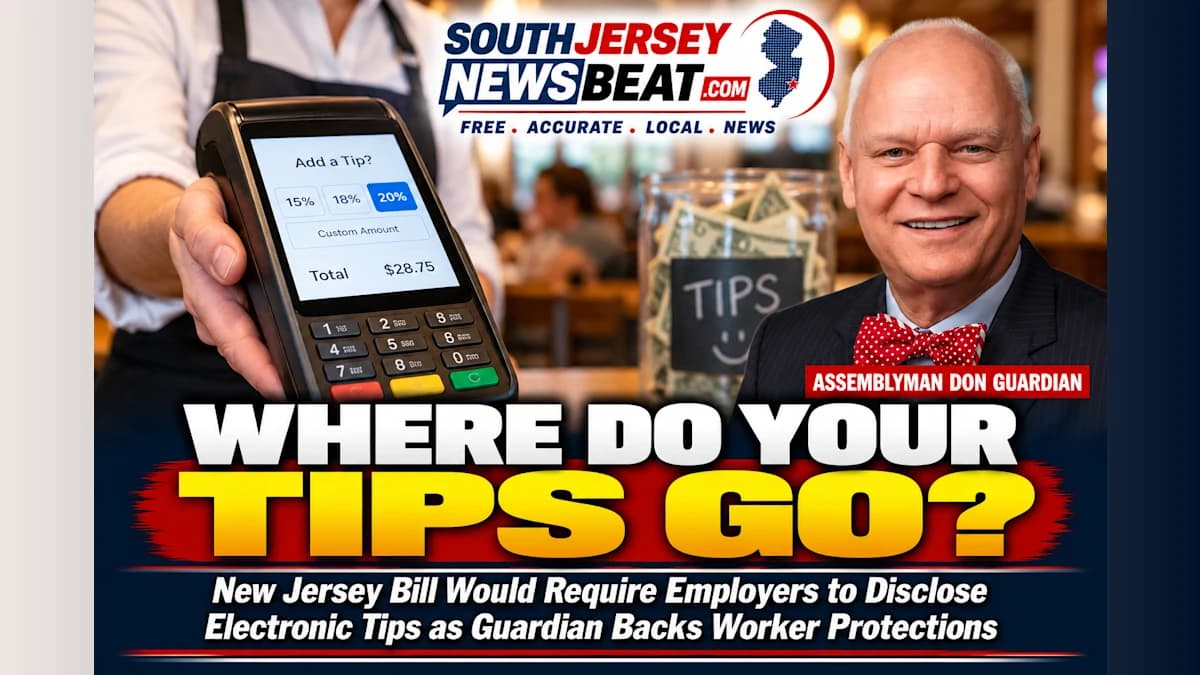
Legislation advancing in Trenton would give restaurant, bar and hospitality workers more information about the tips customers leave and how those gratuities are distributed.
ATLANTIC CITY, N.J. — Restaurant servers, bartenders and other tipped employees across South Jersey could soon have greater access to information about the gratuities customers leave on credit cards and electronic payment systems under legislation advancing through the New Jersey Legislature.
The proposal, Assembly Bill A5517, cleared the Assembly Labor Committee unanimously on October 19 and would require employers to provide tipped workers with statements showing the electronic tips attributed to them during each pay period.
Employers would also be required to provide written policies explaining how gratuities are collected, pooled, split and distributed among employees.
Assemblyman Don Guardian, R-Atlantic, discussed his support for the legislation during an October 21 appearance on The Lorry Young Show on News Talk 1400 & 92.3 WOND.
"Great bill," Guardian said.
Guardian, a former Atlantic City mayor, said the growing use of credit cards has made it increasingly difficult for some hospitality employees to independently verify how much customers have tipped them.
"Now, if you're a Jersey person, a South Jersey person especially, especially if you worked in the industry growing up, you know you always leave cash for your tip," Guardian said.
"But now more and more people are leaving on their credit card."
Guardian said employees deserve to know how much money was collected on their behalf and how that money was distributed.
"The individual workers that would normally get 100% of that don't know how much money is coming in," he said.
What the Legislation Would Require
The measure was introduced September 17 by Assemblyman Anthony Verrelli, D-Mercer and Hunterdon, and Assemblywoman Marisa Sweeney, D-Morris and Passaic.
Under the proposal, employers of workers who customarily receive tips would have to provide a statement for each pay period showing the total gratuities attributed to that employee through credit cards or other electronic transactions.
The bill would also require employers to establish written tipping policies explaining how gratuities are handled.
Those policies would have to address practices including tip pooling, tip splitting and whether the employer takes a tip credit against the employee's hourly wage.
Employers would also have to post notices explaining the rights of tipped employees under state and federal law.
The New Jersey Department of Labor and Workforce Development would be responsible for preparing those notices.
The legislation would not prohibit lawful tip pooling or establish a new minimum wage.
Instead, its principal purpose is to give employees clearer information about how existing tipping arrangements operate.
Guardian: Workers Deserve to Know Where Their Tips Go
Guardian said electronic payment systems can create uncertainty for employees who depend on tips to supplement their wages.
He argued that the legislation would make the process more transparent without fundamentally changing how restaurants and bars operate.
"We're saying how much money is coming in for tips and how is it being distributed," Guardian said.
He emphasized that customers generally intend gratuities to compensate employees who provide service.
"When you give a tip to your waitstaff or to your bartender, it's meant for them," Guardian said.
The assemblyman said transparency could help workers identify discrepancies between what customers leave and what employees ultimately receive.
"If they got a $10 tip, a $15 tip, they don't want, you know, the employer can't say, well, it was only $5," he said.
Guardian framed the proposal as a way to protect workers while reinforcing responsible business practices.
"It's just going to keep honest restaurant owners honest," he said.
"It's going to keep bar owners honest. That's all."
The Idea Came From an Ice Cream Shop
The legislation has an unusual origin.
According to Assembly Democrats, the proposal was developed by Margaret "Maggie" Burns, an intern in Verrelli's office who previously managed an ice cream shop in her hometown.
Her experience exposed difficulties workers can face when trying to understand electronic gratuities and workplace tipping policies.
Burns helped develop the legislation with assistance from Verrelli's district office and the nonpartisan Office of Legislative Services.
During the October 19 committee hearing, she spoke in support of giving employees more information about their compensation.
Verrelli said electronic payment methods have made tip distribution more complicated for workers.
He argued that employees should understand how gratuities are divided and whether they are receiving the compensation customers intended.
The legislation received unanimous support from members of the Assembly Labor Committee.
Business Groups Raise Concerns
Not everyone supports the proposal.
During the committee hearing, the New Jersey Licensed Beverage Association opposed A5517, arguing that additional disclosure requirements could create unnecessary administrative costs for bars and restaurants.
The association contended that many electronic tips are already recorded through point-of-sale and payroll systems.
Its concern is that requiring additional statements and written policies could impose burdens on smaller hospitality businesses already facing rising operating costs.
Supporters countered that because employers already collect electronic payment information, providing employees with clearer records should be manageable.
The disagreement centers less on whether workers should receive their tips and more on whether the legislation creates additional reporting obligations beyond existing payroll and recordkeeping requirements.
What New Jersey Law Already Says About Tips
New Jersey already provides several important protections for tipped employees.
Under state law, tips belong to employees, and employers generally cannot keep any portion of those gratuities for themselves.
Employers also cannot deduct credit card processing fees from workers' tips.
Lawful tip pooling arrangements are permitted, but they must comply with applicable wage and hour requirements.
In 2026, the minimum cash wage for tipped employees is $6.05 per hour when an employer claims the maximum allowable tip credit.
However, the employee's hourly cash wage plus tips must equal at least the state's applicable minimum wage, which is $15.92 per hour for most workers.
If the employee's earnings fall below that minimum, the employer must make up the difference.
Beginning January 1, 2027, the minimum cash wage for tipped workers will increase to $6.61 per hour, while the general minimum wage for most employees will rise to $16.48.
These requirements already exist independently of A5517.
The proposed legislation would add disclosure obligations designed to make electronic tipping practices easier for employees to understand.
Why It Matters in South Jersey
The issue has particular relevance in Atlantic and Cape May counties, where restaurants, bars, hotels, casinos and seasonal tourism businesses employ large numbers of workers.
In Atlantic City, tipped employees are an important part of the casino and hospitality workforce.
Throughout Cape May County, seasonal restaurants, beachfront establishments and other tourism businesses also rely heavily on employees who receive gratuities.
Electronic tipping has expanded beyond traditional table service.
Customers are now routinely prompted to leave gratuities at coffee shops, takeout counters, ice cream parlors and other businesses using touchscreen payment systems.
For employees, those transactions may be less visible than cash tips handed directly to them.
For employers, the proposal could mean additional requirements for documenting and communicating how those electronic gratuities are handled.
Guardian said he believes the benefits to workers justify the added transparency.
"If money is meant for an individual to receive as a tip, they should know what's going on," he said.
What Happens Next?
A5517 has cleared the Assembly Labor Committee but has not become law.
It must continue through the legislative process before any new disclosure requirements can take effect.
As introduced, the bill provides that its requirements would become effective on the first day of the fourth month following enactment.
For now, workers remain protected by New Jersey's existing wage and tip laws.
Employees who believe their tips are being improperly withheld can contact the New Jersey Department of Labor and Workforce Development's Wage and Hour Compliance Division at 609-292-2305.
Guardian said the central issue is straightforward: workers should be able to verify the gratuities they have earned.
"When you give a tip to your waitstaff or to your bartender, it's meant for them," he said
About the Author
Paul Kelly
Paul Kelly is a contributor to LocalBeat, covering local news and community stories.