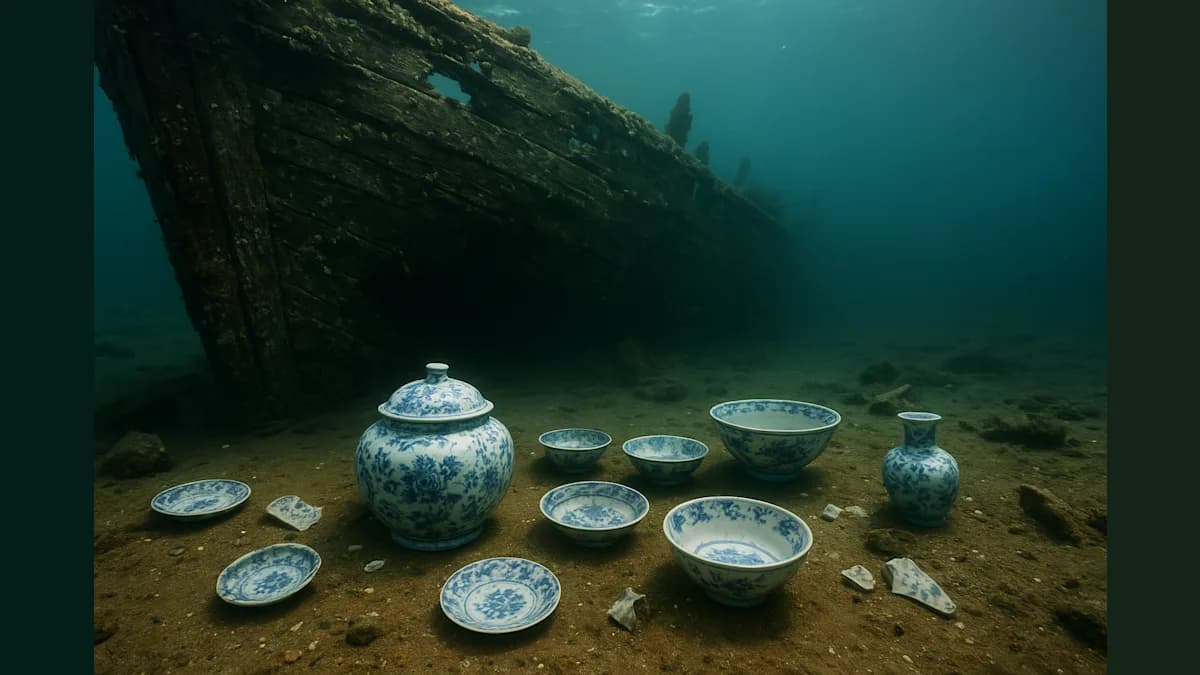
A remarkable archaeological discovery in the waters between Norway and Sweden has revealed a shipwreck containing an astonishing cargo of pristine Chinese porcelain that has rested on the ocean floor for approximately 300 years.
Espen Saastad, a watchmaker who owns a small underwater survey company, made the extraordinary find while conducting a survey in the Skagerrak Strait. His remotely operated vehicle captured stunning footage of sparkling white and blue porcelain dishes protruding from the marine sand at a depth of approximately 2,000 feet.
The discovery, which occurred last fall, prompted Saastad to immediately contact the Norwegian Directorate for Cultural Heritage. The response from officials underscored the significance of the find.
"I had to rub my eyes when I grasped the scale of this find," said Hanna Geiran, director general of the Norwegian Directorate for Cultural Heritage, in a statement. "It is almost beyond belief."
A subsequent joint expedition deployed another remotely operated vehicle equipped with a suction cup to retrieve approximately 40 artifacts from the wreck. The recovered items are now on display at the Norwegian Maritime Museum in Oslo as part of a new exhibition.
The 72-foot vessel sits upright on the seabed, having sunk relatively quickly around 1750. The cargo reveals two distinct styles of Chinese porcelain: Batavia style, characterized by blue decorations, and Dehua style, which is predominantly white. The latter was highly prized in Europe and known as "Blanc de Chine."
The porcelain kilns that produce Dehua ceramics in the city of Dehua on China's south coast are collectively recognized as a UNESCO World Heritage Site. The discovery of rice straw used to pack the crates suggests the cargo originated from the Far East, though experts believe the ship likely acquired the goods from an intermediary rather than traveling directly from China.
Beyond the porcelain, the wreck contained a diverse array of goods that paint a picture of 18th-century maritime commerce. Archaeologists found blown and stemmed glass fashioned into various items ranging from platters to chandeliers, barrels of grain, and containers holding biological substances that have degraded over time but may have originally been coffee, medicine, cocoa, or tea.
The vessel's estimated sinking date of 1750 places it during a transformative period in Northern European history. This era witnessed significant political, economic, and social upheaval, with trade in raw materials and luxury goods evolving from separate markets into an interconnected maritime trading system. The rise of the middle classes and expansion of international commerce drove rapid growth in shipping activity.
Among the wreckage, researchers discovered an intriguing clue about the ship's possible origins: a brick baked in the northern German city of Lübeck. The brick formed part of the galley, or ship's kitchen. However, archaeologists caution that galleys could be repaired or replaced during a vessel's operational lifetime, meaning the brick does not definitively establish the two-masted ship as German in origin.
Numerous questions about the vessel's identity, route, and ultimate fate remain unanswered. Much of the cargo continues to rest on the seabed, awaiting future exploration and study. The discovery highlights both the rich maritime history preserved beneath the waves and the valuable contributions private citizens can make to archaeological research through responsible exploration and reporting.