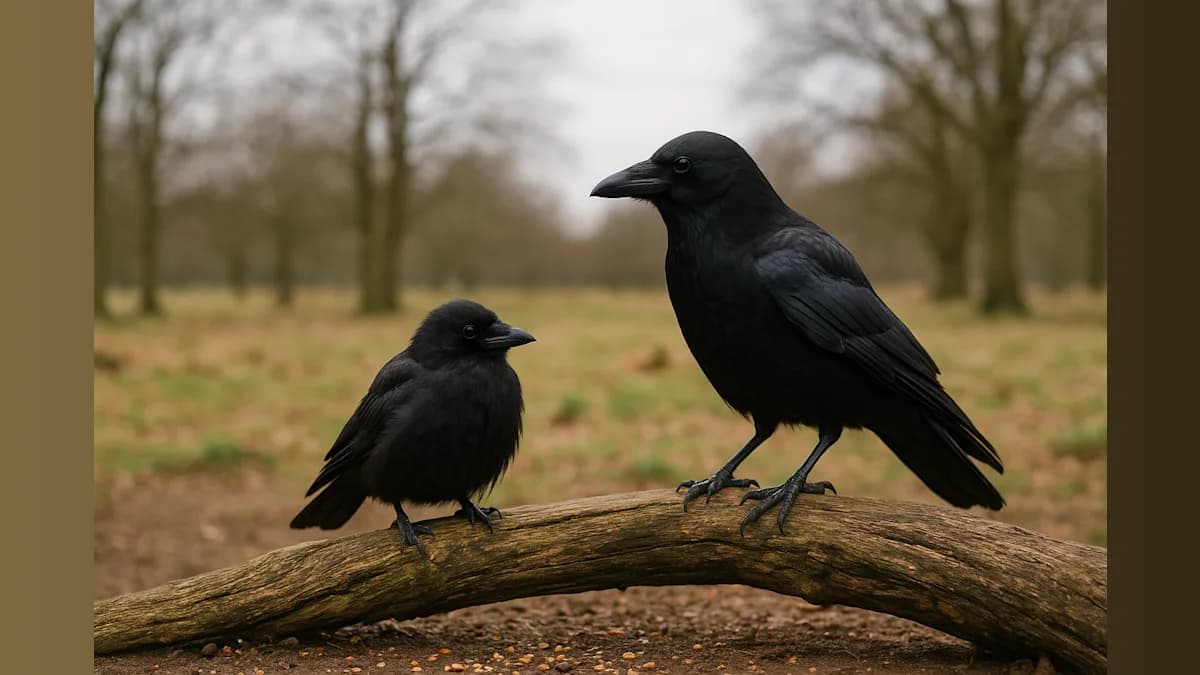
A remarkable display of avian compassion has emerged from Brinsley Animal Rescue in Nottingham, England, where a starving baby jackdaw is receiving life-saving care from an unexpected source: another young crow who has appointed himself as mentor and caregiver.
The tiny jackdaw, discovered in a field in Nottingham earlier this month, arrived at the rescue center in what volunteers described as a sorry state, barely clinging to life with minimal feather coverage. Rescue workers named him Frank Sinatra, inspired by his distinctive piercing blue eyes that captured the attention of everyone at the facility.
Jon Beresford, who co-founded Brinsley Animal Rescue, explained that Frank is approximately six weeks old but appeared significantly smaller due to severe malnutrition. The team placed the vulnerable bird in a recovery unit alongside a slightly older and more experienced fledgling crow, hoping the companionship would aid in his rehabilitation.
What happened next astonished the rescue staff. The older crow spontaneously assumed parental responsibilities, actively feeding Frank his daily meals of worms and seeds despite having only recently mastered self-feeding. Video footage captured at the facility shows the two birds perched together, with the older fledgling patiently helping his charge learn to swallow food.
"As soon as he arrived with us he stole all our hearts," Beresford told SWNS news. "It's not usual that we name the animals that come to us but his piercing eyes led us to call him Frank Sinatra—and it's stuck ever since."
During his initial quarantine period for treatment, Frank was observed calling out to his new companion. The decision to house them together has proven beneficial for the younger bird's development, providing both physical nourishment and behavioral modeling crucial for his species.
"At this stage of his growth, Frank would still be reliant on his parents for food," Beresford explained, noting the critical developmental window the jackdaw is experiencing. The surrogate relationship addresses this biological need in Frank's recovery.
The rescue team expressed amazement at witnessing the older fledgling's instinctive caregiving behavior. The mentorship extends beyond feeding, with Frank closely observing and mimicking his companion's movements and behaviors—essential learning for a young corvid preparing for eventual independence.
"It's amazing to watch them interact. Frank watches the older one's every move and copies him," Beresford told SWNS news.
The rescue center's long-term plan involves transitioning Frank to an aviary environment once his health stabilizes sufficiently. In that setting, he will develop flight capabilities and acquire additional survival skills necessary for his ultimate release back into the wild. The presence of his crow mentor will likely continue to play a vital role in preparing Frank for life beyond the rescue facility.
This interspecies mentorship demonstrates the complex social behaviors exhibited by corvids, a bird family renowned for intelligence and adaptability. The older crow's willingness to feed and teach a younger, unrelated bird highlights the sophisticated social structures these species maintain, even in captive rehabilitation settings.