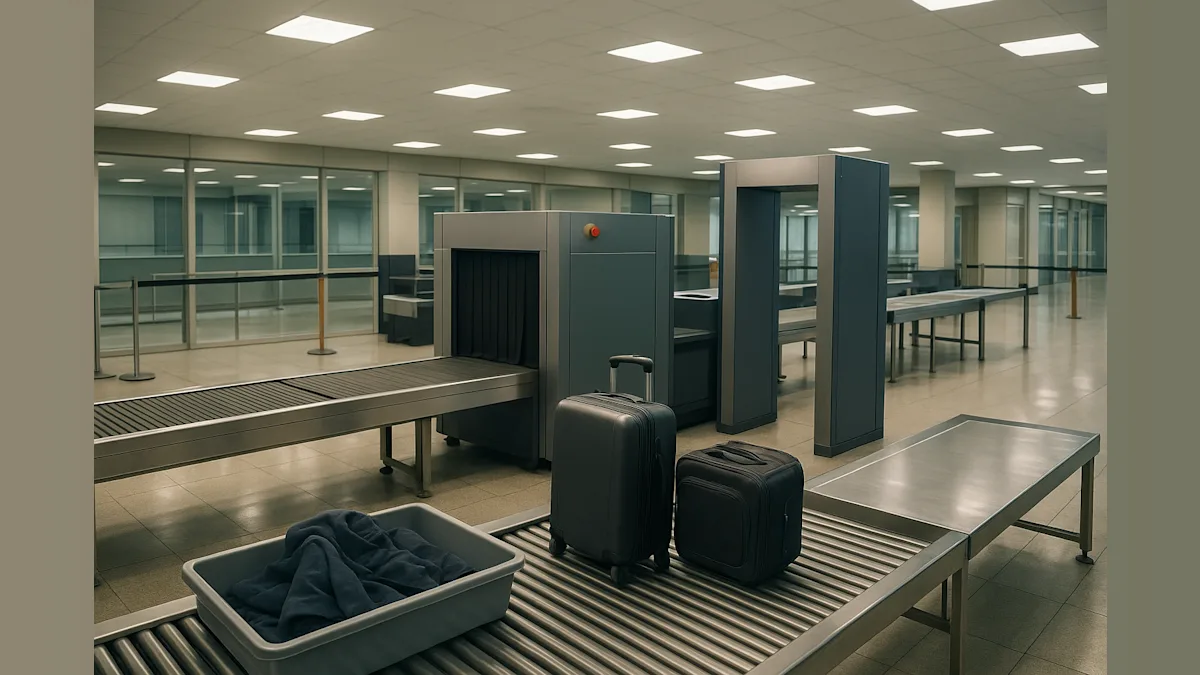
The uniformed officers checking identification and screening carry-on luggage at Kansas City International Airport wear badges and United States flag patches, but they are not federal employees. Instead, they work for VMD Corp., a private security contractor based in McLean, Virginia.
This arrangement represents a lesser-known option available to commercial airports across the nation. While the Transportation Security Administration operates security checkpoints at most of the country's 440 federalized airports, approximately 20 facilities have opted to use private firms under the Screening Partnership Program.
The distinction frequently escapes the notice of passengers. Natasha Greenway, traveling through Kansas City International Airport with her son, described the private security arrangement as news to her. Kim Eckels, heading to Portland, Oregon, with her family, acknowledged she had not noticed the difference in uniforms. She explained her approach to airport security with a laugh: she taught her children not to question anything during the screening process.
The federal-private divide in airport security dates to the creation of the Transportation Security Administration following the terrorist attacks of September 11, 2001. The legislation establishing the agency gave airports a choice between staffing checkpoints with federal security officers or opting out to use private firms under TSA oversight.
Nearly 25 years later, the largest airports using private security remain Kansas City International Airport and San Francisco International Airport. Other participating facilities are scattered across the United States, including locations in Sarasota, Florida; Atlantic City, New Jersey; Tupelo, Mississippi; and Yellowstone, Montana.
Gabe Murphy, VMD's program manager at Kansas City International, emphasized that the Transportation Security Administration maintains a presence at the airport. Federal employees audit the private contractor's operations to ensure compliance with all TSA processes and procedures. Murphy noted that the company follows the same standard operating procedures as federal facilities.
The program has remained relatively stable in size for years, according to Tina Won Sherman, director of the United States Government Accountability Office's Homeland Security and Justice team. However, the landscape may be shifting. The Trump administration introduced a new version of the program called TSA Gold+ last month, with plans to announce the first participating airports later this year. Administration officials have stated that privatizing airport security operations would save tens of millions of dollars.
The expansion proposal has drawn opposition from the American Federation of Government Employees union, which represents federal TSA officers. The union has warned that the privatization plan would undermine the federal workforce. Major airports including Hartsfield-Jackson Atlanta International Airport are considering the transition to private security.
Federal law requires private contracting companies to pay their employees at least as well as comparable federal workers. Transportation Security Administration officers have historically struggled with some of the lowest wages in the federal workforce, though the situation improved significantly in 2023 following an omnibus budget bill. Officers also benefited from a collective bargaining agreement with the American Federation of Government Employees union in 2024, although the Trump administration has sought to revoke that contract.
Sherman emphasized the critical importance of maintaining security standards as the program potentially expands. If dozens of small and medium-sized airports join the private security program, questions will arise about how the Transportation Security Administration handles oversight of technology standards and screener efficiency at a much larger scale.
At Kansas City International Airport, private security operations integrate seamlessly with government agencies. After passengers move through the main checkpoint operated by VMD employees, they pass a desk staffed by local police officers. Murphy explained that this arrangement allows law enforcement to handle situations involving unruly passengers, prohibited items, or loaded firearms immediately.
The airport recently upgraded some equipment in preparation for increased passenger traffic during the World Cup. A new scanning system allows travelers to keep their arms at their waists while pausing between two white panels, replacing the more complicated spinning scanners used in many airports. Murphy noted that the new systems are much quicker and more efficient.
Kim Fisher, the airport's head security-training instructor, oversees training programs at more than a dozen VMD-operated airports. New employees undergo approximately two months of training, depending on their skill level. During a recent visit, about ten new VMD employees had just begun their training program.
Jada Price, a 19-year-old new hire, expressed her long-term commitment to the position. Four of the new employees relocated to Kansas City specifically for the opportunity, citing job stability as a primary motivation.
For frequent travelers like Eric Sauter, who spends approximately 150 days per year on the road for business, the private security arrangement at Kansas City International Airport became apparent during a partial government shutdown earlier this year. While federally run airports experienced long lines, private facilities continued operating smoothly. Sauter, who lives in San Diego but frequently visits Kansas City, reported experiencing no issues during his travel.
The Government Accountability Office recently affirmed VMD Corp.'s $803 million proposal to handle security operations at San Francisco International Airport. Fisher was preparing to travel to San Francisco to work with existing employees there as part of the transition. She characterized the change as business as usual for the company, simply on a larger scale.
Sherman underscored the importance of fair and stable wages for maintaining morale and allowing security officers to focus on their critical responsibilities. Passengers across the country, whether in Washington, D.C., Kansas City, or elsewhere, should receive the same level of security from individuals performing to the best of their ability.