ATLANTIC COUNTY, N.J. — As New Jersey wrestles with the rapid growth of massive data centers needed to power artificial intelligence and other digital services, Assemblywoman Maureen Rowan says she isn't ready to simply embrace or reject them.
She wants to know what they will cost New Jersey in electricity, water and environmental resources.
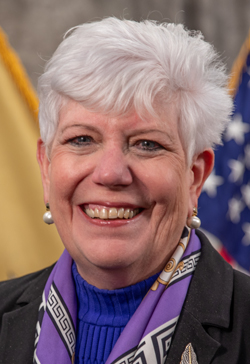
“I need to do more research because I always have to research before I give an answer,” Rowan said Friday during an appearance on Off The Press with Scott Cronick. “But with everything else, I think the truth lies probably somewhere in the middle with regards to the data centers.”
Rowan's comments are particularly relevant because the 2nd District Democrat is a prime sponsor of legislation that would require the New Jersey Board of Public Utilities to conduct a comprehensive study of many of the questions she raised.
Assembly Bill 4945 would examine the environmental, infrastructure and financial effects of data-center development in New Jersey, including energy consumption, water use, effects on the electric grid and the potential impact on utility rates.
“I want to know the data, no pun intended, the facts, statistics about what's really happening with these data centers,” Rowan told Cronick. “You can't fight it, right? It's going to happen. But how do they manage these data centers and the usage of water and electricity?”
The issue has rapidly become one of New Jersey's emerging energy and development debates as artificial intelligence drives demand for facilities containing enormous numbers of computer servers.
Those facilities can consume substantial amounts of electricity, while some use large quantities of water for cooling.
Rowan said the water issue particularly concerns her.
“The water is really scary,” she said. “But then I want to see the data again, sorry, about how much water they use, how much electricity they use.”
Bill Would Examine Water, Electricity and Utility Bills
The legislation Rowan is sponsoring with Assemblymen Cody Miller and David Bailey would direct the BPU to examine a wide range of potential consequences from data-center development.
Among them are energy consumption, water usage, electric-grid impacts, air quality, noise, land use, forest clearing, electronic waste and effects on local water supplies and infrastructure.
The study would also examine a question of particular importance to New Jersey residents already confronting higher electric bills: whether data-center development could increase utility rates.
The measure, introduced May 7, remains before the Assembly Telecommunications and Utilities Committee.
A Senate counterpart has also been introduced.
Rowan said the growth of artificial intelligence makes the underlying infrastructure difficult to avoid.
“I think people have to realize that if you want to use AI, if you want to use all these things that we're using, these data centers are going to exist,” she said. “So we have to make sure if they're going to exist that they exist in the most responsible way possible.”
New Jersey Has Already Started Responding
The debate has moved quickly in Trenton.
In July, Gov. Mikie Sherrill signed legislation creating a new rate structure intended to prevent large data centers from shifting the costs of electric infrastructure needed to serve them onto ordinary utility customers.
Under the law, exceptionally large electricity users such as data centers can be placed into a separate rate class designed to ensure they pay the costs associated with their demands on the electric system.
Then in August, Sherrill signed another law requiring data centers to disclose their energy and water consumption to the BPU twice each year.
Those reports are to include information such as total energy consumption, peak daily water use, cooling-system power requirements and the sources of water used by the facilities.
The measures come as communities across New Jersey increasingly debate whether data centers represent valuable economic development or an unacceptable burden on electric grids, water supplies and surrounding neighborhoods.
That debate has crossed traditional party lines.
Rowan noted that Assemblyman Zach Mullock, the Democratic congressional candidate in South Jersey's 2nd District, has taken a strong position against data centers. Republican U.S. Rep. Jeff Van Drew has also voiced opposition to data-center development.
“It's interesting that the opposition to them has become a bipartisan issue,” Cronick said.
“There's not many things that are bipartisan now, and that's very interesting,” Rowan responded.
AI Raises a Bigger Question
Rowan's concerns extend beyond the physical buildings themselves.
She said lawmakers also need to confront the larger issue of how rapidly artificial intelligence is developing and whether government regulation is keeping pace.
“There has to be regulations,” Rowan said. “They have to be reined in.”
She acknowledged AI could eventually produce major benefits, including medical and environmental breakthroughs, but said those possibilities need to be weighed against potential risks.
Rowan later said elected officials cannot simply avoid the issue because it is complicated or uncomfortable.
“People are putting their heads in the sand,” she said. “I'm like, ‘Oh no, I don't want to talk about it,’ but we have to talk about it. We have to see the real repercussions, what's happening, how it's progressing.”
Rowan also acknowledged that regulating AI itself may ultimately require action beyond New Jersey.
When Cronick asked whether regulation would have to occur primarily at the federal level to be effective, Rowan agreed that it probably would.
“We know how hard that is,” she said, “but again, I think we at least have to try.”
For New Jersey, however, the immediate questions surrounding the infrastructure supporting AI are already here.
Rowan's legislation would attempt to put numbers behind them — including how much electricity data centers consume, how much water they require and whether their expansion ultimately costs New Jersey residents more.
For Rowan, those answers should come before policymakers settle on how aggressively the state should embrace or restrict the industry.
Rowan's comments came during Off The Press with Scott Cronick, which airs Monday through Friday from 4 to 6 p.m. on News Talk 1400 & 92.3 WOND.

About the Author
Peter Killeen
A 25-year radio news veteran, Peter covers South Jersey for NewsTalk 1400 & 92.3 WOND radio. Known for his concise and impactful delivery, he ensures listeners and readers stay informed without unnecessary filler.