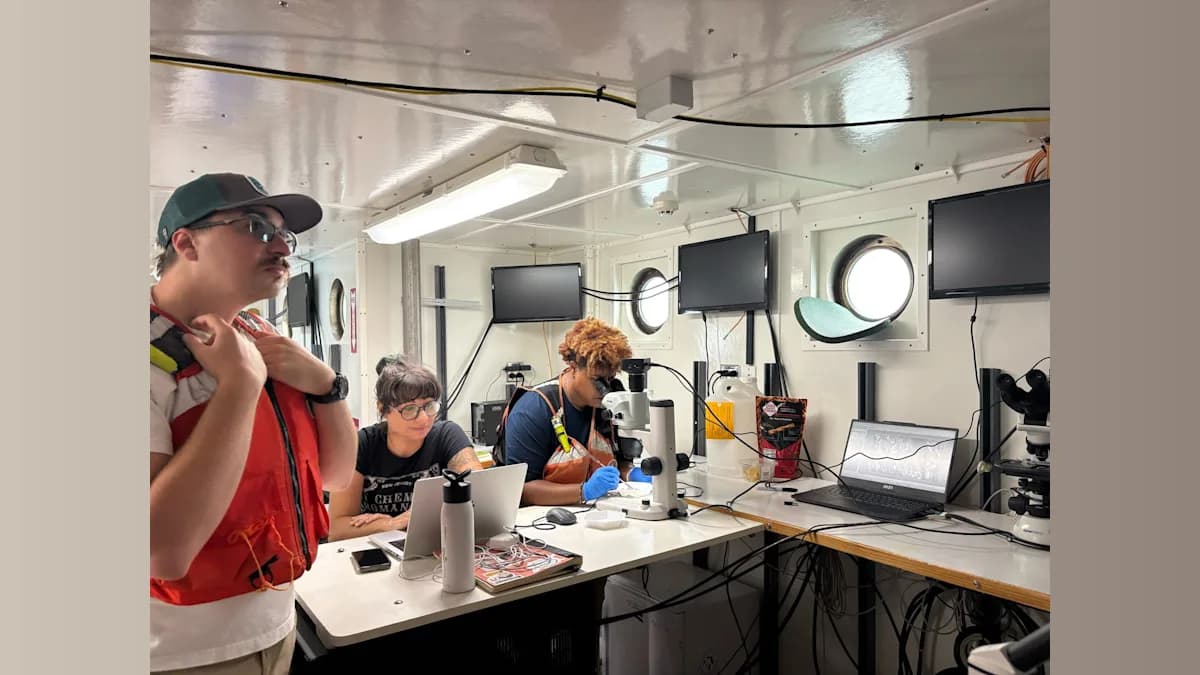
GALLOWAY — Three Stockton University students traded the classroom for the Gulf of Mexico this summer, spending three nights aboard a research vessel studying unusual underwater formations known as “blue holes” — and learning firsthand that science at sea rarely goes according to plan.
Marine Science students Tatiana Anderson, Dylan Meier and Hannah Elliott joined Stockton Assistant Professor of Biology Lauren Seyler aboard the 78-foot research vessel R/V Hogarth off Florida's Gulf Coast.
The trip was part of the Peerside program at the Florida Institute of Oceanography in St. Petersburg, which trains students for careers in marine science and technology.
For Anderson, a Stockton senior from Riverside who previously served nine years aboard a U.S. Navy aircraft carrier, the trip fulfilled a longtime ambition.
“I’ve always had a fascination with the ocean because it’s right there, and there are so many things that we don’t know about it,” Anderson said. “I’ve wanted to be a marine biologist since I was 6.”
Anderson hopes eventually to work with cephalopods such as octopuses and squid.
“The ultimate dream is to do anything with cephalopods,” she said.
Meier, of Brick Township, graduated from Stockton in May and previously spent four years working on a fishing boat out of Point Pleasant.
“I absolutely love being at sea,” he said.
Searching for ‘blue holes’
Seyler applied to serve as a mentor and chief scientist on the research cruise, which focused on blue holes on the West Florida Shelf.
Blue holes are underwater caverns created from sinkholes that filled with water as sea levels rose following the last ice age. According to Seyler, the formations create environments within the seafloor that differ significantly from the water above and can serve as hotspots for biological activity.
The Peerside program funded the cruise, allowing the Stockton team to collect sediment and water samples.
But Seyler said the experience was about more than collecting data.
“As a mentor you are training students how to conduct science at sea, and that includes not just going to sea and being on a boat and doing science, but also all the planning that leads up to that,” Seyler said.
That includes determining what equipment will be needed and how samples will be stored.
“Once you’re out at sea, you can’t just run to the hardware store to pick something up,” Seyler said. “You’re out there.”
Meier said that was a major difference from conducting research in a laboratory.
“For all my projects that I’ve been involved in, I’ll go into the lab and all my samples are right there waiting for me to analyze them and get whatever data I need,” he said. “However, when you go out to sea, you have to collect the data yourself.”
‘Trial by washing machine’
The students quickly learned another lesson about field research: Things go wrong.
The Hogarth had difficulty locating the blue holes using its available sonar, and the vessel's remotely operated vehicle malfunctioned.
Then came the weather.
Six-foot swells and strong winds created conditions Seyler described as a “trial by washing machine.”
“Our whole crew was going through it, getting seasick and nauseous,” Anderson said. “But we all came together in that moment, checking up on each other and making sure we all got the work done that we could.”
The team managed to collect sediment and water-column samples from one blue hole, but the rough conditions made locating two others difficult.
After an especially rough night at sea, Seyler decided to move the research operation closer to Tampa Bay and continue sampling in calmer waters.
While the change meant the researchers couldn't accomplish everything they originally planned, Seyler said that became part of the students' education.
“As disappointing as this was, I think it’s important for students to see that in the real world, science almost never goes the way you think it’s going to go and you have to be flexible,” she said.
The students also toured marine research facilities in the St. Petersburg area during their week in Florida.
For Meier, the experience opened his eyes to career possibilities in marine science beyond becoming a researcher or professor, including working as a marine technician or boat captain.
“I got to network with the crew and my colleagues,” Meier said. “I got to learn invaluable research and collection methods and how to operate machinery.”
He said students can sometimes develop a limited view of the careers available in their field because of the people they encounter most frequently in college.
“When you are a student, you’re just so used to seeing researchers and professors that you don’t see what else you could do beyond that,” Meier said.
“That was truly eye-opening.”
About the Author
Karen Johnson
With over 30 years of news experience in major markets like Los Angeles, Denver, and Columbus, Karen now covers our area for South Jersey NewsBeat. She also brings her articulate and conversational news delivery to WOND radio listeners every weekday. Her background includes work with the NBC Radio Network, and she thrives in fast-paced news environments.