ATLANTIC CITY — Former Atlantic County Democratic Chairman Michael Suleiman says South Jersey needs to demand a larger share of New Jersey’s transportation investment, starting with faster rail service between Atlantic City and Philadelphia.
Suleiman, who has also served on the South Jersey Transportation Authority board, outlined a series of transportation proposals during an appearance on Off The Press with Scott Cronick on WOND.

At the top of his list is the Atlantic City Rail Line.
“An hour 40 train ride from AC to Philly is crazy,” Suleiman said.
He believes NJ Transit should consider express trains between the two cities, particularly around major events in Atlantic City, while longer-term improvements could include adding portions of a second track.
Suleiman said the issue has generated considerable interest online. A video he posted about the rail line has received more than 100,000 views across social-media platforms, he said.
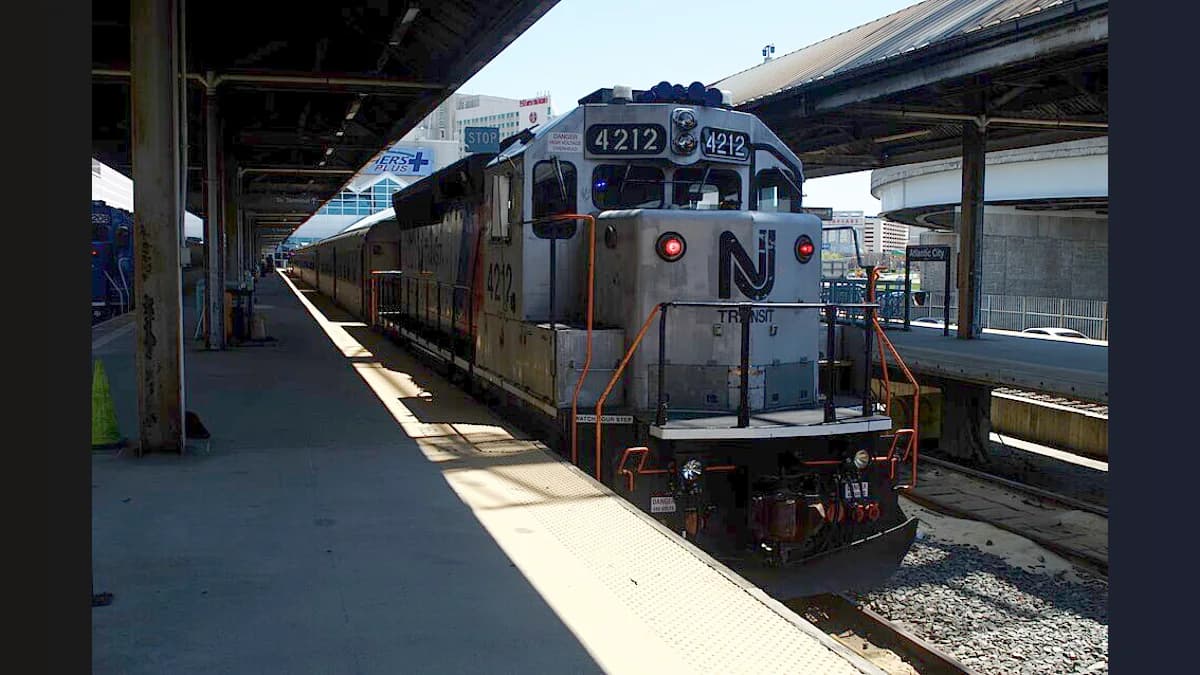
The Atlantic City Rail Line currently provides daily service between Atlantic City and Philadelphia’s 30th Street Station, stopping at Absecon, Egg Harbor City, Hammonton, Atco, Lindenwold, Cherry Hill and Pennsauken.
Could Atlantic City get express trains?
Suleiman said one relatively inexpensive way to improve the service would be to run occasional express trains with fewer stops.
“I think you could have an express train,” Suleiman said.
He also suggested NJ Transit coordinate trains more closely with Atlantic City’s entertainment calendar.
“If there’s a big event in Atlantic City, have an express train from Philly,” Suleiman said.
The idea, he said, is to make rail a more attractive option for visitors who otherwise might drive.
Suleiman also said schedules should be designed around major concerts, conventions and other events so visitors know they can get home after an event ends.
Longer term, he believes portions of the largely single-track route should be double-tracked.
“You don't have to double-track the whole thing,” Suleiman said. “There are certain areas where you can do it.”
Adding passing areas could potentially allow trains traveling in opposite directions to move more efficiently, although such an expansion would require significantly more investment than schedule changes or limited-stop service.
Suleiman argues South Jersey needs to press harder for that investment.
“We need to get our fair share down here,” he said.
‘These poor folks don’t even have a bench’
Suleiman said rail is only part of the region’s public-transportation problem.
He also called attention to bus stops along major Atlantic County roads where riders have little or no protection from weather or traffic.
“These poor folks don't even have a bench, let alone a canopy or a shelter,” Suleiman said.
“One, that's dangerous. Two, it's uncomfortable.”
He argued that improving bus stops doesn't necessarily require enormous transportation projects.
Instead, municipalities, Atlantic County, NJ Transit and other agencies could identify heavily used stops and work together to add benches, shelters and safer waiting areas.
Suleiman said transportation policy needs to account for residents who don't have cars and rely on buses to reach jobs, stores, medical appointments and other destinations.
For those riders, he said, a bus shelter isn't a cosmetic amenity.
It is part of the transportation system.
Concern about Atlantic City’s Jitneys
Suleiman also said government should look for ways to help preserve Atlantic City’s Jitney system.
The familiar minibuses have long provided transportation along Atlantic City routes and are particularly important to casino employees, residents and visitors traveling between properties.
Suleiman said rising insurance costs have created significant pressure on the independent operators.
He said the service is too important to simply allow those financial pressures to overwhelm it.
“We should do everything we can to help the Jitneys,” Suleiman said.
That doesn't necessarily mean government should operate the system, he said, but policymakers should look at whether there are ways to address some of the costs threatening its viability.
Transportation as economic development
Suleiman’s broader argument is that transportation should be viewed as an economic-development issue for Atlantic County.
A faster Philadelphia connection could make Atlantic City more accessible to visitors and workers. Better bus infrastructure could make it easier for residents to reach jobs. And maintaining Jitney service could preserve an important piece of the city's local transportation network.
He also pointed to the possibility that better rail service could spur development in communities along the Atlantic City Rail Line.
One of those communities, he said, is Absecon.
Suleiman believes stronger rail service could help turn the area around the Absecon station and New Jersey Avenue into a more vibrant, walkable downtown.
For Suleiman, those issues are interconnected.
Rather than treating trains, buses and Jitneys as separate problems, he argues South Jersey should be developing a broader transportation strategy — and demanding more state investment to make it happen.

About the Author
Peter Killeen
A 25-year radio news veteran, Peter covers South Jersey for NewsTalk 1400 & 92.3 WOND radio. Known for his concise and impactful delivery, he ensures listeners and readers stay informed without unnecessary filler.