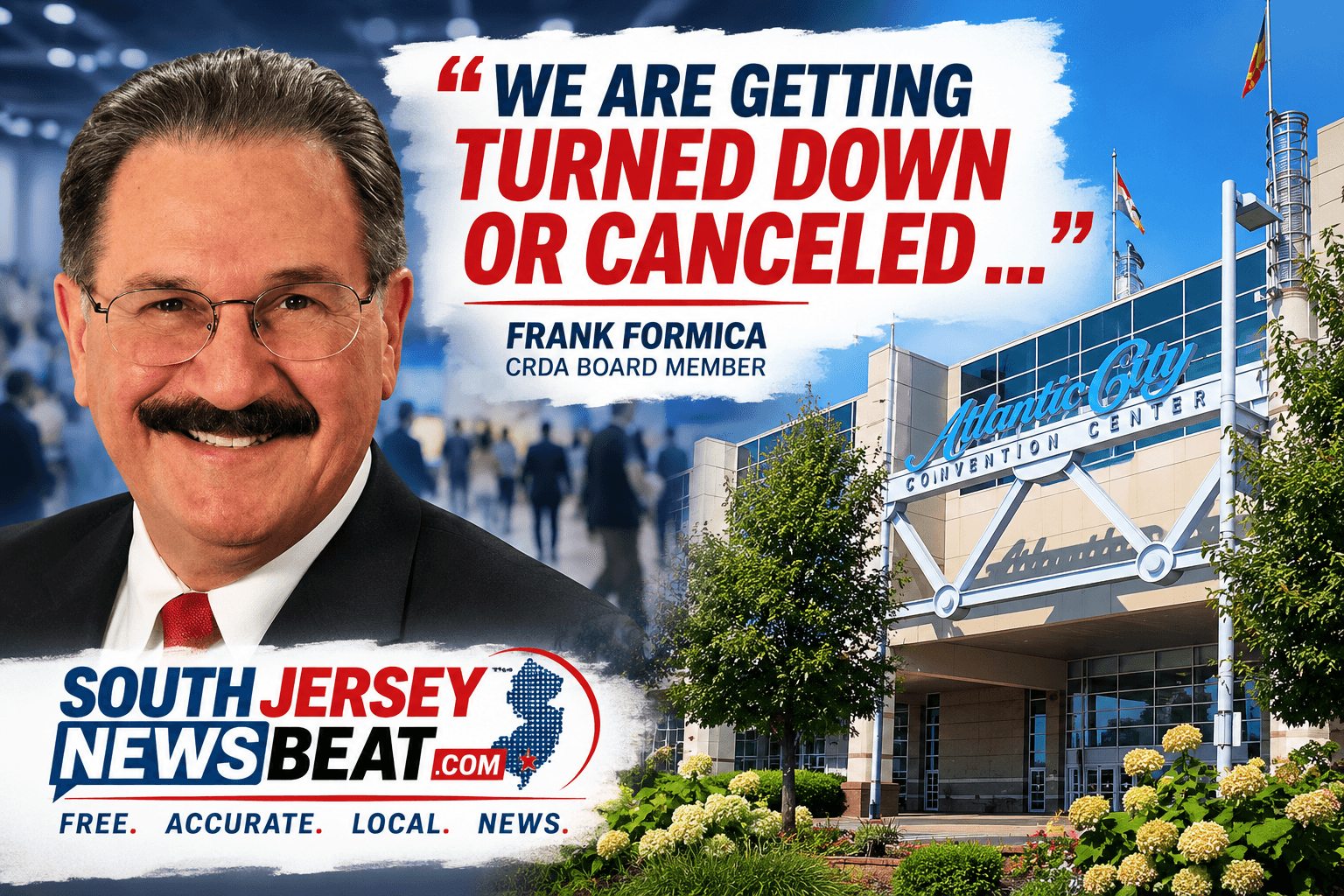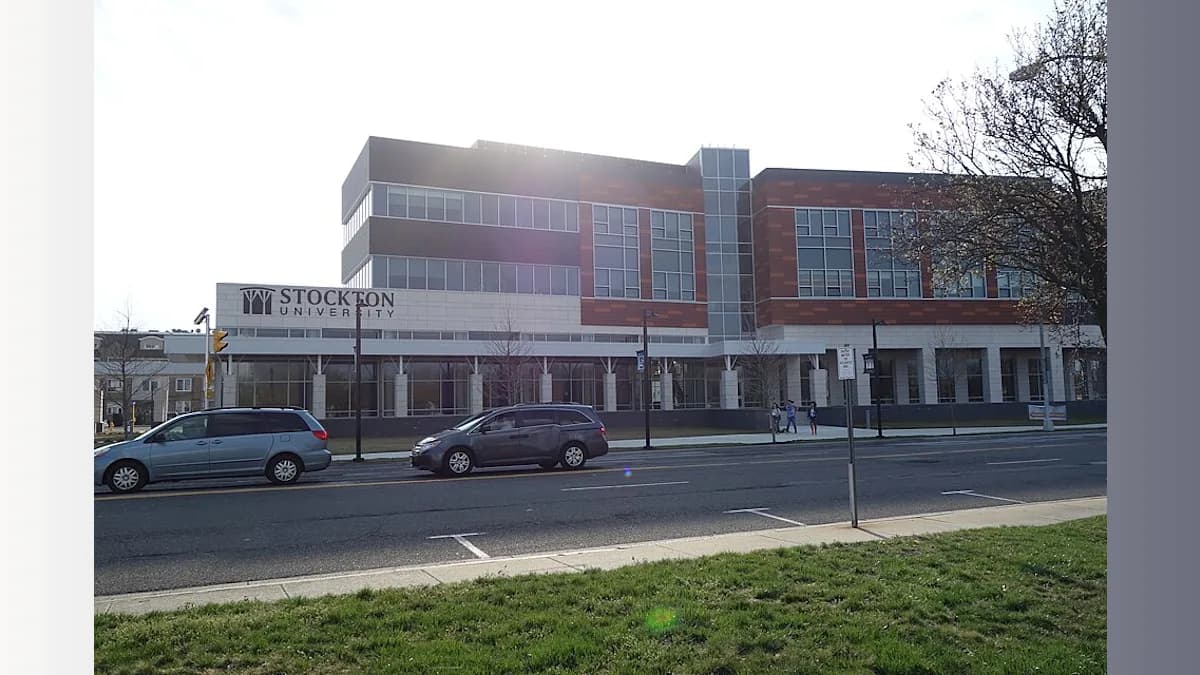
GALLOWAY — Former Atlantic County Democratic Chairman Michael Suleiman says Stockton University needs to reverse its enrollment challenges and develop a clearer academic identity for its Atlantic City campus, arguing that South Jersey cannot afford to let one of the region’s most important institutions weaken.
Suleiman discussed Stockton during an appearance Wednesday on Off The Press with Scott Cronick on WOND.
“Clearly Stockton is hurting,” Suleiman said. “They are dealing with declining enrollment. They are dealing with the so-called enrollment cliff.”

But Suleiman said the nationwide decline in the traditional college-age population does not fully explain Stockton’s situation.
“Even though everybody is down, Stockton is more down than other colleges,” Suleiman said, naming Ramapo, Rowan and The College of New Jersey as comparisons.
“We’ve got to figure out why that is.”
Recent enrollment data provide some support for that concern, although Stockton’s latest numbers are not uniformly negative.
Stockton reported 8,626 students in fall 2025, including 7,583 undergraduates and 1,043 graduate students. The university described that total as essentially flat from 2024. It also welcomed 1,487 first-time students, a 2.3% increase, but declines in transfer and graduate enrollment pushed total new-student enrollment down 1.8%.
The year before, preliminary state figures showed Stockton enrollment declining 1.8% in fall 2024, while Ramapo, TCNJ and Rowan each posted increases of more than 6%.
Statewide, preliminary fall 2025 enrollment rose 1.9%, including a 1.83% increase at New Jersey’s four-year public institutions.
Competitors are growing
Several institutions Suleiman mentioned have recently reported significantly stronger enrollment trends.
Ramapo College said its undergraduate enrollment reached a five-year high of 5,492 students in 2025.
Rowan University reported a record-breaking 2025 academic year, including its largest first-year class ever, with approximately 3,400 students. Its fall 2025 enrollment totaled more than 22,000 students across undergraduate, graduate and professional programs.
The College of New Jersey said full-time-equivalent enrollment reached a record high in fall 2025, a trend cited by S&P Global when it reaffirmed the college’s “A” credit rating and upgraded its outlook to stable.
That contrast is why Suleiman said Stockton should be focused on growth rather than accepting continued contraction.
“I think we’ve got to figure out exactly what the plan is,” he said.
“I think we’ve got to grow enrollment. Slowly but surely.”
He later directly disagreed with the idea that Stockton should primarily “right-size” itself around a smaller student population.
“I think we need to grow enrollment,” Suleiman said. “Or at least stay flat and not keep going down.”
Atlantic City campus needs a clearer mission, Suleiman says
Suleiman reserved some of his strongest criticism for Stockton’s Atlantic City campus.
“Frankly, we’ve got to do something with the Atlantic City campus,” he said.
He cited local economist Jim Kennedy’s characterization of the campus as being “devoid of academic purpose” and said he agreed with the underlying concern.
“We as a community need to figure out what that purpose is,” Suleiman said.
“Is it going to be the eds and meds? Someone in that article said it’s going to be graduate studies. Is it going to be hospitality? Whatever it is.”
Suleiman said health care and education could make particular sense as areas of concentration.
“We’ve got to do that,” he said. “We’ve got to get those dorm rooms filled in Atlantic City.”
He added that it was his understanding that the Atlantic City residence halls were not full. South Jersey NewsBeat did not find a current public Stockton report breaking out residence-hall occupancy specifically by campus, so that portion of Suleiman’s statement remains his assertion rather than a confirmed figure.
Stockton’s own budget documents show, however, that the Atlantic City campus represents a substantial continuing financial commitment.
The university’s fiscal 2026 operating budget assigns about $25.6 million in expenses to Atlantic City, including approximately $10.6 million for housing, $3.7 million for facilities and operations and $2.3 million for academic affairs.
That makes the question of how fully the campus is being used important not only academically, but financially.
Stockton acknowledges enrollment challenges
Stockton President Joe Bertolino has publicly acknowledged that the university faces enrollment and financial pressures.

In his most recent State of the University address, Bertolino said Stockton had seen declines in transfer and graduate enrollment even as first-time student enrollment increased.
The university has responded by expanding transfer agreements with community colleges and looking beyond New Jersey for additional recruitment opportunities.
Stockton is also operating in a difficult demographic environment.
New Jersey’s Office of the Secretary of Higher Education reported that first-time undergraduate enrollment statewide fell 2.9% in fall 2025, the first decline in four years — an early sign of the much-discussed enrollment cliff caused by a smaller population of traditional college-age students.
But Suleiman argues that environment makes strategic choices more important, not less.
‘We can’t let it be taken over’
Suleiman framed Stockton’s future as a regional issue rather than simply a university-management problem.
“We’ve got to help Stockton,” he said.
“We can’t let it be taken over by another institution. Stockton is one of the only amenities we have down here, quite frankly.”
“So we need a vibrant and strong Stockton.”
He said he likes Bertolino and some of the direction the president has taken but disagrees with any strategy that accepts sustained enrollment decline.
Suleiman said the size of the incoming freshman class will be one of the most important numbers to watch this fall.
“If we take a big hit this fall, then that’s not good for Stockton’s future budget prospects,” he said.
For Stockton, the immediate picture is mixed: total enrollment has stabilized, and first-time student numbers improved last year, but the university is not currently growing at the pace of several other New Jersey public institutions.
For Suleiman, that means the question is no longer simply whether Stockton can withstand the enrollment cliff.
It is whether the university can define a strategy — particularly in Atlantic City — that allows it to grow despite it.

About the Author
Peter Killeen
A 25-year radio news veteran, Peter covers South Jersey for NewsTalk 1400 & 92.3 WOND radio. Known for his concise and impactful delivery, he ensures listeners and readers stay informed without unnecessary filler.