
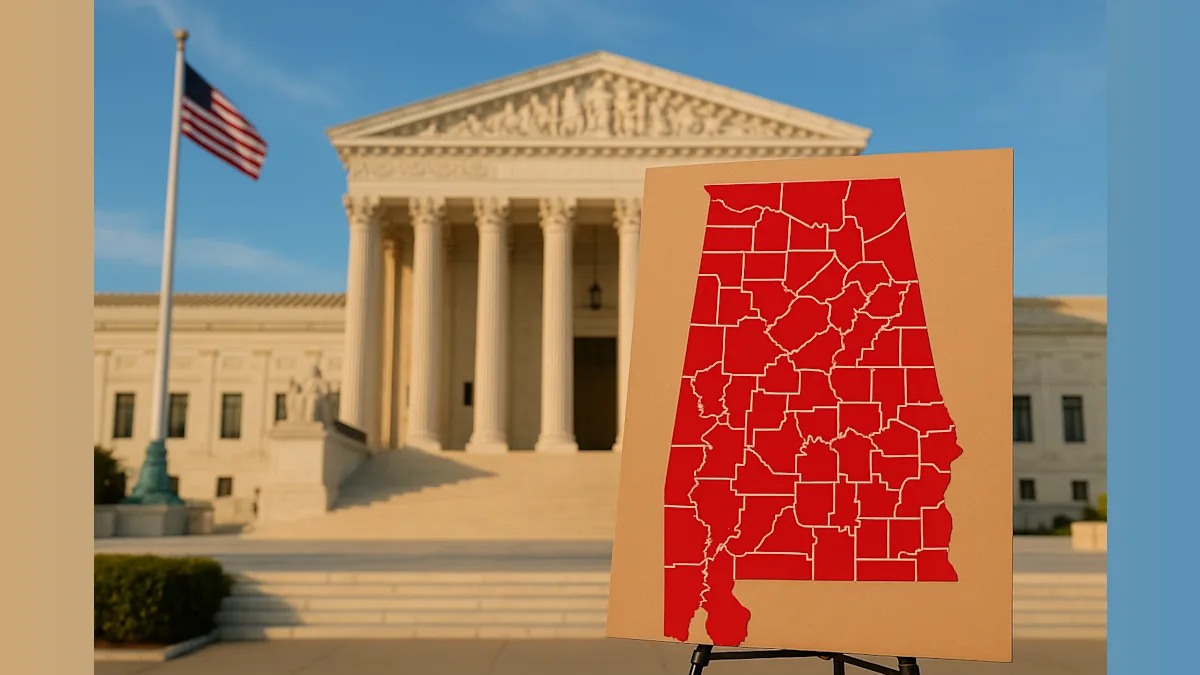
The Supreme Court on Tuesday cleared the way for Alabama to use a congressional district map that favors Republicans, overturning a lower court ruling that found the map tainted by intentional race-based discrimination. The decision represents a significant reversal in the high court's approach to voting rights and could have far-reaching implications for the 2026 midterm elections.
Under the reinstated map, Alabama's 2026 midterm elections will feature six Republican-leaning districts and one Democratic-leaning district, rather than a previously ordered map with only five safe Republican seats. The ruling will likely result in Democrat Shomari Figures, who represents Alabama's Second District, losing his seat.
The controversy surrounding Alabama's congressional map began in 2021, when the state implemented new district boundaries to account for population changes revealed in the census. The map featured only one majority-Black district out of seven total districts, despite Alabama's population being more than one-quarter Black.
Voters immediately challenged the map in court, arguing it illegally diluted minority votes in violation of the Voting Rights Act and the Constitution. Lower court judges sided with the plaintiffs, ruling that Alabama must draw a map with two districts where Black voters have a realistic chance of electing their candidate of choice. The Supreme Court itself had previously ordered Alabama to draw a compliant map on more than one occasion.
However, the state refused to comply and instead continued to litigate the case. On Tuesday, that strategy proved successful.
The turning point came in April, when the Supreme Court's conservative supermajority substantially weakened what remains of the Voting Rights Act, ruling that states cannot purposefully draw districts that are majority-minority. Alabama subsequently asked the high court to reinstate their original map, arguing that this new precedent made it permissible to use a map with only one majority-Black district.
In an unsigned, unexplained order, the Supreme Court essentially reversed its previous opinions and allowed Alabama to use the contested map for the upcoming midterm elections. The decision triggered immediate consequences in Alabama. By the time the Supreme Court issued its May order, absentee balloting had already begun using a court-drawn map. Republican Governor Kay Ivey responded by canceling elections and scheduling a special primary for August for the affected congressional races.
The legal battle did not end there. The Supreme Court had ordered a lower court panel to continue evaluating Alabama's map in light of its recent Voting Rights Act decision. Just fifteen days after that order, the panel—composed of three Republican judges, two of them Trump appointees—concluded unanimously that even under the Supreme Court's new standards, the plan for a single Black district was intentionally discriminatory.
Alabama returned to the Supreme Court once again, this time arguing that the map was partisan rather than racially discriminatory. The state contended that the Republican legislature simply drew the map to elect more Republicans, and that under the Supreme Court's new interpretation of the Voting Rights Act, the GOP map should be allowed to stand.
The court's three liberal justices publicly dissented, criticizing the conservative majority for failing to abide by its 2006 decision in Purcell v. Gonzalez. That precedent established that courts should not change election rules too close to an election.
Tuesday's decision represents the latest in a series of Supreme Court rulings that could reshape the 2026 midterm elections, potentially making it substantially more difficult for Democrats to prevail in contested races across the country. The ruling demonstrates the court's willingness to revisit and reverse its own recent decisions on voting rights, signaling a fundamental shift in how election law disputes may be resolved going forward.