In a pre-dawn operation on Saturday, June 13, 2026, workers removed President Donald Trump's name from the John F. Kennedy Center for the Performing Arts in Washington, concluding a legal battle over the controversial renaming of the iconic venue. The removal came hours after a court-ordered Friday deadline and less than six months after the bronze letters were first installed.
The action followed a federal judge's ruling that the Center could not be renamed without Congressional approval. Kennedy Center Executive Director and Chief Operating Officer Charles Matthew Floca confirmed in a court filing that the name had been removed from the building façade, despite what he described as weather-related delays. References to Trump on the center's website have also been eliminated.
The controversy began just one month into Trump's second term, when the president ousted the Kennedy Center's president, board chair, and board members. He replaced them with a new group of trustees who subsequently named Trump as chairman. Shortly thereafter, the president's name was added to the building, transforming it into "The Donald J. Trump and the John F. Kennedy Memorial Center for the Performing Arts."
The administration had requested a higher court to stay the ruling on Friday, arguing that Trump's name on the building had proven essential to fundraising efforts. In a court filing, the administration stated: "Without the name, 'Trump' on the Building, our fundraising will not only come to a halt, but any and all monies raised or committed would be obligated to be returned, refunded or terminated."
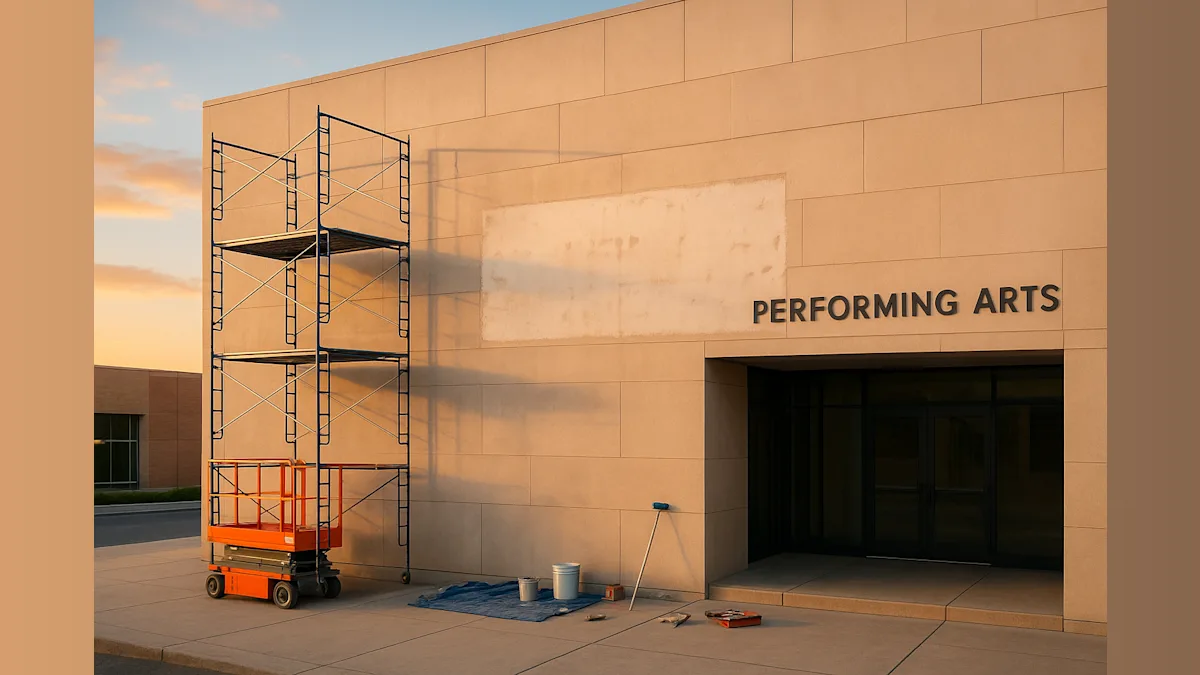
An appeals court denied that request Friday night. Workers erected scaffolding on Friday around the section of the building where Trump's name had been added in December 2025. The Kennedy Center had requested a brief extension of the deadline due to thunderstorms forecast for Washington, D.C. on Friday night.
With scaffolding in place and tarpaulin covering their work, laborers began removing the giant metallic letters in the early morning hours. Hundreds of people braved rain and thunderstorms overnight to witness the removal. Some onlookers heckled those involved for concealing the operation with tarpaulin, shouting "Cover up!" and "Cowards!"
Among those watching was Krystal Brewer, 40, who works for a social justice advocacy group. She characterized the removal as a way to enforce accountability and maintain governmental checks and balances. "It's about just not being able to do something just because you think you're the most powerful person and you can defy the courts," Brewer said.
Brewer also expressed broader concerns about Trump's impact on the nation's capital. The president has recently overseen the controversial demolition of the White House's East Wing in favor of a giant ballroom and ordered large banners of his face to hang from several federal buildings during his second term.
"I wanted to see us get a part of our city back," Brewer said. "With all the things that he's trying to destroy and corrupt and taint and alter, it's nice to see a piece of it being restored."
Rep. Joyce Beatty of Ohio, who initiated the lawsuit to remove Trump's name from the building, was also present on the Center's plaza Friday. She wrote on social media that she had stood outside to watch, stating: "No more stalling. It's time for Trump to obey the law."
Mary Foltz, a 60-year-old nurse who watched the tarps go up shortly before 2 a.m. Saturday, viewed the concealment as symbolic. "I think there's a lack of transparency — and that's just the epitome of it," Foltz said. "This is a meme."
The removal marks a significant legal victory for those who argued that the renaming violated Congressional authority over the federally funded institution. The Kennedy Center, which opened in 1971 as a living memorial to President John F. Kennedy, has long served as the nation's cultural center and a symbol of the performing arts in America.