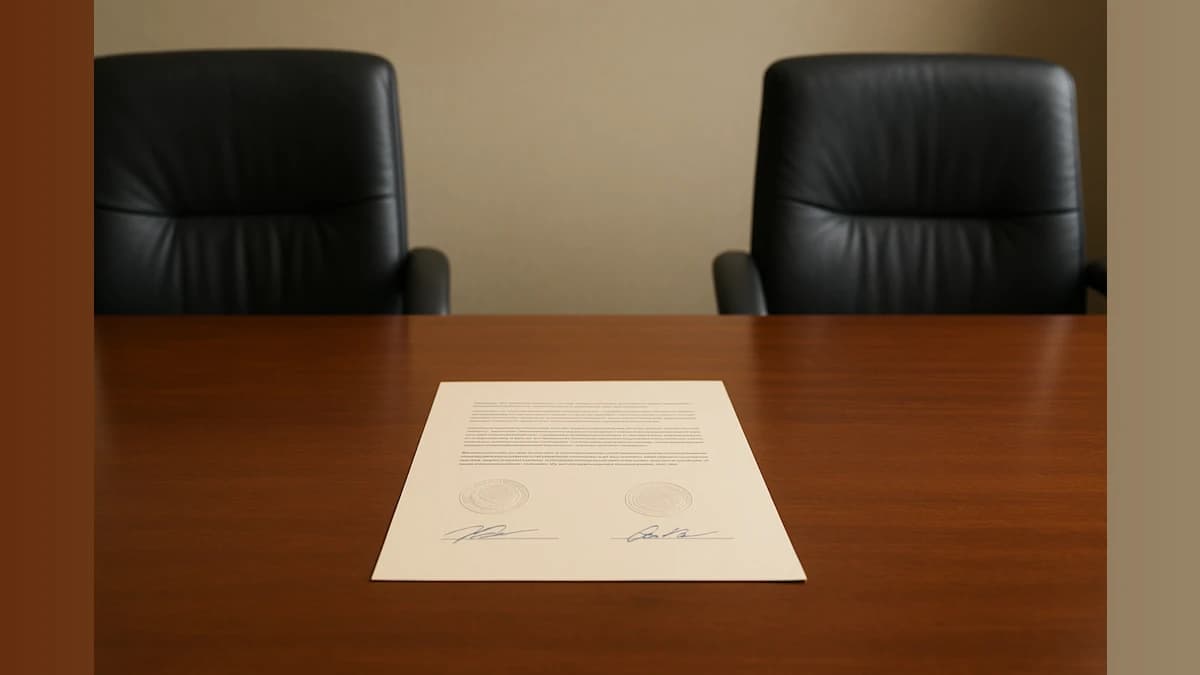
The United States and Iran have signed a preliminary agreement to end their ongoing military conflict, with President Trump and Iranian President Masoud Pezeshkian putting their signatures to a memorandum of understanding Wednesday during a ceremony in Pakistan. The framework document, mediated by Pakistani Prime Minister, establishes an immediate ceasefire and sets a 60-day timeline for negotiating a comprehensive final peace deal.
The agreement, formally titled the "Islamabad Memorandum of Understanding between the Islamic Republic of Iran and the United States of America," was signed at the Versailles Palace in Versailles, France, where President Trump was attending a gala dinner. The text of the memorandum was obtained by NPR from a source who shared it on condition of anonymity because they were not authorized to discuss the preliminary deal.
Immediate Ceasefire and Military Commitments
The memorandum declares the immediate and permanent termination of military operations on all fronts, including in Lebanon. Both nations have committed to refrain from initiating any war or military operation against each other and to respect the territorial integrity and sovereignty of Lebanon. The agreement represents a significant de-escalation after months of military confrontation that has disrupted global commerce and threatened regional stability.
Under the terms, the United States will begin immediately removing its naval blockade against Iran, with full removal to be completed within 30 days of signing. American forces will withdraw from the proximity of Iran within 30 days after a final deal is reached. The agreement also commits both parties to respect each other's sovereignty and territorial integrity and to refrain from interfering in internal affairs.
Strait of Hormuz Reopening
Iran has agreed to make arrangements for the safe passage of commercial vessels through the Strait of Hormuz, offering free passage for 60 days as traffic resumes. The memorandum acknowledges the need for removing technical and military obstacles and conducting de-mining operations, with full commercial traffic to be restored within 30 days. Iran will engage in dialogue with the Sultanate of Oman to define future administration and maritime services in the strait, in consultation with other Persian Gulf coastal states.
The reopening of the Strait of Hormuz carries enormous economic implications, as the waterway serves as a critical chokepoint for global oil shipments. The closure or restriction of the strait during the conflict disrupted energy markets and contributed to supply chain challenges affecting American consumers and businesses.
Economic Reconstruction and Sanctions Relief
The United States has committed to developing a reconstruction and economic development plan for Iran worth at least 300 billion dollars, to be finalized with regional partners as part of the final deal within 60 days. The agreement also obligates the United States to terminate all sanctions against Iran, including United Nations Security Council resolutions, International Atomic Energy Agency Board of Governors resolutions, and all unilateral American sanctions, both primary and secondary.
Immediately upon signing, the United States Department of Treasury will issue waivers for the export of Iranian crude oil, petroleum products and derivatives, along with all associated services including banking transactions, insurance, and transportation. Frozen or restricted Iranian funds and assets will be made fully available for use upon implementation of the memorandum, with procedures for release to be agreed upon during negotiations.
Nuclear Program Provisions
Iran has reaffirmed that it will not procure or develop nuclear weapons. The two nations have agreed to resolve the disposition of stockpiled enriched material through a mutually agreed mechanism, with the minimum methodology being down-blending on-site under International Atomic Energy Agency supervision. The parties will also discuss enrichment issues and other matters relating to Iran's nuclear needs as part of the final deal negotiations.
Pending the final agreement, both nations have committed to maintaining the status quo. Iran will maintain the current status of its nuclear program, while the United States will not impose new sanctions or deploy additional forces to the region. The memorandum acknowledges that both the sanctions termination and nuclear issues are of critical importance, with both parties expressing intentions to address these matters immediately in negotiations.
Path Forward
The memorandum commits both nations to negotiating and achieving a final deal within a maximum of 60 days, extendable with mutual consent. An executive mechanism will be established to monitor successful implementation of the memorandum and future compliance with the final deal. Once completed, the final agreement will be endorsed by a binding United Nations Security Council resolution.
Negotiations for the final deal will begin after the signing of the memorandum and subject to the commencement of implementation of key provisions, including the ceasefire, naval blockade removal, Strait of Hormuz reopening, oil export waivers, and release of frozen funds. The agreement represents a dramatic diplomatic breakthrough after years of escalating tensions between Washington and Tehran, though significant challenges remain in translating the framework into a lasting comprehensive peace.