
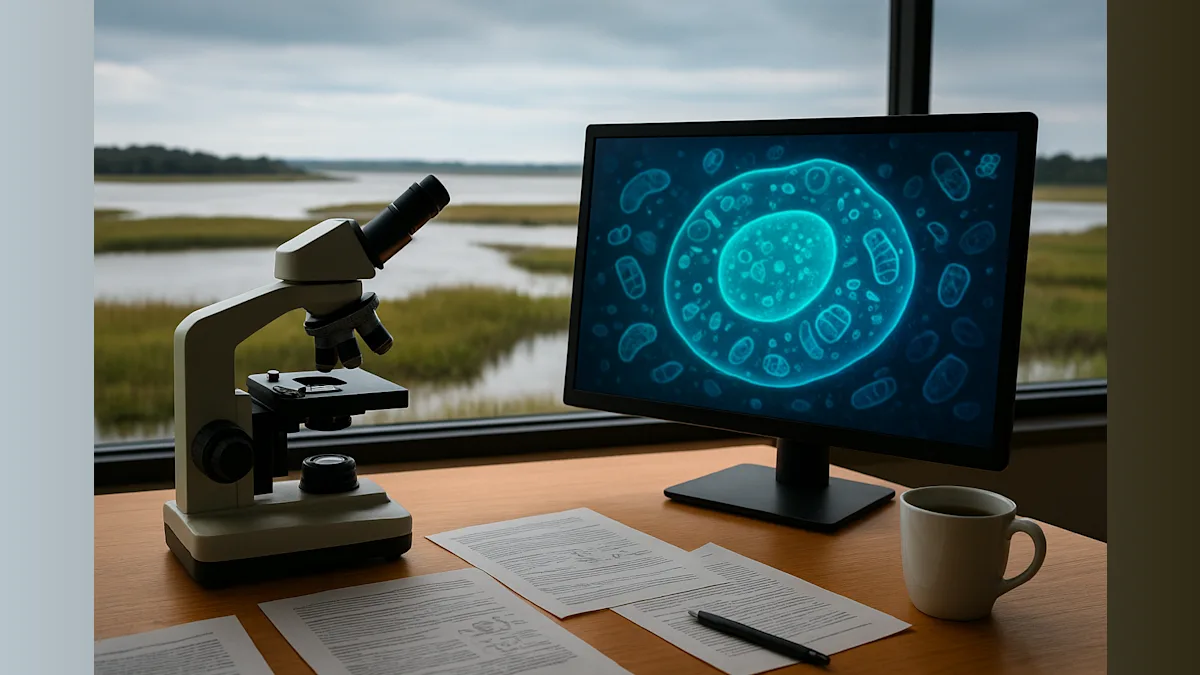
For years, Jon Zehr pursued something he could identify only through genetic traces—what he described as a footprint without an animal. Halfway across the globe, Kyoko Hagino dedicated herself to cultivating an algae specimen her own supervisor dismissed as insignificant, working without salary while her daughter grew up believing beaches served solely as collection sites for seawater samples.
Neither researcher knew the other existed. Neither understood they possessed complementary pieces of an extraordinary puzzle.
When their paths finally converged, the result transcended mere scientific collaboration. Together, they identified the nitroplast—the first organelle confirmed to have evolved in more than one billion years. The discovery challenges fundamental assumptions about cellular biology and demonstrates how life continues to develop new mechanisms for survival.
The nitroplast exists within the tiny organism Hagino had observed under her microscope and Zehr had spent his career attempting to locate through genetic analysis. This cellular structure represents a milestone in understanding how complex life forms develop new capabilities through symbiotic relationships that eventually become permanent features.
Organelles are specialized structures within cells that perform specific functions, much like organs within a body. Mitochondria, which generate energy, and chloroplasts, which enable photosynthesis in plants, are familiar examples. The emergence of new organelles represents one of the rarest events in evolutionary history, occurring when a host cell and a symbiotic organism become so interdependent that they can no longer exist separately.
Hagino's persistence proved particularly remarkable given the obstacles she faced. Working without financial compensation and enduring skepticism from colleagues who questioned the value of her research, she continued her painstaking cultivation work. Her dedication sustained itself on curiosity and, by her own account, bowls of seaweed jelly during long hours at the laboratory bench.
Reflecting on the discovery, Hagino offered an observation that resonates beyond marine biology. "This experience has shown that we don't know which research will be useful and when," she noted—a statement that validates countless hours spent pursuing questions without guaranteed outcomes.
The story of the nitroplast's discovery illustrates a fundamental truth about scientific progress. Breakthrough findings often emerge not from coordinated institutional efforts but from individual researchers who maintain their focus despite uncertainty, limited resources, and professional doubt. Zehr's genetic detective work and Hagino's microscopic observations, conducted independently across continents, ultimately revealed a biological phenomenon that had eluded detection for eons.
Their achievement underscores the importance of supporting diverse research paths, even those that appear obscure or impractical in the moment. The natural world continues to harbor secrets that reveal themselves only to those willing to look closely, consistently, and without certainty of reward. Sometimes the most profound discoveries require nothing more than two people, unknown to each other, who refuse to abandon their search.