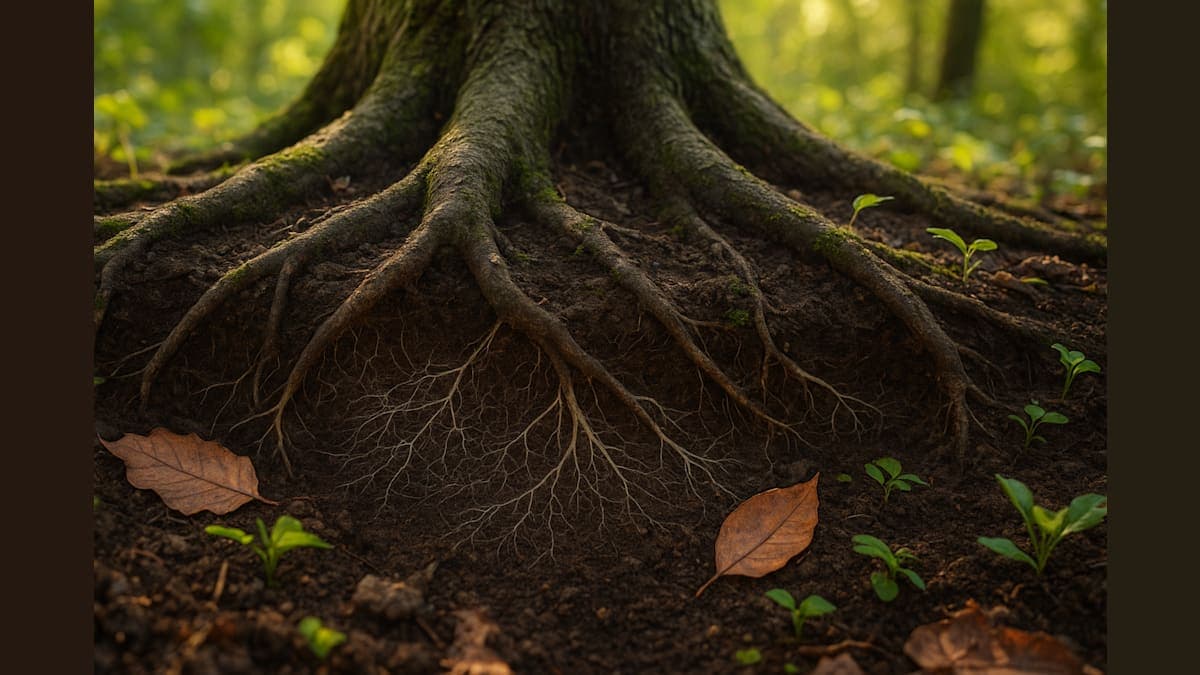
What if the key to understanding family healing lies beneath the forest floor? Ashley Glowiak presents a compelling framework that reimagines individuals not as isolated beings, but as interconnected nodes within living networks—much like the mycelial systems that link trees and plants underground.
In her exploration of generational patterns and family systems, Glowiak draws a striking parallel between human lineages and fungal networks. Just as mycelia transport nutrients across vast distances to support struggling organisms, families transmit resources, patterns, and unresolved experiences across generations. Each person functions as a node, carrying forward what ancestors survived, loved, and left unprocessed.
The comparison illuminates how collective intelligence operates beyond individual awareness. "When a node in a fungal network is struggling, depleted, isolated, unable to access what it needs from its immediate environment, the network routes toward it," Glowiak writes. "Resources move from abundance toward deficiency with a precision no individual organism is directing, because the intelligence of the whole understands what no single node can see from its own position."
This natural wisdom applies directly to family systems. When family members become severed through shame or silence, they do not simply disappear from the network. Instead, they transform into distortion points where healthy signals scatter and fragment. The exclusion creates ripples that affect the entire system, often manifesting in unexpected ways across subsequent generations.
Glowiak outlines four essential movements for family healing. The first involves establishing boundaries that function as "selectively permeable" membranes—allowing beneficial connections while filtering harmful patterns. The second requires acknowledging excluded members, restoring their rightful place within the family narrative rather than maintaining silence around difficult histories.
The third movement addresses stored activation through somatic processing, recognizing that unmetabolized experiences lodge themselves in the body and require physical release. Finally, families must prune patterns that have outlived their protective function—discarding survival strategies that once served a purpose but now constrain growth.
The framework extends the ecological metaphor to include decomposition as a vital process. "The saprotrophic fungi are the network's composters," Glowiak observes, suggesting that what families consciously release and metabolize becomes "the fertility of everything growing next." This perspective reframes painful family work not as mere personal healing, but as essential preparation of the soil for future generations.
The implications challenge conventional notions of individual therapy and self-improvement. When one person within a family system undertakes genuine transformation, the effects transmit throughout the entire network. A single family member's healing work can alter the signal that propagates through the lineage, affecting relatives both living and yet to come.
This understanding carries profound significance for those grappling with inherited trauma, addiction patterns, or relationship difficulties that seem to repeat across generations. The mycelial model suggests that such patterns represent not individual failings but systemic responses—and that systemic responses require systemic solutions.
Glowiak's central assertion challenges the myth of isolated self-improvement: no healing ever happens alone. Each person exists within multiple overlapping networks—family, community, culture—and transformation in one node necessarily affects the whole. The work of acknowledging pain, metabolizing stored experiences, and pruning outdated patterns serves not only the individual but the entire living system of which that person forms an integral part.
For those seeking to understand persistent family patterns or undertake healing work, the mycelial framework offers both explanation and encouragement. It suggests that the intelligence required for healing already exists within the system itself, waiting to be accessed through conscious participation. Like the fungal networks that have sustained forests for millions of years, human lineages possess inherent wisdom about how to route resources toward depletion and transform what no longer serves into nourishment for what comes next.