
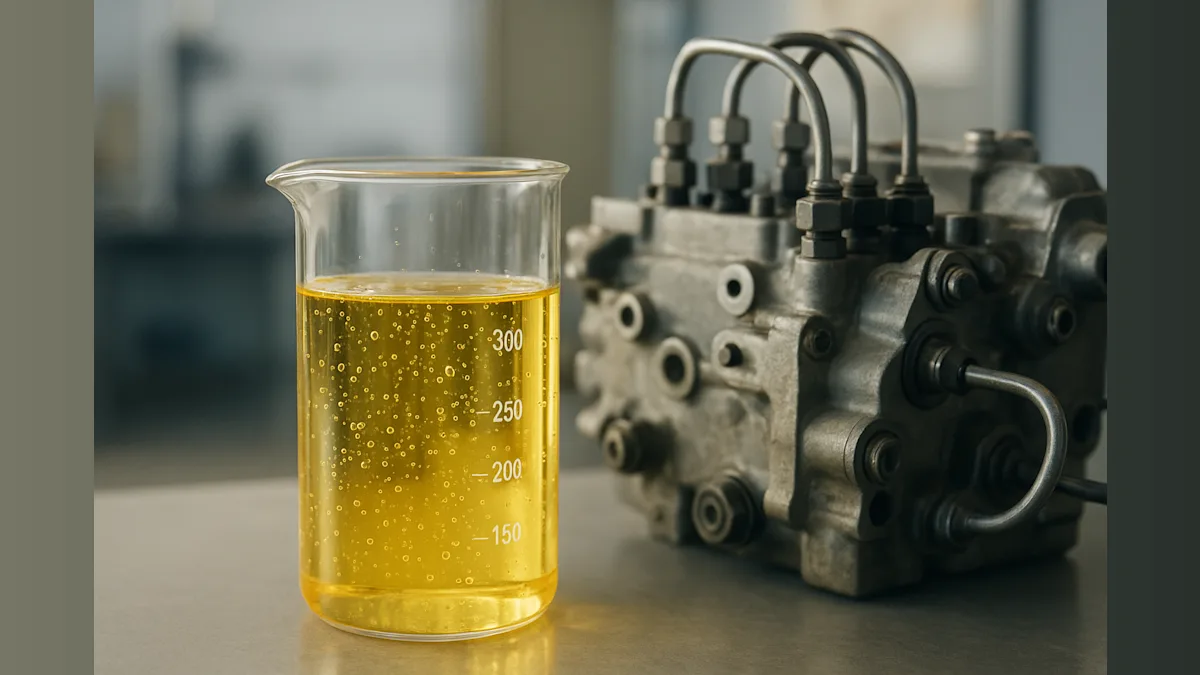
A comprehensive review of global research has confirmed that adding water to diesel fuel represents a practical and cost-effective method to reduce engine emissions by up to 67 percent while maintaining or even improving performance. The finding could provide industries and transportation sectors with an immediate solution to air pollution challenges without requiring expensive engine redesigns.
Researchers from the Federal University of Technology Owerri in Nigeria examined evidence on Water-in-Diesel Emulsion technology, an approach that disperses microscopic water droplets throughout diesel fuel using stabilizing compounds. Their analysis reveals that this straightforward fuel modification could make diesel engines significantly cleaner while preserving the strength, durability, and fuel efficiency that make diesel power essential to industrial operations worldwide.
Diesel exhaust represents a major source of air pollution, releasing nitrogen oxides and particulate matter that harm human health and contribute to environmental degradation. Nitrogen oxides contribute to urban smog formation and can irritate lung tissue, while particulate matter consists of microscopic particles that penetrate deep into the respiratory system. Exposure to these pollutants has been linked to respiratory illnesses and other serious health concerns, with millions of life-years lost annually in urban centers around the world.
Modern diesel vehicles typically employ catalytic converters and particulate filters to reduce pollution. While effective, these systems increase both the complexity and cost of engines. The Nigerian research team suggests that Water-in-Diesel Emulsion technology may offer a simpler complementary approach that works alongside existing pollution control systems or provides an alternative for older equipment.
The Science Behind the Solution
The concept of adding water to diesel fuel may initially appear counterintuitive, as water and fuel are generally considered incompatible inside an engine. The critical distinction is that water is not simply poured into the fuel tank. Instead, tiny droplets of water are evenly dispersed throughout the diesel using compounds known as surfactants, which act as stabilizers to keep the water suspended in the fuel and prevent separation. According to the review, properly formulated emulsions can remain stable for up to 60 days.
When the fuel mixture is injected into the engine and ignites, the trapped water rapidly converts to vapor. This sudden expansion creates what researchers describe as a micro-explosion, breaking the fuel into finer droplets and improving the way it mixes with air. Enhanced mixing leads to more complete combustion, while the presence of water helps lower peak combustion temperatures inside the engine.
This combination delivers two significant benefits. Lower temperatures reduce the formation of nitrogen oxides, while more complete combustion reduces soot and particulate emissions. Compared with conventional diesel fuel, Water-in-Diesel Emulsion fuels reduced nitrogen oxide emissions by as much as 67 percent and particulate matter emissions by up to 68 percent.
Performance Benefits Beyond Emissions
The benefits extend beyond cleaner exhaust. Many experiments documented in the review also found improvements in brake thermal efficiency, a measure of how effectively an engine converts fuel energy into useful mechanical power. Higher efficiency means more of the fuel's energy is used to perform work rather than being lost as heat, potentially offering economic advantages alongside environmental benefits.
"Water-in-diesel emulsions are a practical and cost-effective way to make diesel engines cleaner," said lead author Dr. Chukwuemeka Fortunatus Nnadozie, speaking to Good News Network. "Because the technology does not require redesigning the engine, it offers an immediate path toward lower emissions in developing and developed countries alike."
A major factor in the success of Water-in-Diesel Emulsion technology is the selection of surfactants. The researchers found that using combinations of surfactants often produced the most stable fuel mixtures and the best combustion performance. Selecting the right surfactant formulation was identified as one of the most important aspects of making the technology work effectively.
Path Forward Requires Additional Research
Despite promising results, the researchers emphasize that additional studies remain necessary. Future work could help identify the most effective surfactant combinations and determine how long-term use of water diesel emulsions affects engine components over time. Understanding potential wear patterns and maintenance requirements will be essential for widespread commercial adoption.
"This technology can bridge the gap between conventional diesel use and a cleaner energy future," said co-author Professor Emeka Emmanuel Oguzie, speaking to Good News Network. "With proper formulation and testing, it could become an important part of sustainable transportation and industrial power systems."
For industries that continue to depend on diesel power, this simple blend of water and fuel could offer an unexpectedly effective path toward cleaner air. The technology's ability to work with existing engines without requiring costly modifications makes it particularly attractive for developing nations and industries seeking immediate emissions reductions while transitioning toward longer-term sustainable energy solutions.