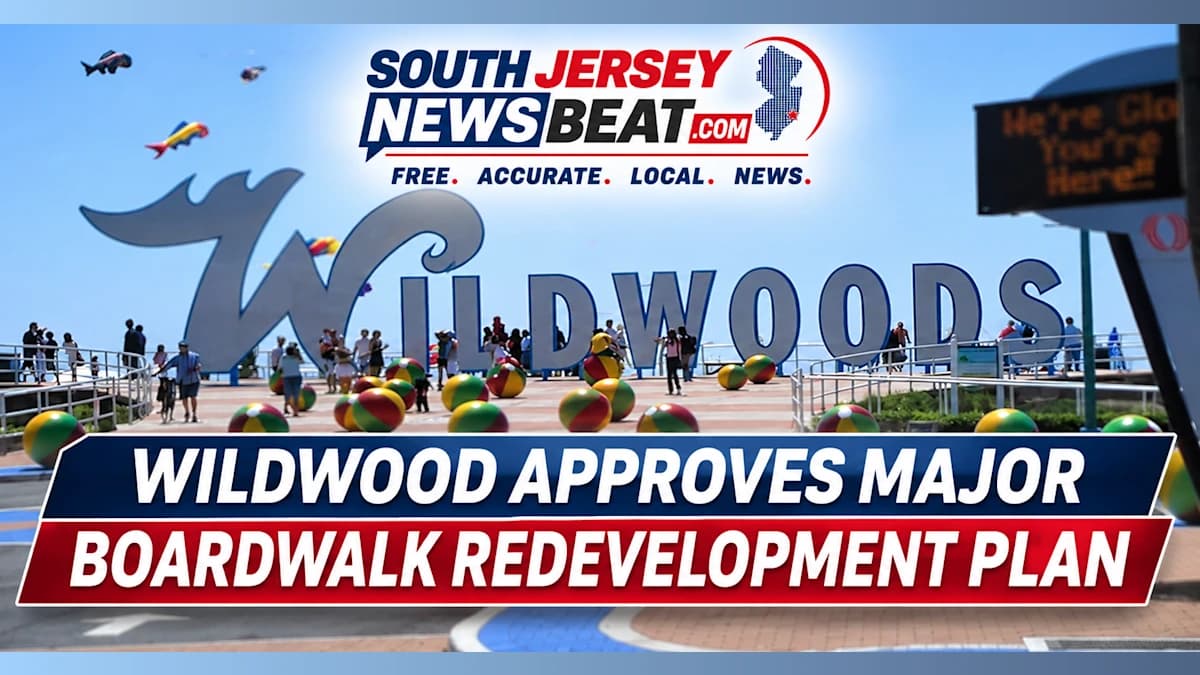
Plan covers approximately 29 blocks and 134 properties, potentially reshaping one of South Jersey's most important tourism destinations.
WILDWOOD, N.J. — The Wildwood Boardwalk could undergo significant changes in the coming years following unanimous approval of a sweeping redevelopment plan that allows for taller buildings, new hotels, multistory parking garages and mixed-use developments along one of the Jersey Shore's best-known tourism destinations.
The Wildwood Board of Commissioners approved the plan October 28, establishing a new framework for development across approximately 29 blocks and 134 properties stretching from Cresse Avenue to 26th Avenue.
Mayor Ernie Troiano Jr., Deputy Mayor Steve Mikulski and Commissioner Krista McConnell voted in favor of the measure.
The city formally posted Ordinance 1363-26, adopting the Wildwood Boardwalk Redevelopment Plan, on October 29.
The approval represents a significant step in the city's efforts to encourage private investment, improve parking and modernize the commercial corridor surrounding the Boardwalk.
However, the plan does not authorize immediate construction of specific hotels, parking garages or other developments. Individual projects will still require applicable approvals before moving forward.
Taller Buildings and New Hotels Could Change the Skyline
One of the most significant elements of the redevelopment plan involves allowing greater building heights in designated areas.
The plan contemplates certain mixed-use developments reaching heights of approximately 155 feet, with additional height potentially available under specified conditions.
That could create opportunities for new hotels and larger commercial developments near the Wildwoods Convention Center and other sections of the Boardwalk corridor.
The goal is to encourage investment in properties that city planners believe are not being used to their full potential.
The redevelopment framework also allows for combinations of commercial, residential and parking uses, potentially replacing some existing surface parking lots with larger buildings.
Those changes could eventually alter portions of Wildwood's skyline and the appearance of neighborhoods immediately surrounding the Boardwalk.
The actual impact will depend on which property owners pursue redevelopment and what projects receive approval.
Parking Is a Major Focus
Parking is among the central issues addressed in the new plan.
According to the redevelopment investigation, nearly 30% of the study area consists of surface parking lots.
Ten blocks were identified where parking occupies more than half of the available land, with many of those properties located near the Convention Center.
City planners see an opportunity to use some of that land more efficiently.
Rather than relying exclusively on large ground-level parking lots, the redevelopment plan encourages multistory parking garages and buildings that incorporate parking into their design.
That approach could allow developers to provide parking while also using portions of their properties for hotels, restaurants, shops or residential units.
The plan also seeks to increase convenient visitor parking and reduce conflicts between tourism-related parking and nearby residential neighborhoods.
Parking has long been an important issue in Wildwood, particularly during summer weekends and major events when thousands of visitors arrive on the island.
The redevelopment plan follows separate efforts to expand parking capacity, including Cape May County's consideration of property for a multistory parking facility.
No specific construction schedule has been established for new parking garages under the redevelopment plan.
What Happens to Existing Businesses and Property Owners?
One of the most important provisions involves how the redevelopment designation affects private property.
Wildwood designated the corridor as a non-condemnation redevelopment area.
That means the designation does not authorize the city to acquire private properties through eminent domain for this redevelopment initiative.
Property owners are not required to sell their buildings or land simply because their properties fall within the designated area.
Existing businesses are also not being ordered to close as a result of the plan's approval.
Instead, the redevelopment framework establishes new development standards and opportunities for owners who may wish to improve, expand or replace existing buildings.
The distinction is particularly important along the Wildwood Boardwalk, where family-owned businesses, restaurants, arcades and shops have operated for generations.
While redevelopment could bring new investment and additional customers, the longer-term effects on property values, rents and operating costs will depend on the projects that ultimately move forward.
The plan itself does not establish that existing businesses will be displaced.
Could the Convention Center Area See Major Changes?
The area surrounding the Wildwoods Convention Center could be among the locations most affected by future redevelopment.
The plan contemplates opportunities for additional hotel development, structured parking and a possible expansion of the Convention Center footprint.
New hotels within walking distance of the Convention Center could potentially help accommodate visitors attending conventions, sporting events and other activities.
Mixed-use developments could also introduce additional restaurants, retail establishments and residential accommodations.
The concept is to encourage investment that supports Wildwood's tourism economy while making more efficient use of available land.
However, no specific Convention Center expansion project has been authorized by the redevelopment plan alone.
Any such proposal would require separate planning, funding and approvals.
Separate From Ongoing Boardwalk Reconstruction
The redevelopment plan should not be confused with the ongoing reconstruction of the Wildwood Boardwalk itself.
The city has been undertaking a multiyear rehabilitation program to replace aging Boardwalk infrastructure, including decking and structural components.
In August, commissioners approved additional rehabilitation and re-decking work for the 2026-27 offseason.
Those projects focus on maintaining and improving the existing Boardwalk.
The newly approved redevelopment plan addresses a different issue: how surrounding properties can be developed and used in the future.
Together, the initiatives represent separate but potentially complementary efforts to improve Wildwood's tourism infrastructure.
What Happens Next?
With the redevelopment plan approved, attention now turns to property owners, developers and potential investment proposals.
The city has established the regulatory framework, but the pace of redevelopment will depend largely on private-sector interest and the ability of individual projects to secure financing and required approvals.
Some properties may remain unchanged for years, while others could eventually be redeveloped into hotels, parking structures, residential buildings or mixed-use projects.
The plan does not establish a timetable for transforming the entire corridor.
It also does not guarantee that every type of development contemplated in the document will ultimately be built.
For residents, business owners and visitors, the most visible changes could take years to materialize.
Still, the October 28 vote marks an important decision about the future of the Wildwood Boardwalk and the surrounding tourism district.
The challenge moving forward will be balancing new investment and modern development with the businesses, attractions and distinctive character that have made Wildwood a popular vacation destination for generations.

About the Author
Peter Killeen
A 25-year radio news veteran, Peter covers South Jersey for NewsTalk 1400 & 92.3 WOND radio. Known for his concise and impactful delivery, he ensures listeners and readers stay informed without unnecessary filler.