ATLANTIC CITY — Casino analyst Anthony Marino says Atlantic City's gambling industry is undergoing a fundamental change that could ultimately be more important than how much money gamblers win or lose on any particular month.
Increasingly, people don't have to come to Atlantic City at all.
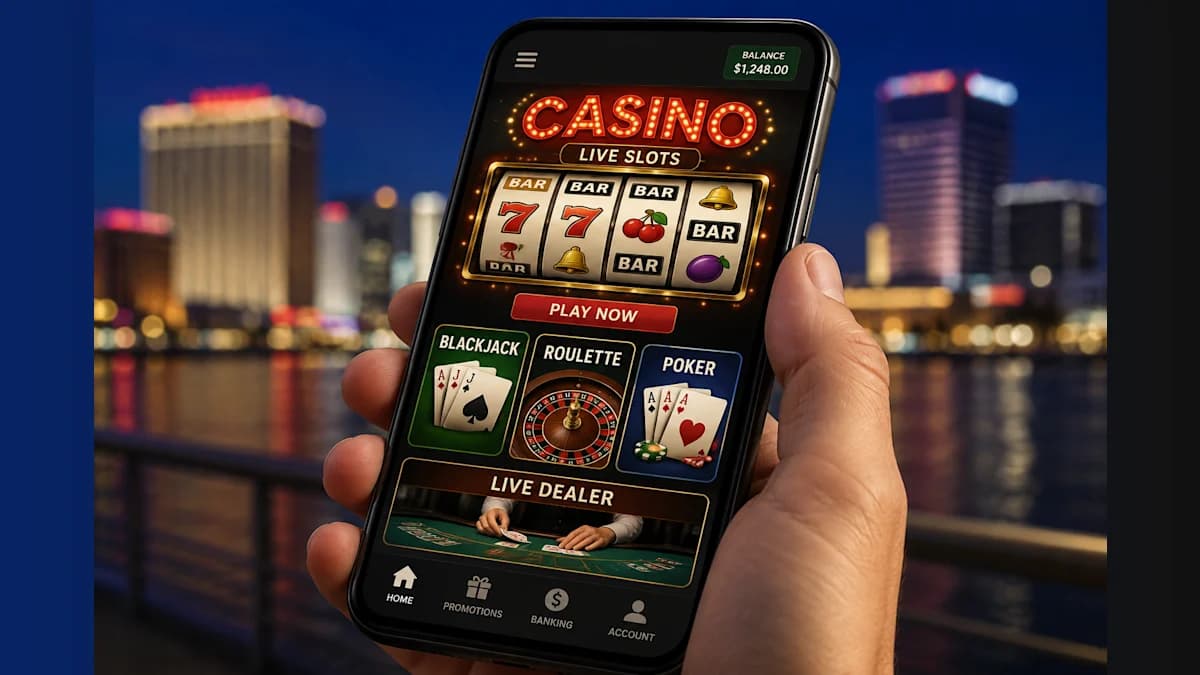
Internet casino gambling, mobile sportsbooks and rapidly expanding prediction markets allow customers to gamble from a phone or computer — raising a critical question for a resort whose economy has traditionally depended on getting people physically through the doors of its casinos.

"Everybody can gamble if they want, and they can do it digitally without going anywhere near a casino now," Marino said during an appearance on "The Don Williams Show" on WOND. "And that's true of sportsbooks as well as the new development of prediction markets."
Marino, who spent 32 years with the South Jersey Transportation Authority and has tracked Atlantic City tourism and casino finances since 1980, said the implications go well beyond casino revenue.
If someone gambles from home instead of visiting Atlantic City, the resort potentially loses that person's spending on hotel rooms, restaurants, entertainment, parking and other activities.
"It's the nine brick-and-mortar operations that employ the majority of people in this area," Marino said.
"You can make an argument that, yes, it's taking away employment because if someone doesn't come to Atlantic City, they not only lose the gambling revenue of that person, but in most cases, more importantly, they lose the non-casino revenue within a casino."
Marino used his own recent visit to Hard Rock as an example.
"We spent a lot more money in the restaurants of Hard Rock than any of the four of us did on the casino floor," he said.
New Study Raises Similar Warning
Marino's concerns come as a new Atlantic County Economic Alliance study raises alarms about the future of Atlantic City's brick-and-mortar casino economy.
The Greater Atlantic City Casino-Hotel Employment Exposure Assessment identifies a combination of threats that include online gambling, higher operating costs, new casinos in New York City, the possibility of future North Jersey casinos and a potential economic downturn.
Under the study's modeled scenarios, as many as 8,005 jobs and $1.8 billion in regional economic output could be exposed by 2035 without steps to strengthen and diversify the region's physical tourism economy.
The report does not predict that all of those jobs will necessarily disappear. Rather, it attempts to quantify the employment and economic activity potentially exposed to the combination of competitive pressures facing the resort.
That distinction is important.
Marino also cautioned against claiming that prediction markets such as Kalshi have already been proven to be taking measurable amounts of business away from Atlantic City's casinos.
"There is not yet any information, any real data that will prove one way or another that the sportsbooks here in New Jersey are being adversely affected," Marino said.
But he said the potential threat is significant because prediction markets can operate much differently from state-regulated sportsbooks.
New Jersey Takes Fight to Supreme Court
The regulatory battle escalated Wednesday when New Jersey asked the U.S. Supreme Court to review a federal appeals court ruling that prevented the state from regulating Kalshi's sports-related event contracts as gambling.
The dispute goes to the heart of a question with major implications for Atlantic City: Are sports contracts offered by prediction markets federally regulated financial products, or are they sports gambling that states have the authority to regulate?
A divided 3rd U.S. Circuit Court of Appeals ruled in April that federal law preempts New Jersey from regulating Kalshi's sports event contracts.
But last week, the 9th U.S. Circuit Court of Appeals reached the opposite conclusion in a Nevada case, ruling that Kalshi could not block Nevada gaming regulators from overseeing its sports prediction markets.
The conflicting appellate decisions increase the possibility that the Supreme Court will take up the issue.
New Jersey Attorney General Jennifer Davenport said companies such as Kalshi should not be allowed to offer what the state considers sports bets while avoiding state gambling laws.
Marino said the regulatory distinction matters because Atlantic City's casinos and their sportsbook partners operate under extensive state regulation.
"The problem with prediction markets, we don't know what the heck's going on," Marino said.
He contrasted that with New Jersey's Division of Gaming Enforcement, which can investigate and penalize licensed casino and sportsbook operators for violations.
"The fundamental reason for the existence of the Division of Gaming Enforcement is to enforce the gaming regulations," Marino said. "And they do it. They've been doing it now for 48 years, and they're going to keep doing it."
Polistina: 'We Cannot Compete With Ourselves'
State Sen. Vince Polistina has been raising similar concerns.
In an August appearance on WOND's "Off The Press with Scott Cronick," Polistina warned that Atlantic City already faces substantial external competition and should not create additional competition for itself.

"We, of course, are dealing with the competition you see now with the online gaming and people on their phones," Polistina said. "We cannot compete with ourselves."
Polistina said Atlantic City must protect its nine existing casinos because of the jobs they support directly and throughout the regional economy.
"We got to do everything we can to support the nine casinos we have there and all of the jobs and all the ancillary things," Polistina said, pointing to food, construction and other businesses that depend on casino activity.
In another interview this week, Polistina was even more direct.
"The prediction markets and the online gaming are absolutely having an impact," he said. "People can sit on their couch and gamble."
Polistina also cited inflation, labor costs and looming New York competition.
"Some challenging times there," Polistina said. "I really am fearful for some of the properties."
Revenue Doesn't Tell the Whole Story
The debate highlights an increasingly important distinction in Atlantic City's gaming numbers.
Money attributed to an Atlantic City casino's internet gaming or sports wagering operation does not necessarily mean a gambler ever set foot in Atlantic City.
That matters because physical visitors support an economic ecosystem extending well beyond gambling.
Marino said Atlantic City casinos traditionally use amenities — including sportsbooks — to bring customers onto the property, where they may spend money elsewhere.
"It's always argued that by operating sportsbooks, we bring in younger gamblers who not only do some wagering, through the phone or in person at the sportsbook, but they decide to walk over and maybe try slot machines, maybe sit down for a game of blackjack," Marino said.
He cautioned that there are no definitive public numbers quantifying that crossover spending.
But the economic principle is straightforward: A customer sitting in a casino can potentially buy dinner, stay overnight or see a show. A customer making a wager from a living-room couch cannot.
That is why Marino believes Atlantic City's future cannot be measured simply by adding together every dollar reported as casino, internet and sports wagering revenue.
"You have to keep an eye on what's happening in the casino industry locally," Marino said.
For a resort built around attracting visitors, where the gambling takes place may increasingly be just as important as how much is wagered.

About the Author
Scott Stephens
Scott has been an on-air personality, producer and newscaster for 30+ years. He has been a mainstay in the South Jersey Community and on the air across many different area stations. Scott can currently be heard on Kool 98.3 and News Talk 1400 & 92.3 WOND.