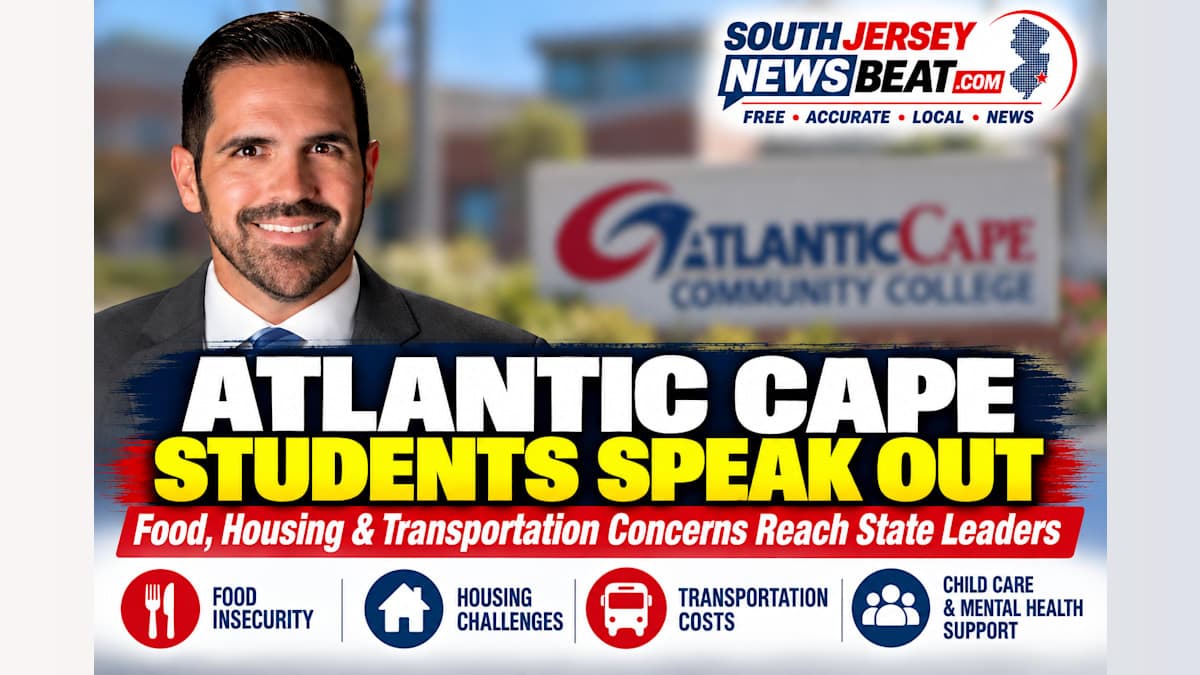
College President Jason Abreu tells WOND that meeting students' basic needs is essential to their success, while announcing a November summit to strengthen South Jersey's health care workforce.
MAYS LANDING, N.J. — For students at Atlantic Cape Community College, the challenges of earning a degree often extend far beyond the classroom.
Finding affordable food, getting to campus, paying for child care and securing stable housing are among the obstacles facing students in Atlantic and Cape May counties, according to college President Dr. Jason Abreu.
Those concerns took center stage Tuesday, October 20, when New Jersey Secretary of Higher Education Margo Chaly visited Atlantic Cape's Mays Landing campus to hear directly from students, faculty and administrators.
Later that afternoon, Abreu discussed the visit and the college's priorities during an appearance on Off The Press with Scott Cronick on News Talk 1400 & 92.3 WOND. Assemblyman Don Guardian, who participated in the campus visit, was filling in as host.
"One of the challenges that we see for our students is what we refer to now in 2026 as basic needs," Abreu said.
He identified transportation, child care, food insecurity, housing and mental health support as critical concerns.
The discussion comes as New Jersey's colleges confront questions about affordability, enrollment, emerging technology and how effectively higher education prepares students for employment.
Students Get an Audience With State Education Leader
Chaly's October 20 visit was part of an 18-stop tour of New Jersey colleges and universities.
At Atlantic Cape, she met with college administrators and faculty before participating in a separate discussion with five students representing different academic programs and backgrounds.
The student meeting gave participants an opportunity to speak directly about challenges affecting their education.
Guardian said he was impressed that the college allowed students to discuss their concerns without administrators in the room.
He also noted that the students identified many of the same issues raised earlier by college leadership.
"Students raised the same issues that you had raised," Guardian told Abreu during the WOND interview.
Abreu said including students with different experiences was an important part of planning the visit.
The college wanted to hear from recent high school graduates, adult learners returning to school and students balancing education with family and financial responsibilities.
For Abreu, those perspectives are essential to understanding how the institution can better serve its community.
Food Insecurity and Transportation Among Top Concerns
One of the students who met with Chaly was Student Government Association President Jayed Hasan Sourov.
According to Atlantic Cape's account of the visit, Sourov raised concerns about access to affordable food for students who spend long days on campus.
He pointed to limited food-service hours and the difficulty some students experience obtaining meals between classes.
Transportation was another concern.
Students who depend on public transportation or have limited access to vehicles can face additional obstacles getting to class, participating in campus activities or attending required training.
Abreu said Atlantic Cape is exploring ways to help students address these challenges.
"So what we strive to do is that as a student comes into the college, how can we meet some of those basic needs challenges that they have?" he said.
Possible approaches include student employment opportunities, subsidized bus passes and additional support services.
Abreu emphasized that addressing those needs is directly connected to academic success.
"We wouldn't want a student to be in the classroom hungry," he said.
He explained that students struggling with food insecurity may have difficulty concentrating and fully participating in their education.
Adult Learners and Working Families Face Additional Challenges
The meeting also highlighted the experiences of students returning to college after years in the workforce.
Guardian described meeting a woman who had been away from school for approximately 25 years before deciding to pursue additional education.
He said her enthusiasm illustrated the opportunities community colleges can provide to people seeking a new career or greater financial stability.
Abreu said Atlantic Cape serves students at many stages of life, including recent high school graduates, working adults and people looking to develop new skills.
Before formally beginning his presidency, Abreu said he visited approximately 35 student homes across Atlantic and Cape May counties.
Those conversations included people who had never attended college and others returning to education after decades away.
"For us at Atlantic Cape, the beauty is come as you are," Abreu said. "We are here to help you get to that finish line."
The college president said his first months in South Jersey have also included more than 100 meetings with community members, employers, school districts and other educational institutions.
State Officials Hear Concerns About Artificial Intelligence
Artificial intelligence emerged as another major topic during Chaly's visit.
Students and faculty discussed how AI should be used in coursework and how colleges can establish appropriate expectations as the technology becomes more common in workplaces.
During the WOND interview, Guardian asked Abreu whether Atlantic Cape has a collegewide policy governing AI or leaves those decisions to individual instructors.
Abreu said faculty members currently have considerable discretion.
"Right now we leave a lot of autonomy to our faculty members," he said.
He explained that the appropriate use of AI can vary depending on the subject being taught.
Abreu said the goal is to help students understand how to use emerging technology responsibly while preserving the skills and judgment they need to develop independently.
"Artificial intelligence should be complementary to what we are teaching," he said.
The president also described the college's use of assignment-review technology, although automated similarity reports should not be treated as definitive proof of whether a student used AI.
The issue has implications beyond Atlantic Cape as colleges across the country work to balance academic integrity with preparing students for technology-driven careers.
November 20 Health Care Summit Planned
Beyond immediate student concerns, Abreu announced a significant workforce development initiative during the interview.
Atlantic Cape plans to host a regional health care summit on November 20, bringing together hospital executives, nursing leaders and other health care professionals.
The goal is to better understand South Jersey's workforce needs and identify opportunities for new or expanded educational programs.
"For us to build our capacities in healthcare, and we know that's a driving industry in South Jersey, we are inviting all hospital CEOs, chief nursing officers, chief operating officers of any healthcare sector to come to the college for a facilitated conversation on building the future of healthcare in this region," Abreu said.
He explained that the college wants to use feedback from employers to determine which programs and training opportunities would best prepare students for available jobs.
The summit could help shape future decisions about curriculum, equipment and workforce partnerships.
No specific new degree program or funding commitment was announced during the interview.
Preparing Students for South Jersey Jobs
Abreu also emphasized the college's responsibility to adapt to changing employment opportunities.
He identified health care, hospitality, aviation and tourism as important industries for Atlantic and Cape May counties.
Atlantic Cape already offers aviation-related education and training. Earlier this year, the state awarded the college $1.5 million to strengthen its air traffic controller training programs.
Abreu said community colleges should be able to respond quickly when regional employers identify new workforce needs.
"The challenges [are] making sure that we're keeping up to the workforce needs," he said.
Career preparation, he explained, extends beyond technical instruction.
Students also need communication skills, interviewing experience, résumé development and time-management skills.
Atlantic Cape provides career services and transfer opportunities for students who intend to continue their education at four-year institutions.
Facilities and Equipment Also on President's Agenda
Abreu identified campus infrastructure and instructional equipment as additional priorities.
He said students entering fields such as nursing and health care should have opportunities to learn using equipment that reflects what they will encounter in professional settings.
The president also emphasized supporting the college's employees.
Some of those priorities would require financial investment, he acknowledged, while others involve improving the overall experience of students and staff.
Abreu did not announce a specific construction project, equipment purchase or new budget allocation during the interview.
A New President's First 100 Days
Abreu became Atlantic Cape's 10th president on July 1, succeeding longtime President Dr. Barbara Gaba.
He told Guardian that one of the most encouraging aspects of his first 100 days has been the community's willingness to support the college.
The president said conversations with residents, employers, educators and local officials have reinforced his belief that Atlantic Cape can play a central role in the region's economic future.
The college serves both Atlantic and Cape May counties, with campuses in Mays Landing, Atlantic City and Cape May County.
For Guardian, who has long supported the institution, the October 20 visit reinforced the importance of ensuring that higher education remains accessible to students from different backgrounds.
For Abreu, the immediate priority is making sure students have the support they need to remain enrolled, complete their education and move into successful careers.
The discussions with Chaly provided an opportunity to bring those concerns directly to state leadership.
Whether the conversations lead to additional funding, new programs or policy changes remains to be seen.
But the message from Atlantic Cape's students and president was clear: Making college affordable involves more than tuition. It also means helping students overcome the everyday challenges that can prevent them from completing their education.
South Jersey NewsBeat will continue following Atlantic Cape's student-support initiatives, the November 20 health care summit and any statewide policy developments resulting from Secretary Chaly's campus tour.

About the Author
Peter Killeen
A 25-year radio news veteran, Peter covers South Jersey for NewsTalk 1400 & 92.3 WOND radio. Known for his concise and impactful delivery, he ensures listeners and readers stay informed without unnecessary filler.