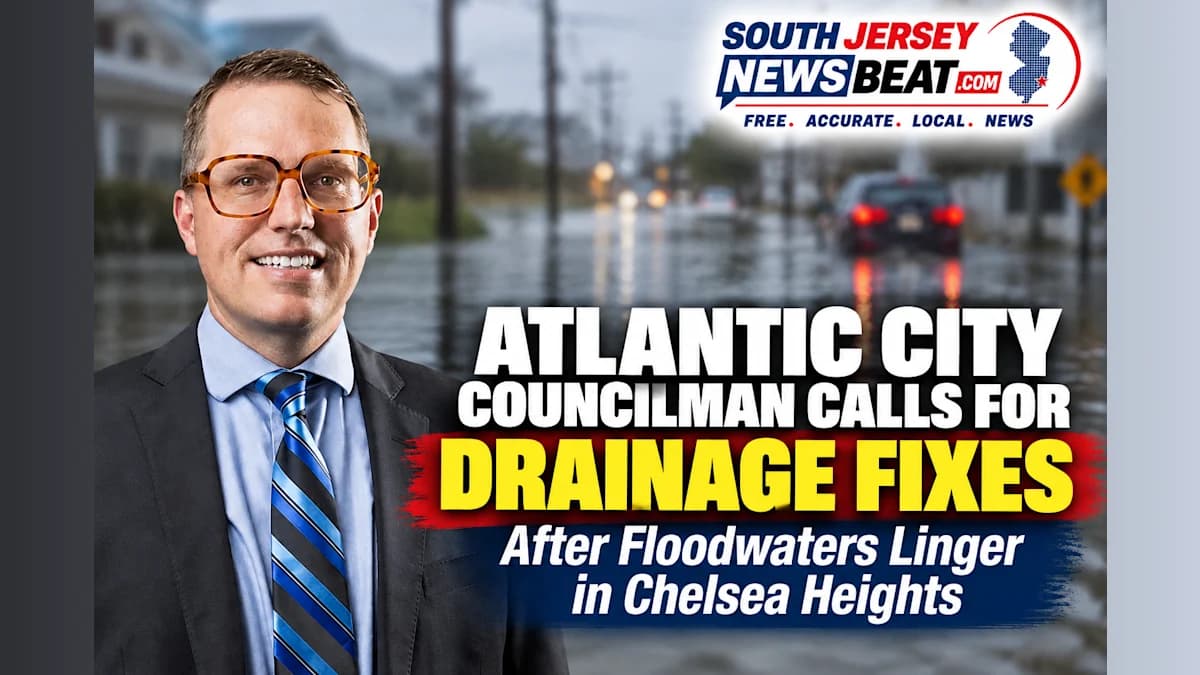
Jesse Kurtz says recent flooding exposed infrastructure problems that need attention before the next major coastal storm.
ATLANTIC CITY, N.J. — Atlantic City has spent millions of dollars on flood protection and drainage improvements, but Sixth Ward Councilman Jesse Kurtz says the recent nor'easter exposed a troubling problem in Chelsea Heights: Floodwaters that remained in some neighborhoods even after the tides receded.
During an October 20 appearance on The AC Mike Lopez Show on News Talk 1400 & 92.3 WOND, Kurtz said the city needs to take a closer look at drainage infrastructure, particularly in areas where standing water persisted longer than expected.
"There were some spots in Chelsea Heights that were hit pretty hard, and what was worse was that the water did not flow out even when the tides around it subsided, and it had to do with the infrastructure conditions," Kurtz said.
"That's something we have to get fixed before the next storm comes around."
His comments raise questions about whether existing drainage systems are adequately protecting flood-prone neighborhoods and whether additional improvements are necessary.
Millions Spent, but Flooding Persists
Kurtz acknowledged the frustration residents can experience when major investments in flood protection fail to prevent streets and neighborhoods from flooding.
"We're holding our own in some respects," he said.
"It's hard to appreciate sometimes that we just spent millions of dollars but it still floods everywhere. Sometimes you're spending that money just to kind of keep things where they are."
The councilman explained that coastal communities must continually maintain and improve their infrastructure simply to prevent existing conditions from deteriorating.
"Naturally, the way that things work, they get eroded and they get worse," Kurtz said. "They get worse if you don't do anything."
While flood protection projects may reduce the severity of certain problems, Kurtz suggested that residents should not necessarily expect every investment to eliminate flooding altogether.
But he said the city must identify where systems failed to perform as expected during the latest storm.
"I think our challenge is to look at what really went poorly from a flood standpoint in the last storm and to get ready for the next," he said.
Drainage Valves, Pumps and Standing Water
Kurtz identified drainage infrastructure as a particular concern.
He said Atlantic City has invested in upgrading check valves, which are designed to help prevent tidal water from flowing backward through drainage systems.
"We've spent some money upgrading all the check valves, which allow water to not just run in when it's high tide," he said.
However, those valves cannot necessarily prevent flooding when tidal conditions leave stormwater with nowhere to drain.
"At one point during the storm, there's nowhere for the water to go, so it's kind of irrelevant whether the valve works," Kurtz explained.
The bigger concern, he said, arises when water remains trapped after conditions should allow it to drain away.
"But when you get to your second high tide and water's still sitting there, you start wondering, well, why isn't it getting out?" he said.
"Oh, the valve's not working the way it should. Or we might need something like a pump in order to shift water or add additional drains, elevate a drain, et cetera."
Kurtz did not identify a specific failed valve or announce that an engineering assessment had confirmed the cause of flooding at any particular location.
His comments instead outlined potential problems that he believes deserve further examination.
A Block-by-Block Approach
Rather than relying solely on large-scale flood protection projects, Kurtz said he wants the city to examine drainage problems at the neighborhood level.
"Those are the kind of things that I'm trying to bring light to, draw attention to in order to almost look at like a block-by-block standpoint, especially in my ward," he said.
Chelsea Heights, which lies along Atlantic City's western side, is among the neighborhoods vulnerable to coastal and tidal flooding.
The recent storm's impact underscores the challenges facing low-lying communities, where heavy rainfall, high tides and drainage limitations can combine to leave roads and properties inundated.
Kurtz's comments suggest that some problems may require targeted infrastructure improvements rather than a single citywide solution.
Possible measures he identified include evaluating drainage valves, installing pumps where appropriate, adding drains and adjusting drainage elevations.
Whether any of those measures will be recommended or funded remains undetermined.
Preparing for the Next Storm
Host Mike Lopez asked Kurtz what Atlantic City could do to become more resilient after the recent nor'easter.
Kurtz said the priority should be learning from the storm while the problems are still fresh.
The councilman emphasized that improvements have been made in several areas of the city, but said more work is necessary.
His concerns come as Atlantic City and surrounding shore communities continue to confront the costs of maintaining infrastructure in flood-prone areas.
The next steps could include identifying specific streets where water remained after the tide fell, determining whether drainage equipment operated properly and establishing what improvements would be needed to address those problems.
Kurtz did not announce a formal proposal, project budget or timetable for repairs during the interview.
Still, he made clear that he considers the drainage problems in Chelsea Heights an issue requiring attention before another significant storm.
"That's something we have to get fixed before the next storm comes around," he said.
For residents who watched floodwaters linger outside their homes and along neighborhood streets, the question now is whether those concerns will translate into specific infrastructure improvements.
Jesse Kurtz made his comments during an October 20 interview on The AC Mike Lopez Show, which airs weekdays from noon to 1 p.m. on News Talk 1400 & 92.3 WOND.

About the Author
Karen Johnson
With over 30 years of news experience in major markets like Los Angeles, Denver, and Columbus, Karen now covers our area for South Jersey NewsBeat. She also brings her articulate and conversational news delivery to WOND radio listeners every weekday. Her background includes work with the NBC Radio Network, and she thrives in fast-paced news environments.