
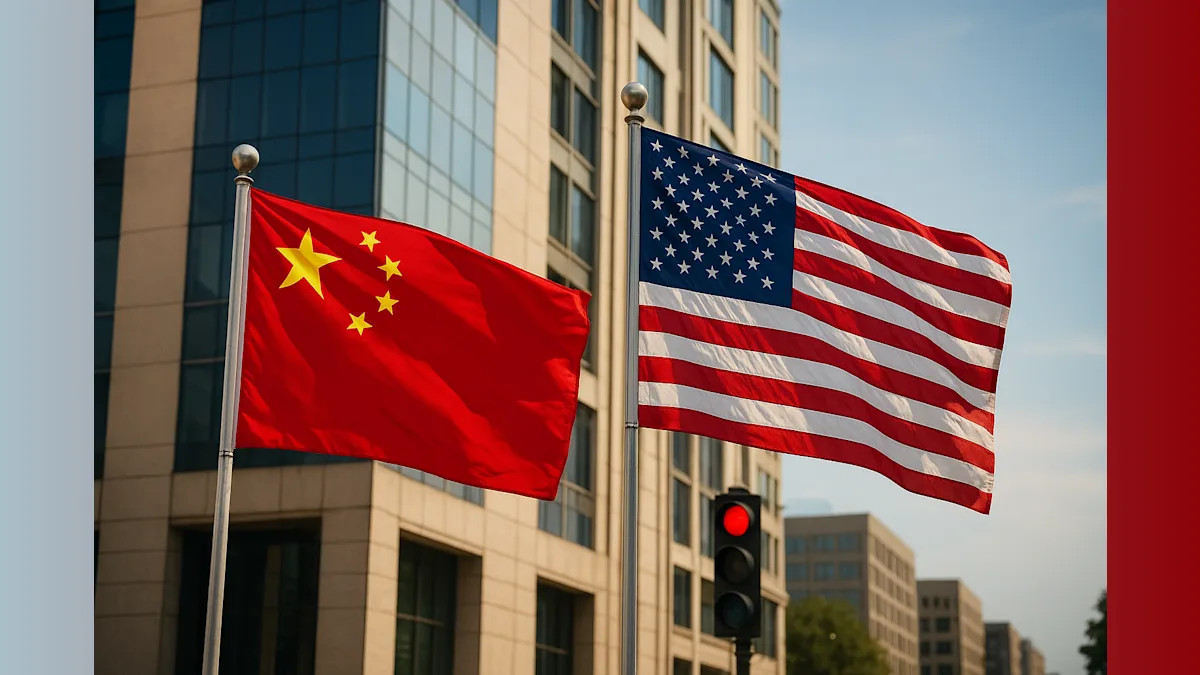
China escalated its trade confrontation with the United States on Monday, June 22, 2026, imposing sanctions on 10 American military-related companies in direct retaliation for recent U.S. restrictions on Chinese technology firms.
The Commerce Ministry announced that Chinese companies would be prohibited from exporting dual-use items to the sanctioned American firms. Dual-use goods are products that can serve both military and civilian purposes, making them strategically significant in international trade disputes.
The ministry justified the export ban as necessary to safeguard China's national security while simultaneously responding to what it characterized as the U.S. government's wrongful expansion of its List of Chinese Military Companies. This designation carries significant commercial consequences, as it prevents affected firms from securing U.S. military contracts.
The 10 sanctioned American companies span multiple states and industries. They include AVEOX in Simi Valley, California; Red Cat Holdings and Teal Drones, both located in South Salt Lake, Utah; IMSAR in Springville, Utah; Jaia Robotics in Bristol, Rhode Island; Ball Aerospace & Technologies in Broomfield, Colorado; Oshkosh Defense in Oshkosh, Wisconsin; L3Harris Maritime Services in Norfolk, Virginia; MP Materials in Las Vegas; and USA Rare Earth in Stillwater, Oklahoma.
The affected companies represent critical sectors of American defense infrastructure, including military drone manufacturing and rare earth mining operations. Rare earth elements are essential components in advanced military systems, making access to these materials strategically vital.
In a separate but related action, China's Finance Ministry announced that government entities would be barred from purchasing products from 46 American companies, including multiple units of Lockheed Martin, Raytheon, and General Dynamics. The ministry provided no explanation for these prohibitions in its brief statement.
The Chinese sanctions follow the U.S. Defense Department's decision earlier this month to add several major Chinese technology companies to its list of firms allegedly linked to the Chinese military. Among those designated were Alibaba and Baidu, two of China's most prominent technology corporations. Baidu responded by calling the suggestion that it operates as a military company totally baseless.
China's Commerce Ministry had previously criticized the American sanctions as contradicting the consensus reached between Chinese leader Xi Jinping and U.S. President Donald Trump during Trump's visit to China in May 2026. The ministry reiterated this position in Monday's announcement, suggesting the U.S. actions undermine diplomatic progress.
The new Chinese restrictions extend beyond direct bilateral trade. Companies or individuals in third countries are now prohibited from transferring dual-use items from China to the sanctioned American firms, potentially complicating global supply chains. However, the ministry indicated that Chinese companies could apply for export approval for goods deemed genuinely necessary, leaving some flexibility in the enforcement mechanism.
The tit-for-tat sanctions represent a significant deterioration in U.S.-China commercial relations, particularly in the defense and technology sectors. As both nations maintain extensive economic interdependencies while simultaneously competing for technological and military supremacy, these restrictions signal growing willingness on both sides to accept economic costs in pursuit of strategic objectives.