A manufacturing facility in northwest Georgia has transformed its operations through artificial intelligence, using the technology to maintain competitiveness against international rivals while expanding its workforce.
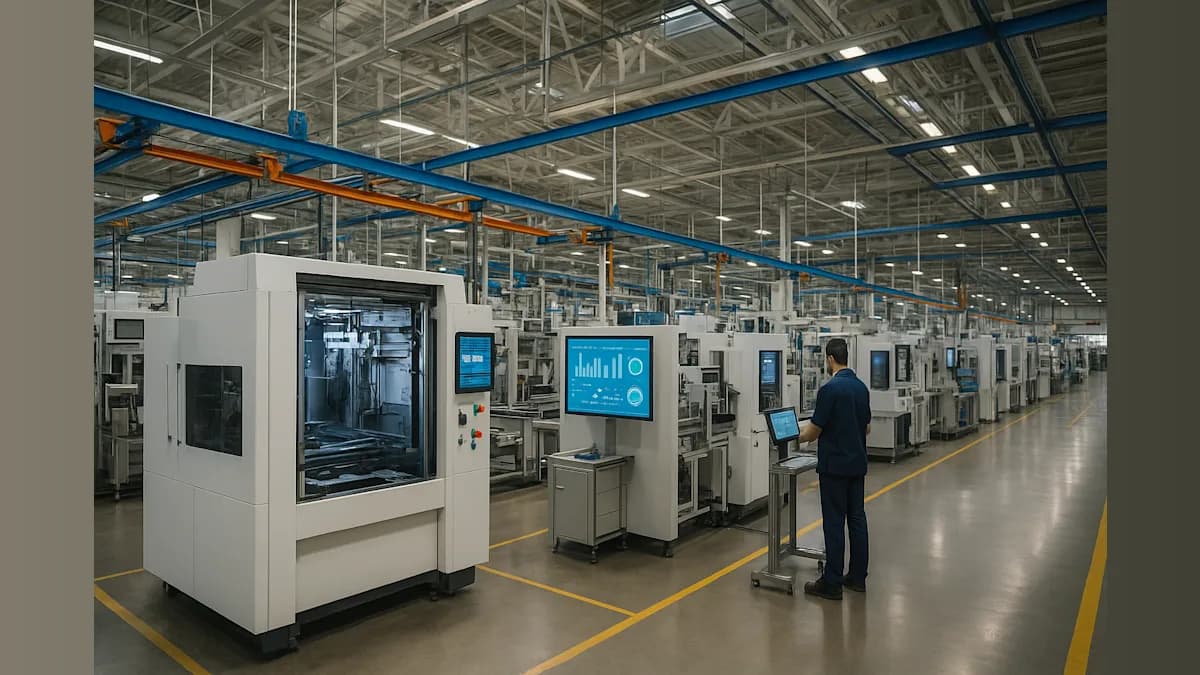
The Roper Corporation plant in LaFayette, owned by GE Appliances, has integrated AI-powered cameras and sensors across its assembly lines to identify defects in real time. When the system detects an error—such as an incorrect gasket on an oven—it immediately halts production on that section of the line and alerts workers with loud music.
"If you hear AC/DC, you know to come running down here," Tony Gabbert, the plant's director of manufacturing operations, told NPR. "The quicker we know what the problem is, the quicker we can fix it."
The facility also employs autonomous vehicles for parts delivery and robots that attach glass cooktops to metal frames. These technological advances represent more than a decade of investment in data collection systems that now generate millions of lines of information daily.
Through its Brilliant Factory data platform, GE Appliances can monitor all nine of its major appliance plants in real time, tracking performance down to individual workstations. Company executives in Louisville, Kentucky, can see which machines are offline, why appliances are being sent to repair bays, and how much scrapped parts are costing the operation.
The financial impact has been substantial. Bill Good, GE Appliances' vice president of manufacturing, estimates the company saves between $1.5 million to $2 million annually for each percentage point improvement in performance metrics. When an assembly line stops unexpectedly, the cost ranges from $300 to $500 per minute.
"The name of the game in manufacturing is speed — speed at which you see the problem, speed at which you solve the problem," Good told NPR. "Literally, minutes matter."
The artificial intelligence system does more than detect problems—it predicts them. When data indicates a motor is running hot, signaling potential failure, the plant can schedule preventive maintenance rather than face an unexpected breakdown. Plant managers now begin their days reviewing AI-generated reports that not only identify issues but recommend solutions.
Gabbert emphasized the facility's pursuit of perfection in manufacturing metrics. "We're not shooting for 97. We want to run 100 every day," he told NPR, referring to performance standards used throughout the industry.
Good, who brings nearly 40 years of manufacturing experience to his role, acknowledged the technology's capabilities. "It can outthink me," he told NPR, while noting he does not anticipate widespread job displacement. "At least in the foreseeable future, I don't see AI replacing large populations of humans," Good told NPR.
Rather than eliminating positions, the company views AI as enabling domestic manufacturing. GE Appliances, acquired by Chinese conglomerate Haier in 2016, recently added 600 jobs in Georgia as part of a $180 million expansion. The efficiency gains from artificial intelligence help the facility compete with overseas factories that benefit from lower labor costs.
The company now uses AI to optimize staffing levels, moving workers to different tasks when certain areas require fewer personnel. The technology also forecasts market demand, allowing last-minute production decisions about which products to manufacture each week.
"You have to be faster, better, more flexible. That's the only thing that neutralizes the threat," Good told NPR, describing the competitive landscape facing American manufacturers.