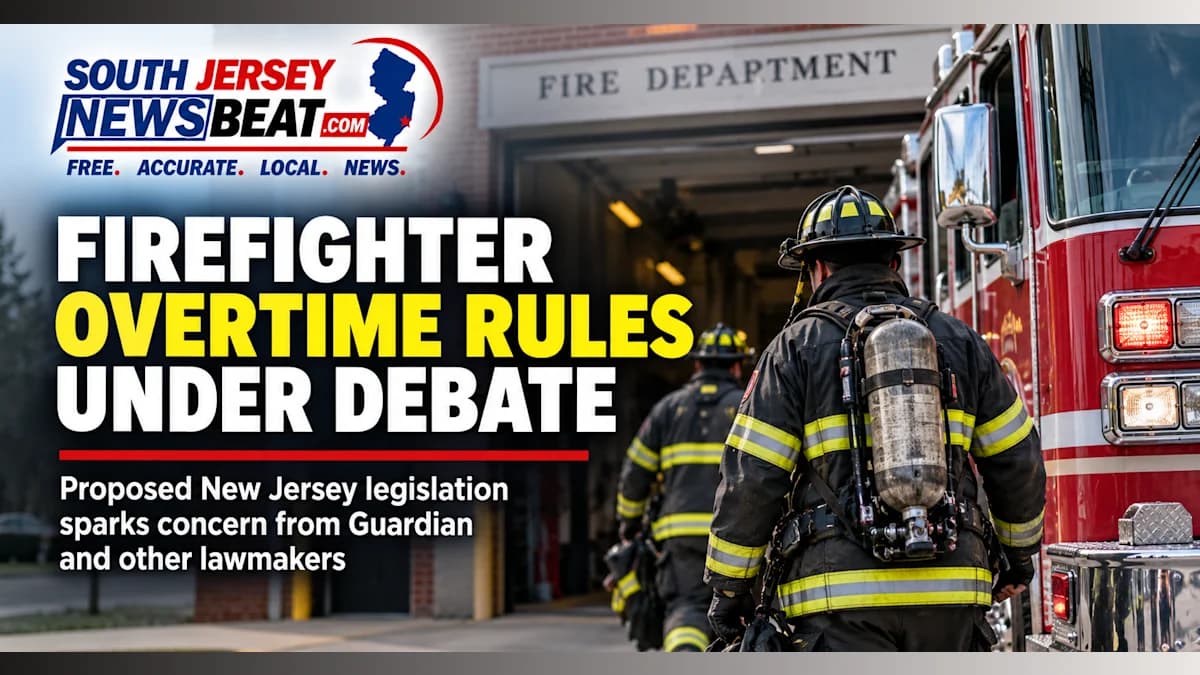
ATLANTIC CITY, N.J. — A New Jersey bill that would change overtime compensation requirements for certain firefighters and law enforcement officers is drawing opposition from Assemblyman Don Guardian, who says the legislation could undermine negotiated employment agreements and create financial uncertainty for public safety workers.
Guardian, R-Atlantic, discussed the legislation Monday, Sept. 21, while guest-hosting Off The Press with Scott Cronick on News Talk 1400 and 92.3 WOND.

The former Atlantic City mayor said he was particularly concerned about provisions that would apply retroactively to compensation requirements dating back several years.
"They want to take overtime away from firefighters," Guardian said during the broadcast.
He also questioned whether the Legislature should change compensation standards affecting employees whose wages and benefits are governed by collective bargaining agreements.
The legislation, Assembly Bill A5276, was approved by the Assembly Labor Committee on Sept. 14 by a 7-3 vote, with Guardian among the three members voting against it.
The bill was subsequently referred to the Assembly Appropriations Committee. It has not become law.
What the Legislation Would Change
A5276 would clarify overtime compensation requirements for certain public employees engaged in fire protection and sworn law enforcement activities.
The measure would incorporate federal overtime standards that recognize the unusual schedules worked by firefighters and law enforcement officers.
Under the federal Fair Labor Standards Act, qualifying public agencies may use special work periods for certain fire protection and law enforcement employees rather than calculating overtime exclusively on a conventional 40-hour workweek.
For example, under the federal standard referenced in the bill, qualifying firefighters working a 28-day schedule generally become entitled to overtime compensation after exceeding 212 hours during that work period.
For qualifying sworn law enforcement employees, the corresponding threshold is 171 hours during a 28-day period.
Different proportional thresholds apply to qualifying work periods lasting between seven and 28 days.
The bill would establish that public employers meeting those federal standards have not violated the applicable state overtime requirements for covered employees.
It would also recognize qualifying compensatory time arrangements under federal law.
The legislation is intended to clarify how New Jersey's wage and hour requirements apply to public safety employees whose work schedules differ from those of employees working traditional five-day, 40-hour schedules.
Guardian Questions Impact on Firefighters
During Monday's interview, Guardian argued that firefighters must remain available to respond to emergencies regardless of when their regular shifts end.
He questioned the potential consequences of changing overtime requirements for employees whose work schedules can be extended by emergencies, staffing shortages and other operational demands.
"You're only working overtime because someone didn't come in for that shift or isn't coming in and things like that," Guardian said.
The assemblyman also raised concerns about the relationship between the legislation and collective bargaining agreements negotiated between public employees and their employers.
"They have collective bargaining agreements. They sign that. That's legal," Guardian said.
"That determines if there's overtime, what the overtime is, et cetera."
Guardian argued that the state should be cautious about changing compensation requirements affecting employees who provide essential emergency services.
He also said municipalities already face challenges recruiting firefighters, police officers and other public safety personnel.
The bill's supporters, however, maintain that the legislation is intended to clarify existing overtime obligations rather than eliminate compensation negotiated through valid collective bargaining agreements.
The amended bill expressly states that its purpose includes preserving existing collectively bargained agreements made in good faith.
Retroactive Provisions Raise Additional Questions
One of Guardian's principal objections involved the bill's retroactive provisions.
During the interview, he expressed concern that firefighters could face demands to return overtime compensation previously received.
"They want to make it retroactive for 10 years," Guardian said.
He questioned whether employees could be required to repay overtime they had earned under previous compensation arrangements.
However, the actual legislation establishes a different retroactive framework.
The amended bill would apply its overtime standards retroactively to Feb. 4, 2019, the date associated with New Jersey's earlier minimum wage legislation.
It does not expressly direct firefighters or law enforcement officers to repay overtime compensation already received.
Instead, the retroactive provisions are intended to protect qualifying public employers from liability for certain additional overtime claims arising under interpretations of the state's wage and hour laws.
The distinction is significant.
The bill could affect whether covered employees are entitled to additional overtime compensation for previous work periods, but its text does not establish a general requirement that employees return overtime payments they have already received.
Guardian's concerns about retroactivity nevertheless raise questions about how the legislation could affect existing compensation disputes and the rights of employees who have pursued claims under current law.
Municipal Officials Say Bill Could Prevent Substantial Costs
The New Jersey State League of Municipalities has expressed support for the legislation.
In a Sept. 16 update, the organization said the measure would address uncertainty created by the interaction between New Jersey's wage and hour laws and the federal overtime standards applicable to certain public safety employees.
The league noted that New Jersey's 2019 minimum wage legislation created questions about how state overtime requirements should apply to firefighters and other public employees working specialized schedules.
According to the organization, subsequent litigation has raised the possibility that municipalities could face substantial liability for additional overtime compensation covering previous years.
The league warned that, without legislative clarification, public employers could face billions of dollars in potential costs for work already compensated under collectively bargained wage arrangements.
That figure represents the organization's assessment of potential statewide exposure, not an independently established liability or a confirmed cost to Atlantic or Cape May County municipalities.
The league maintains that A5276 would help prevent unexpected financial obligations for local governments and taxpayers.
The bill's legislative findings similarly state that lawmakers did not intend the 2019 wage legislation to alter existing good-faith collective bargaining agreements or change the federal overtime exemptions applicable to certain public safety employees.
What It Could Mean for South Jersey
The legislation could have implications for municipal fire departments and law enforcement agencies throughout Atlantic and Cape May counties.
Communities operating professional fire departments or employing other covered public safety personnel could be affected by changes to the applicable overtime standards.
The actual impact would depend on each department's work schedules, collective bargaining agreements, existing compensation practices and any pending overtime claims.
The bill does not establish that every firefighter would lose overtime compensation or that all departments would need to change their existing pay arrangements.
It also does not establish a specific financial impact on any individual South Jersey municipality.
Guardian's concerns focus on the potential consequences for employees and negotiated compensation arrangements, while municipal advocates emphasize the possibility of substantial financial liability for local governments under existing law.
What Happens Next?
A5276 remains under consideration in the New Jersey Legislature.
Following its approval by the Assembly Labor Committee on Sept. 14, the measure was referred to the Assembly Appropriations Committee.
A companion measure, Senate Bill S4443, has also been introduced.
The legislation would need to complete the required legislative process before becoming law.
During Monday's interview, Guardian said he hoped the proposal would be reconsidered before reaching a final Assembly vote.
"Let's just hope it dies or gets seriously reviewed and changed before it actually comes to the floor," Guardian said.
For firefighters and law enforcement officers, the outcome could determine how state overtime requirements apply to their work schedules and whether certain additional compensation claims remain available.
For municipalities, the legislation could affect potential financial exposure associated with overtime disputes dating back to 2019.
The debate centers on how New Jersey should balance compensation protections for public safety employees with the financial obligations of the governments that employ them.

About the Author
Peter Killeen
A 25-year radio news veteran, Peter covers South Jersey for NewsTalk 1400 & 92.3 WOND radio. Known for his concise and impactful delivery, he ensures listeners and readers stay informed without unnecessary filler.