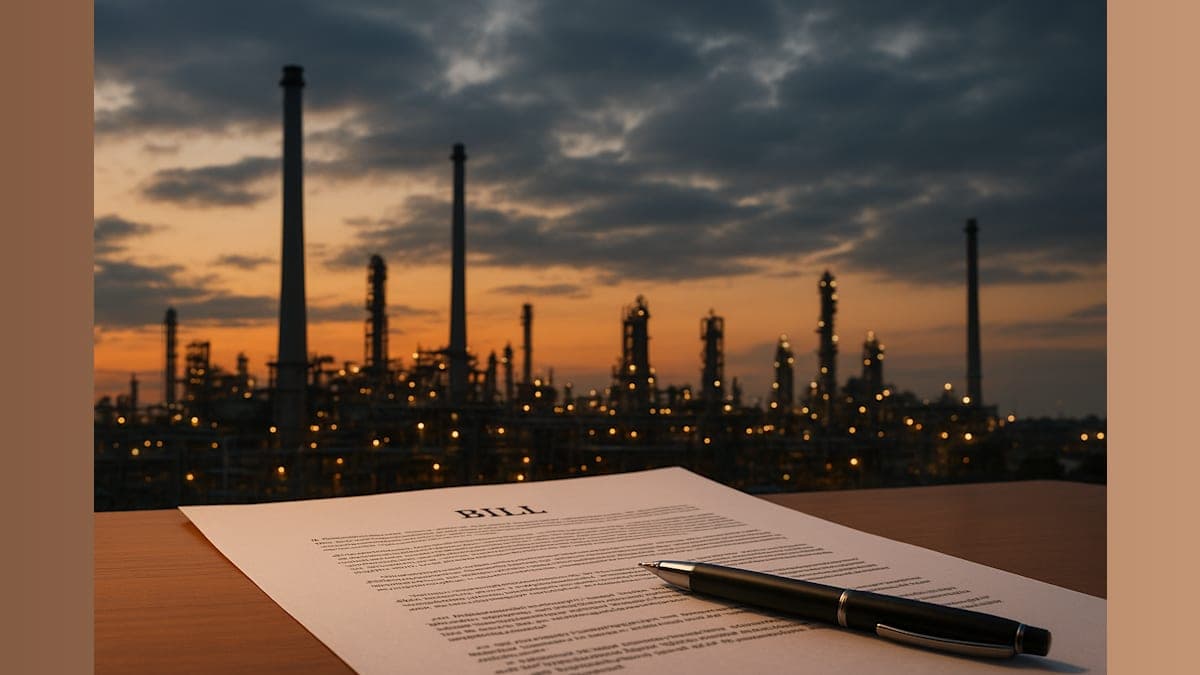
The world's largest oil and gas companies are generating extraordinary profits as crude prices climb during the ongoing U.S.-Israeli conflict with Iran, prompting renewed calls from Democratic lawmakers to impose a windfall profits tax on the industry.
The top 100 oil and gas firms worldwide earned $30 million per hour in excess profits during the early days of the current war, according to an analysis by environmental nonprofit Global Witness and the Guardian. European oil giants alone generated at least $22 billion in the first quarter of 2026, representing a 43 percent increase over the same period in 2025, the organization reported to NPR.
These windfall gains stem from a fundamental market dynamic: while oil prices have surged in response to geopolitical instability, the actual cost of extracting petroleum has remained relatively stable, according to the American Petroleum Institute. The result is unexpected profit margins that some policymakers argue should be shared with struggling consumers.
Democratic Senator Sheldon Whitehouse of Rhode Island has proposed legislation that would capture half of these excess profits and redistribute them to lower-income Americans through tax rebates. The measure, co-sponsored by Democratic Representative Ro Khanna of California, was reintroduced this March after an initial 2022 proposal.
"We're actually somewhat generous about letting [the oil companies] keep half of the excess profits," Whitehouse told NPR, "but we want at least half of it to go back."
The proposed tax would establish a baseline using pre-war oil prices, then calculate excess profits on barrels sold above that benchmark. Companies producing or importing more than 300,000 barrels daily would face the levy, leaving approximately 70 percent of domestic production unaffected, according to Whitehouse's office.
The petroleum industry has mounted strong opposition to the proposal. Dustin Meyer, senior vice president with the American Petroleum Institute, characterized the measure as counterproductive to energy security.
"For investment in any industry," Meyer told NPR, "you need certainty. And proposals like this erode exactly the sort of certainty that is needed to make the investment that has brought the United States to such an unparalleled position of American energy leadership."
Meyer further argued that penalizing energy production during a period of geopolitical tension represents flawed policy. Major oil companies including Chevron, ExxonMobil, and Shell declined to comment on the proposal, while BP directed inquiries to the American Petroleum Institute.
The United States has precedent for such taxation. Congress enacted a windfall profit tax in 1980 following the oil price shocks of the 1970s. However, that measure generated less revenue than projected, partly because oil prices collapsed in the mid-1980s and partly because companies exploited loopholes in the tax structure.
Tyler Priest, a historian of oil and energy at the University of Iowa, explained that the 1980 tax allowed companies to manipulate transfer prices when selling crude to their own refineries, effectively shifting profits to avoid the levy. The current proposal attempts to address such vulnerabilities by using average market prices rather than individual company transactions and by covering both domestic production and imports.
International precedents offer mixed lessons. The United Kingdom implemented a windfall tax on oil and gas production following Russia's invasion of Ukraine in 2022, raising more than $12 billion through the end of fiscal year 2025. The European Union imposed a similar temporary measure that generated nearly $30 billion over two years, with proceeds primarily supporting families facing elevated energy costs.
"Those profits went mainly to support families that were struggling with very high energy bills," Dominic Eagleton, who researches fossil fuels at Global Witness, told NPR.
In April, energy ministers from Austria, Germany, Italy, Portugal, and Spain petitioned the European Commission to reinstate an EU-wide windfall tax in response to current market conditions.
The American proposal faces significant political obstacles. Approximately a dozen senators have endorsed the bill, all Democrats plus Independent Bernie Sanders. Whitehouse acknowledged the measure faces an uphill battle in Congress.
Beyond revenue generation, the Rhode Island senator views the legislation as an opportunity to highlight the economic advantages of renewable energy sources, which have not experienced the price volatility affecting fossil fuels.
"Wind, solar, and battery power, they're not raising their prices," Whitehouse told NPR.
As gasoline prices climb at the pump and oil company profit margins expand, the debate over windfall taxation reflects broader tensions between energy policy, corporate profits, and consumer relief during periods of international crisis.