
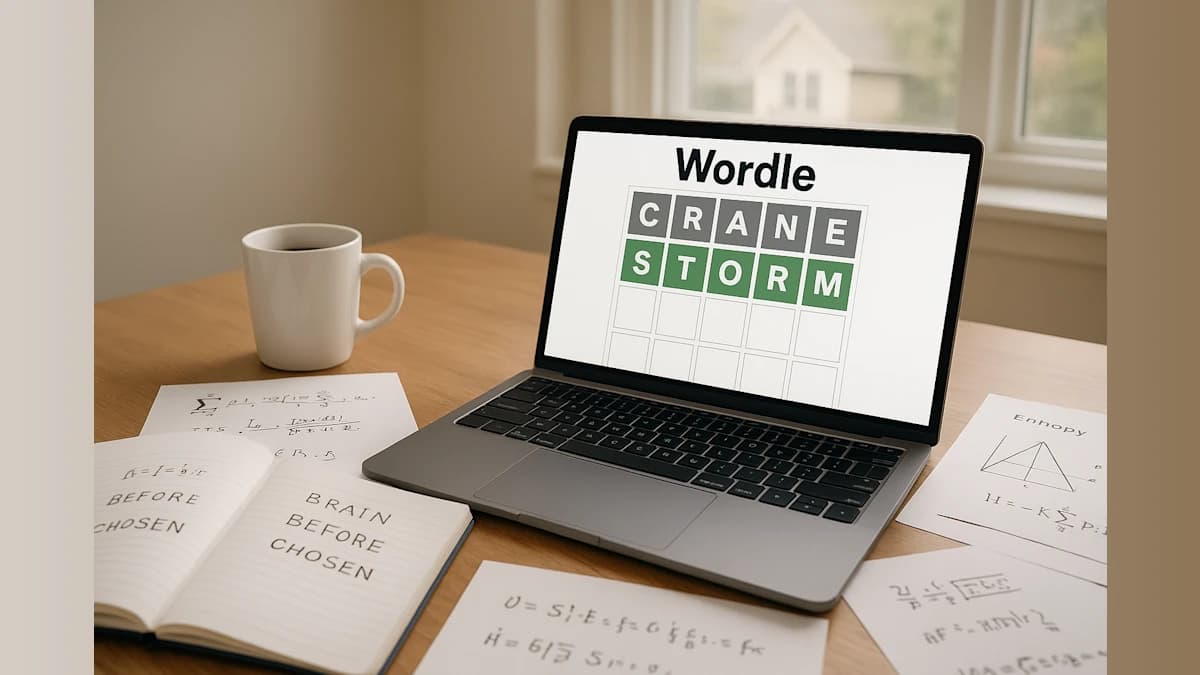
A team of researchers has cracked the code to winning at Wordle with near-perfect accuracy, offering hope to millions of daily players who struggle with the popular word puzzle game.
Scientists from Binghamton University and State University of New York have developed a strategy that solves The New York Times online game with a 99% success rate by applying information theory principles. Their approach dramatically outperforms conventional methods, which achieve only 90% success in simulations.
The research team, led by Assistant Professor Congyu "Peter" Wu, employed Shannon entropy—a mathematical concept that measures uncertainty—to identify which word guesses yield the maximum amount of information. This strategy differs fundamentally from traditional approaches that focus on guessing common letters such as A, E, and R.
The key insight involves prioritizing information gathering over immediate accuracy. Rather than attempting to guess the correct answer from the outset, the method systematically eliminates possibilities by selecting words that reveal the most data about the puzzle's solution.
"Let's say you're at a certain guess. The previous guesses will eliminate a whole bunch of options, and based on the remaining options, guessing some words will send you into a trajectory where information gain is speedier," Wu told Good News Network.
Donald Stephens, a doctoral student at Binghamton University, explained the counterintuitive nature of the approach. A guess does not need to represent the most probable answer, he noted—it simply needs to provide valuable information that narrows down possibilities.
"By applying Shannon entropy, the objective shifts to maximizing the expected reduction in uncertainty rather than the probability of being right. In practice, this approach can lead to solving the puzzle in fewer guesses," Stephens told Good News Network.
For players hoping to implement this winning strategy, the researchers acknowledge that real-time application requires running a computer program alongside the game. Players would input the color-coded feedback Wordle provides after each guess, and the program would calculate the optimal next word to maximize information gain.
In Wordle, players attempt to identify a five-letter word within six guesses. The game provides feedback through color coding: grey indicates a letter does not appear in the solution, yellow shows a correct letter in the wrong position, and green confirms a correct letter in the proper location.
Wu praised his team's achievement for transforming theoretical mathematics into practical application. The work demonstrates how static scientific measurements can become dynamic solutions for real-world challenges, he said, showcasing both deep understanding of complex material and engineering talent.
The complete research, including detailed mathematical explanations and charts, has been published in the Northeast Journal of Complex Systems. The findings offer a scientifically validated path to Wordle mastery for the game's dedicated following of daily players.