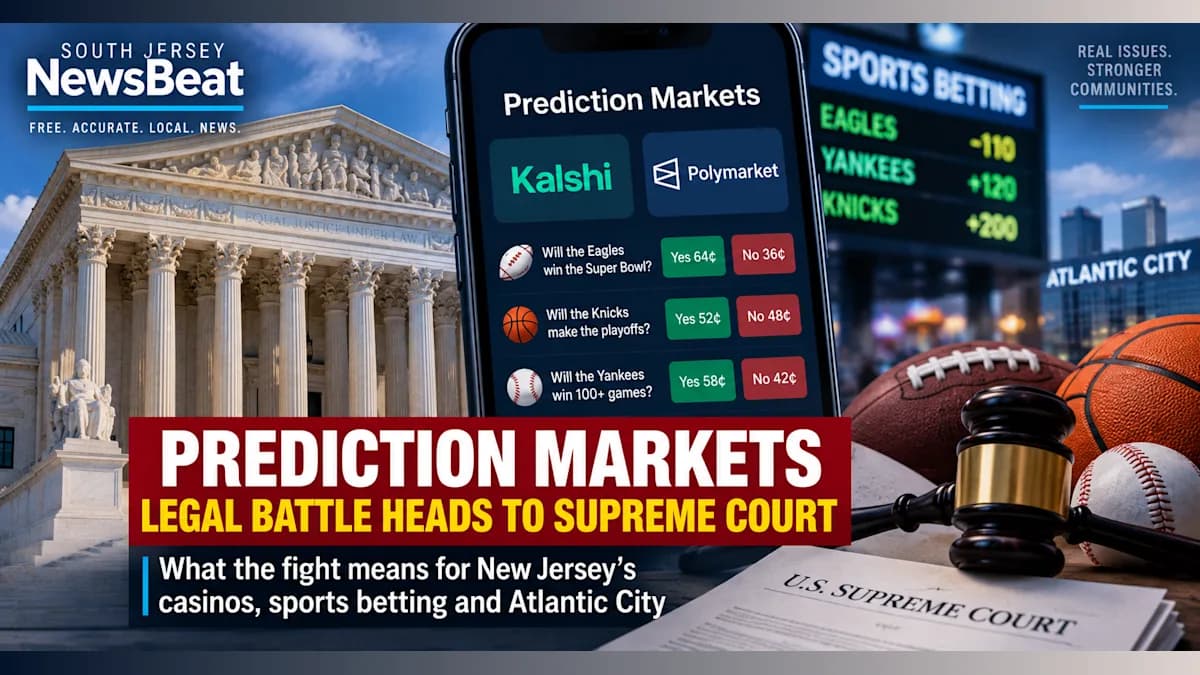
ATLANTIC CITY — A rapidly expanding form of online wagering is putting New Jersey at the center of a national legal battle over who gets to regulate sports betting — states such as New Jersey or federal commodities regulators.
Casino analyst Anthony Marino said Monday that the fight over prediction markets such as Kalshi and Polymarket could have major implications for Atlantic City casinos and New Jersey’s regulated sportsbook industry.

Speaking on The Don Williams Show, Marino described prediction markets as one of the biggest issues currently facing the gaming industry.
“We need clarity,” Marino said. “We need the federal courts, most notably the Supreme Court, to make a ruling.”
That prospect is no longer theoretical.
New Jersey Attorney General Jen Davenport asked the U.S. Supreme Court earlier this month to review a federal appeals court decision involving Kalshi and determine whether states retain authority to regulate sports-related wagering offered through prediction markets.
What is a prediction market?
Prediction markets allow customers to buy and sell contracts tied to whether an event will happen.
Instead of a traditional sportsbook offering odds on which team will win, a prediction market might offer a contract asking whether a particular team will win a game, with users trading “yes” or “no” positions.
Operators argue those products are federally regulated event contracts rather than traditional sports wagers.
Critics — including New Jersey regulators and much of the established gaming industry — argue that when those contracts concern the outcome of sporting events, they effectively function as sports betting.
Marino described the dispute this way:
“They say that they’re regulated by a federal agency,” Marino said, referring to the Commodity Futures Trading Commission.
But he said the practical concern for states is that contracts can look and behave much like bets already regulated under state gambling laws.
New Jersey asks Supreme Court to step in
New Jersey's appeal followed a divided ruling by the U.S. 3rd Circuit Court of Appeals that found federal law gives the CFTC exclusive jurisdiction over the contracts at issue.
The state argues that interpretation improperly prevents New Jersey from enforcing its gambling laws against prediction-market platforms offering sports contracts.
Attorney General Davenport said the case could determine whether states continue to have authority over a major part of the sports-gambling industry.
“Companies like Kalshi claim to offer legal sports betting in all 50 States, but they refuse to follow the gambling laws of any State,” Davenport said when announcing the Supreme Court filing.
The state notes that the dispute has taken on added urgency because different federal courts have reached different conclusions about state authority over prediction markets.
The age difference is significant
One of the sharpest differences highlighted by Marino involves age restrictions.
New Jersey law allows people 21 and older to place legal sports wagers in the state.
Kalshi, by contrast, says an individual generally needs to be only 18 years old to open an account.
Polymarket's U.S. rules similarly state that individual participants generally must be at least 18 and have reached the age of majority where they live.
Marino said that difference is one reason casino and sportsbook operators see an uneven regulatory environment.
Prediction markets, he said, can reach customers who would not legally be able to place a sports wager through a New Jersey sportsbook.
“There are very strict regulatory activities,” Marino said of traditional sportsbooks. “For example, no one below the age of 21.”
44 states have weighed in
Marino also pointed to the unusually broad coalition of states opposing the idea that sports-related prediction markets should escape state gambling regulation.
That claim is supported by the New Jersey Attorney General's Office, which says 44 states, along with hundreds of tribes and casino interests, have weighed in against legal arguments advanced by prediction-market companies.
A coalition of 44 state attorneys general also submitted comments to the CFTC this summer challenging the federal agency's approach to sports prediction markets.
The dispute crosses traditional political lines because it affects states with very different gambling policies.
Some states tightly regulate sports betting. Others prohibit it entirely.
Prediction-market operators, however, have argued their federally regulated contracts can be offered much more broadly.
Why Atlantic City cares
For Atlantic City, the issue reaches beyond legal terminology.
New Jersey's regulated gaming industry operates under state licensing requirements, age limits, responsible-gambling rules and taxation.
Prediction-market operators argue that they fall under a different federal regulatory structure.
Traditional gaming operators contend that allows prediction markets to compete for many of the same customers without facing the same state requirements.
The New Jersey Attorney General's Office said sports betting generated $16.89 billion in revenue for states nationwide in 2025 and cited data showing that sports-related activity accounted for the overwhelming majority of Kalshi's revenue that year.
The fight has grown even more significant as major traditional sportsbook companies explore prediction-market products of their own.
The lines between the two industries are becoming increasingly blurred as DraftKings, FanDuel and other major gaming companies examine or participate in prediction-market offerings.
Supreme Court could reshape sports betting
Whether the U.S. Supreme Court agrees to hear New Jersey's case remains to be seen.
But Marino said the fundamental question needs a definitive answer: If a contract effectively allows a customer to wager on the outcome of a sporting event, can a platform avoid state sports-betting rules simply by structuring that wager as a federally regulated event contract?
New Jersey says no.
Kalshi argues federal law gives the CFTC exclusive jurisdiction.
The answer could determine not only the future of prediction markets but also how much authority states such as New Jersey retain over an industry they have spent years building and regulating.
For Atlantic City casinos and sportsbooks, billions of dollars — and the structure of the legal gaming market itself — could ultimately be at stake.
Anthony Marino appeared on The Don Williams Show, heard Monday through Friday from 6 to 10 a.m. on News Talk 1400 and 92.3 WOND.

About the Author
Scott Stephens
Scott has been an on-air personality, producer and newscaster for 30+ years. He has been a mainstay in the South Jersey Community and on the air across many different area stations. Scott can currently be heard on Kool 98.3 and News Talk 1400 & 92.3 WOND.