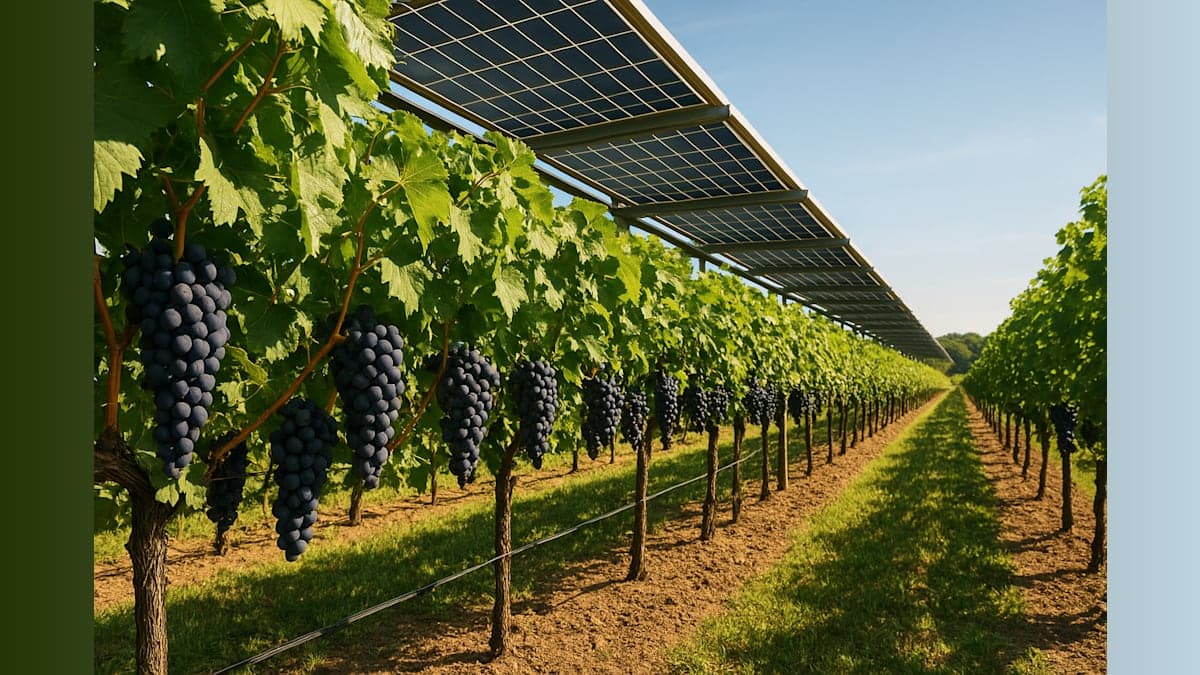
Grapevines cultivated beneath banks of solar panels developed more vigorously and bore heavier fruit than vines grown in full sun, according to a new study from the University of Bari in southern Italy. The research, conducted in the Puglia region, examined how the practice known as agrivoltaics affects viticulture — a question that had not previously been explored in depth.
The experiment took place in a 2.2-acre vineyard planted with 8-year-old vines of the Primitivo variety, also known as Zinfandel. Puglia, which forms the heel of Italy's boot, is known for intense sunlight and a hot Mediterranean climate that supports olives, tomatoes, and grapes.
Researchers found that shoots on the partially shaded vines grew to more than double the length of those on vines exposed to full sun during the growing season. By harvest time, individual grape bunches from the panel-shaded vines weighed nearly three times as much as those from the sun-grown vines.
The berries themselves also showed improved quality. Grapes grown under the panels had lower sugar concentrations and higher levels of organic acids, including polyphenols. According to the study, the healthier profile results from reduced heat stress, easier photosynthesis, and the plant's ability to direct more energy into metabolic processes.
Giuseppe Ferrara, a professor in the University of Bari's Department of Soil, Plant and Food Sciences, told PV Magazine that the results indicate agrivoltaics can deliver substantial benefits for vineyards, though he cautioned that the approach is not universally applicable. Shade tolerance varies by region and grape variety, he noted.
"Certainly, this applies to grapevines, particularly in a hot, dry climate such as Puglia in summer," Ferrara told PV Magazine. "We believe similar results can also be expected for other species under comparable climatic conditions, while always considering the shade tolerance of the species being studied."
The study also points to water savings. In southern Italy, limited rainfall makes irrigation a challenge, and the reduced watering needs of partially shaded grapes could lessen pressure on aquifers and other local water sources while lowering growers' utility costs.
Previous agrivoltaics research has documented a synergistic effect: partial shade helps plants devote less energy to sun protection and more to growth, while increased ground-level humidity beneath the panels moderates the temperature of the panels' circuitry and modestly boosts energy output.
Viticulture in Italy dates to the Bronze Age, and the peninsula's grape varieties have undergone thousands of years of refinement and adaptation — from the Etruscans and Greek settlers to the Romans and modern growers. The latest findings suggest that pairing vines with solar panels may become another chapter in that long tradition of experimentation.