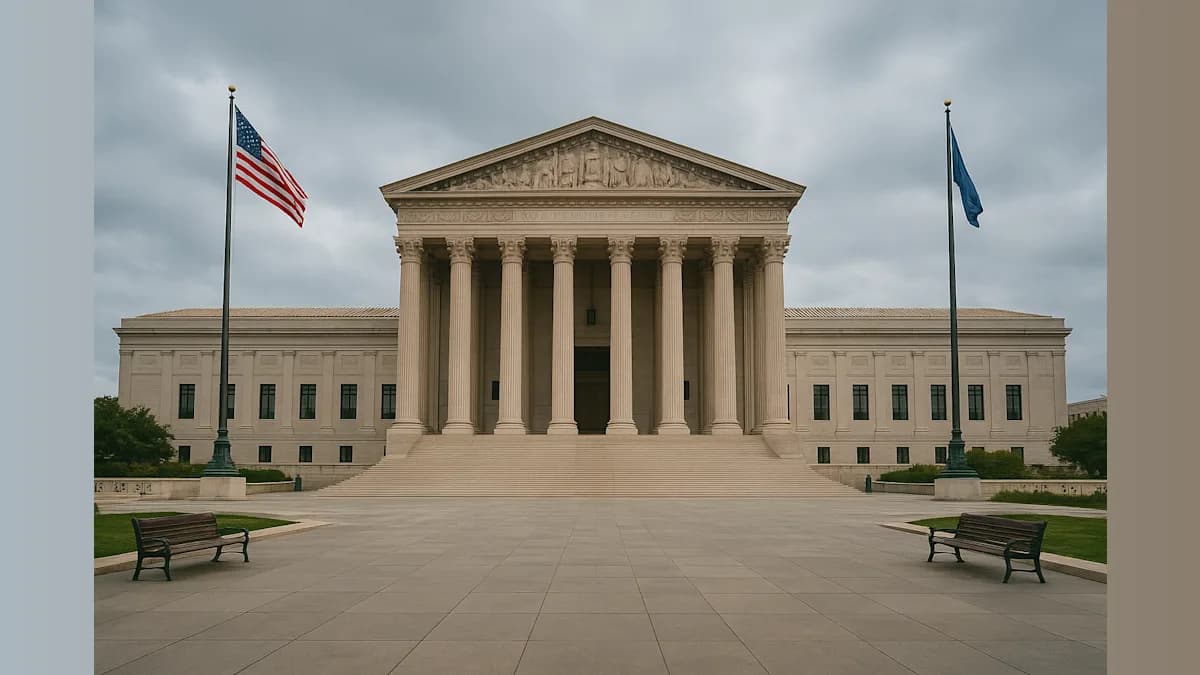
The United States Supreme Court delivered a significant ruling on Tuesday that fundamentally alters the landscape of campaign finance law, striking down decades-old limits on how much political parties may raise and spend on candidates.
In a 6-to-3 decision that divided along ideological lines, the court ruled that restrictions enacted in 1974 violate political parties' First Amendment rights. Justice Brett Kavanaugh authored the majority opinion in the case, which centered on provisions of the Federal Election Campaign Act passed in the aftermath of the Watergate scandal.
The law in question had imposed limits on both the amount of money individuals can contribute to political parties and the amount parties can spend on their candidates. While other political organizations such as political action committees and Super PACs already operate without fundraising or spending limits, those entities cannot coordinate directly with candidates. Political parties, by contrast, work hand-in-hand with their nominees.
The practical effect of Tuesday's ruling is that political parties now enjoy what some observers characterize as the best of both worlds: the ability to coordinate with candidates while simultaneously raising unlimited funds. This represents a substantial shift in the balance of power within the campaign finance ecosystem.
The challenge to the law was brought by Republicans, including Vice President Vance and the National Republican Senatorial Committee, who argued that the restrictions unconstitutionally burdened political parties' First Amendment rights. The Trump Justice Department supported their position, contending that the only legitimate justification for such limits would be preventing corruption, and asserting that no evidence demonstrates the law achieved that goal.
This decision overturns a 2001 Supreme Court precedent that had upheld the constitutionality of party spending limits. It represents the latest chapter in a sustained judicial dismantling of campaign finance regulations that began in earnest in 2010.
That year, the court issued its landmark Citizens United ruling, establishing that corporations possess a First Amendment right to unlimited election spending. The following year, the court invalidated Arizona's public election financing system, which had provided additional funds to less-wealthy candidates to level the playing field. In 2014, the court eliminated aggregate limits on individual donations in national elections. Each of these decisions followed the same pattern as Tuesday's ruling: ideologically divided votes resulting in the elimination of regulations deemed to burden First Amendment rights.
The full implications of the ruling remain uncertain. Lawyers representing the Democratic Party, who intervened in the case to defend the existing restrictions, had warned that eliminating the limits would create obvious potential for actual or apparent corruption. They argued that authorizing unlimited coordinated expenditures would fundamentally reshape the campaign finance regime.
The Democratic Party's position carried additional weight because the Supreme Court had previously cited these anti-corruption protections as justification for rolling back other campaign finance regulations, suggesting that those other changes were safe precisely because party spending limits remained in place.
Republican lawyers who brought the challenge dismissed concerns about corruption, arguing in their brief to the court that the concept of a party corrupting its own candidates is illogical. They contended that influencing a candidate's stance is the fundamental purpose of a political party, making the notion of corruption in that relationship nonsensical.
The decision arrives as the nation approaches a major election cycle, though its immediate practical effects on fundraising and campaign strategy remain to be seen. Political parties and campaign finance experts will now work to understand how the new legal landscape will reshape the mechanics of electoral politics at every level of government.