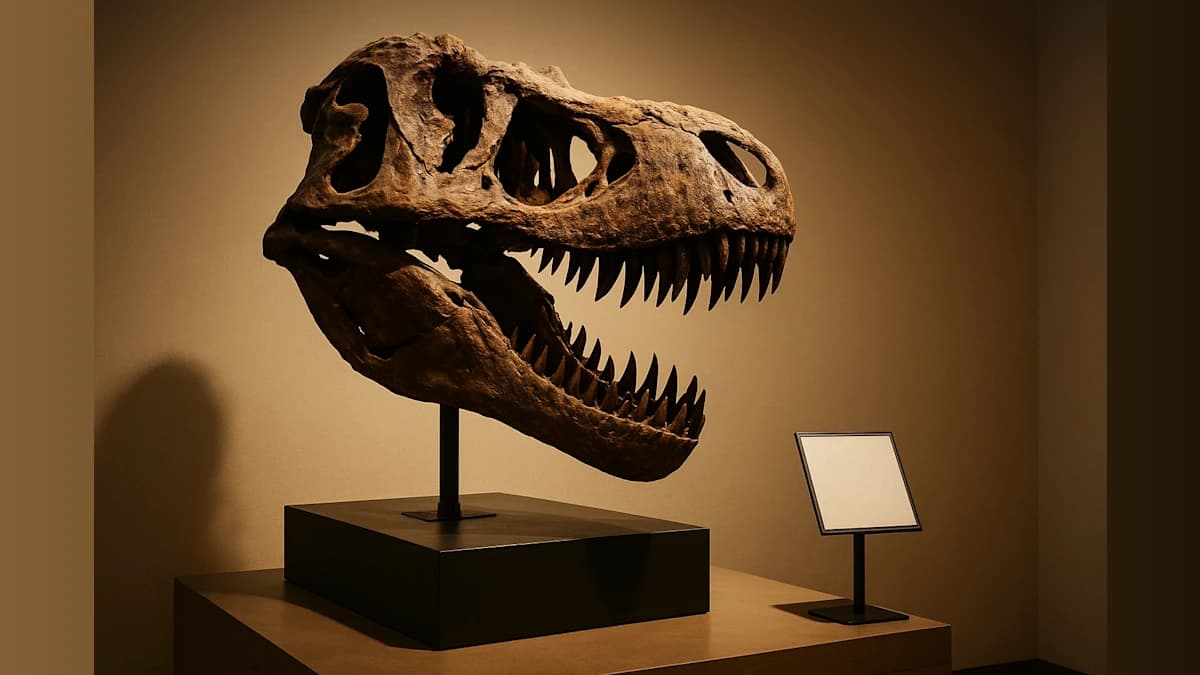
A massive Tyrannosaurus rex fossil has shattered auction records, selling for $50.1 million to an unidentified buyer during a competitive bidding session at Sotheby's in New York on Tuesday, July 14, 2026.
The 67-million-year-old specimen, known as 'Gus,' now holds the distinction of being the most expensive set of dinosaur bones ever auctioned. The sale surpasses the nearly $45 million paid for a stegosaurus in 2024 and the $32 million record set by another T. rex skeleton called 'Stan' in 2020.
The fossil represents an extraordinary find in the world of paleontology. Standing approximately 12 and a half feet tall and stretching 38 feet in length, the adult dinosaur is roughly 61 percent complete. The specimen includes an exceptionally well-preserved skull featuring the species' characteristic powerful teeth, two well-represented feet, and several rarely discovered bones including a furcula, commonly known as a wishbone.
"Gus is not only an exceptional find, but a specimen that's been excavated, documented, prepared, and cared for with real excellence," Cassandra Hatton, Sotheby's vice chair, said after the sale was completed, according to The Associated Press. "The market responds when great specimens are taken care of in the right way."
The fossil was unearthed in 2021 on a ranch in South Dakota. Its nickname honors Gary Licking, the property owner who died during the approximately five-year process of excavation, restoration, and mounting.
Seven prospective buyers competed during the 10-minute bidding battle. The winning bidder, who participated by telephone and wishes to remain anonymous, exceeded pre-sale estimates that had projected the fossil would sell for between $20 million and $30 million. Auctioneer Phyllis Kao encouraged bidders during the proceedings, at one point urging them to "try a bigger bite" because "it's a T. rex, after all."
The sale has prompted calls from the scientific community for the fossil to be placed in a public institution. The Society of Vertebrate Paleontology, representing scientists, scholars, and students, emphasized that scientifically significant fossils should remain accessible for research and education rather than entering private collections.
"Our hope is that the new owner recognizes the extraordinary scientific and educational value of Gus the T. rex and that they aim to keep it in the public trust by immediately donating it to an accredited natural history museum," Kristi Curry Rogers, the society's president-elect, said in a statement Tuesday, according to The Associated Press. "That outcome would ensure that this remarkable specimen continues to advance science, rather than becoming unavailable for study."
Several previous record-breaking dinosaur fossils have found homes in museums. The stegosaurus known as "Apex" is currently on long-term loan to the American Museum of Natural History in Manhattan. "Sue," a T. rex that became the first dinosaur sold at auction in 1997, serves as a centerpiece at the Field Museum in Chicago. "Stan," the previous T. rex record holder, is displayed at the Natural History Museum Abu Dhabi.
Tyrannosaurus rex dominated the food chain during the late Cretaceous period. The species, whose name translates roughly to "King of the Tyrant Lizards," roamed what is now western North America when the region featured warm climates, high sea levels, and coastal floodplains that supported large herbivores such as triceratops.
The dinosaur has become deeply embedded in popular culture, from children's entertainment to major film franchises, making it perhaps the most recognizable prehistoric creature. Its distinctive features—a fearsome jaw and disproportionately small arms—have made it an enduring symbol of the age of dinosaurs.