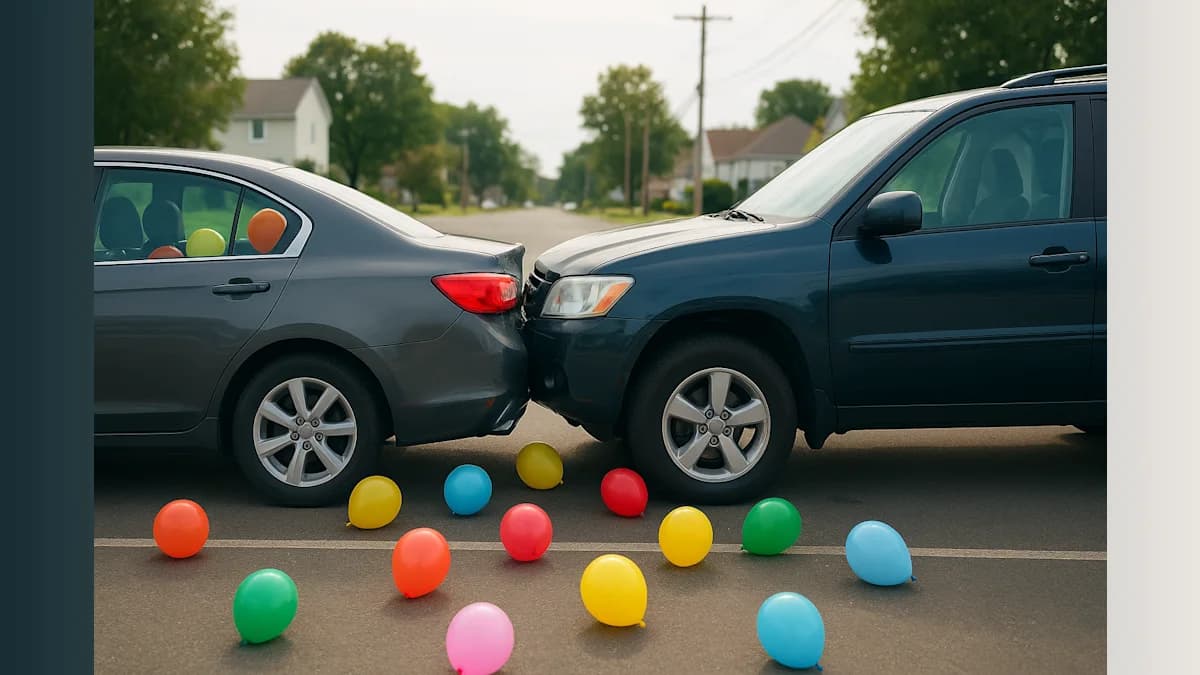
A car accident on a Vienna sidewalk became an unlikely testament to the power of immediate compassion when Matthias Hombauer, unable to see through fifteen birthday balloons filling his rear window, reversed at full speed into a stranger's brand-new SUV.
What happened next defied the typical script of such confrontations. Rather than retreating into defensiveness or launching into apologies, Hombauer found himself walking slowly toward the furious, trembling driver and extending his arms for an embrace.
The gesture was not calculated. Hombauer, a former molecular biologist who transitioned into concert photography before becoming a life coach, describes the action as something that moved through him without conscious decision. He acknowledges the strangeness of his own behavior, noting that he never addresses strangers as brother—yet the word emerged naturally in that charged moment, and something shifted in the other man's demeanor.
The incident crystallizes a question Hombauer has explored in his coaching work: the distance between the principles people espouse in calm moments and their capacity to embody those values when tested by real circumstances. He has developed a practice centered on documenting the relentless inner commentary that runs through daily life—commentary he estimates is ninety percent negative—and then deliberately transforming those patterns through forgiveness into affirmations of authentic identity.
The contrast between theory and practice became vivid on that Vienna street. Declaring a belief in the inherent goodness of all people while seated comfortably at home requires little courage. Maintaining that conviction while facing an enraged stranger whose property you have just damaged demands something more substantial.
The collision carried an additional layer of synchronicity. The damaged vehicle belonged to a father transporting balloons for his ten-year-old child's birthday celebration—the same age as Hombauer's own child. The parallel was not lost on either man.
After exchanging insurance information, Hombauer took an unusual step. He mailed a book to the other driver's address, including a drawing of the crash scene so the recipient would understand the sender's identity. The gesture bridged the gap between a moment of destruction and an attempt at connection.
One day later, Hombauer's phone rang. The other driver was calling back.
The episode suggests that collisions—whether between vehicles or between people—sometimes serve purposes beyond the immediate damage they cause. What appears to be error or fault may function as an opening, a rupture in routine that creates space for encounters that would not otherwise occur. The question becomes whether those involved can recognize such moments and respond with something beyond anger or blame.
For Hombauer, the accident became a public examination of whether his professional teachings could withstand the pressure of an actual crisis. The answer arrived not through perfect execution but through an instinctive movement toward rather than away from difficulty—a hug offered before words, connection attempted before calculation.
The fifteen balloons that obscured his vision became, in retrospect, less an explanation for the crash than a symbol of the obstacles that prevent clear sight in daily interactions. What matters, his experience suggests, is not the absence of such obstructions but the willingness to step forward with open arms when they inevitably cause collision.