ATLANTIC CITY, N.J. — More than 5,000 Atlantic County jobs could be exposed to economic disruption over the next decade even without casinos opening in North Jersey, according to a new analysis of Atlantic City's gaming industry.
Under a more severe scenario that includes new casinos at the Meadowlands and Monmouth Park, that number climbs to more than 8,000.
Casino analyst Anthony Marino says the findings should serve as a warning to South Jersey's political and business leaders.

“Stop fighting,” Marino said Monday on Off The Press with Scott Cronick on WOND. “Politicians, stop fighting and look at the data.”
Marino was discussing the Atlantic County Economic Alliance's new Greater Atlantic City Casino-Hotel Employment Exposure Assessment, an extensive examination of how online gambling, New York City casinos, a potential recession and possible North Jersey casino expansion could affect Atlantic County.
The study does not predict that 5,105 or 8,005 people will lose their jobs.
Instead, it describes those positions as jobs “in exposure” — employment that could be affected under different economic scenarios.
But Marino believes the risks outlined in the report are real enough that South Jersey should begin preparing now.
“I think the ACEA has done a great job in explaining what the problems are, what is possibly going to happen,” Marino said.
5,105 Jobs Exposed Even Without North Jersey Casinos
The study examines several possible futures for Atlantic City's casino industry through 2035.
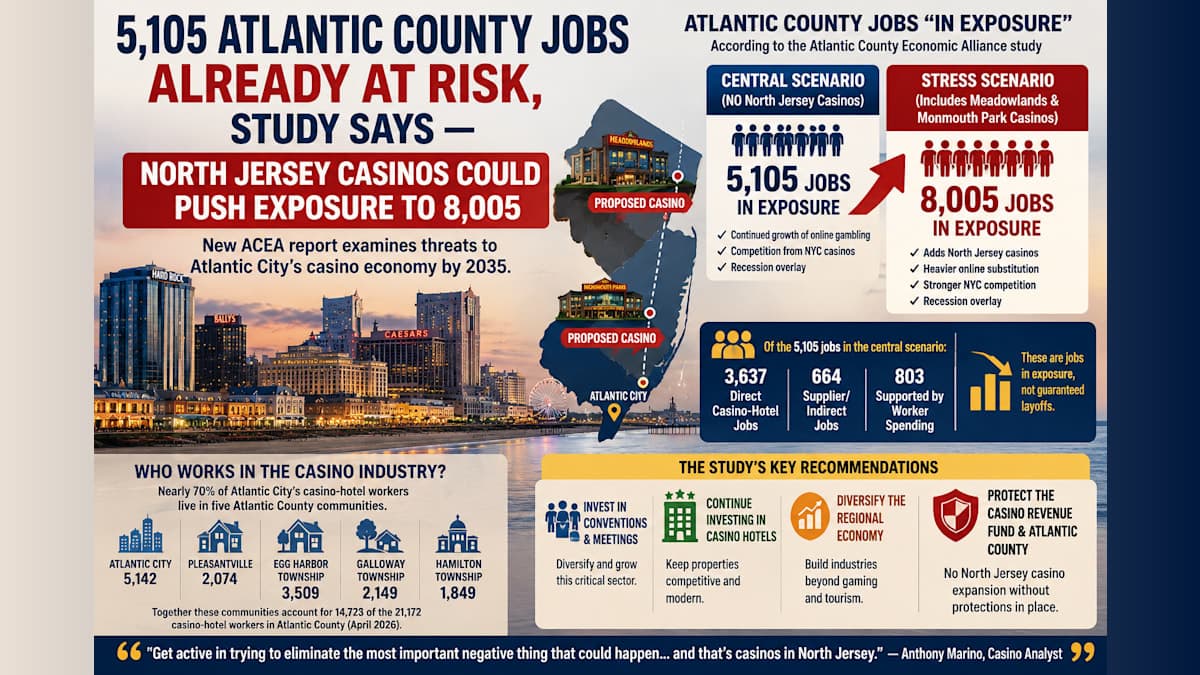
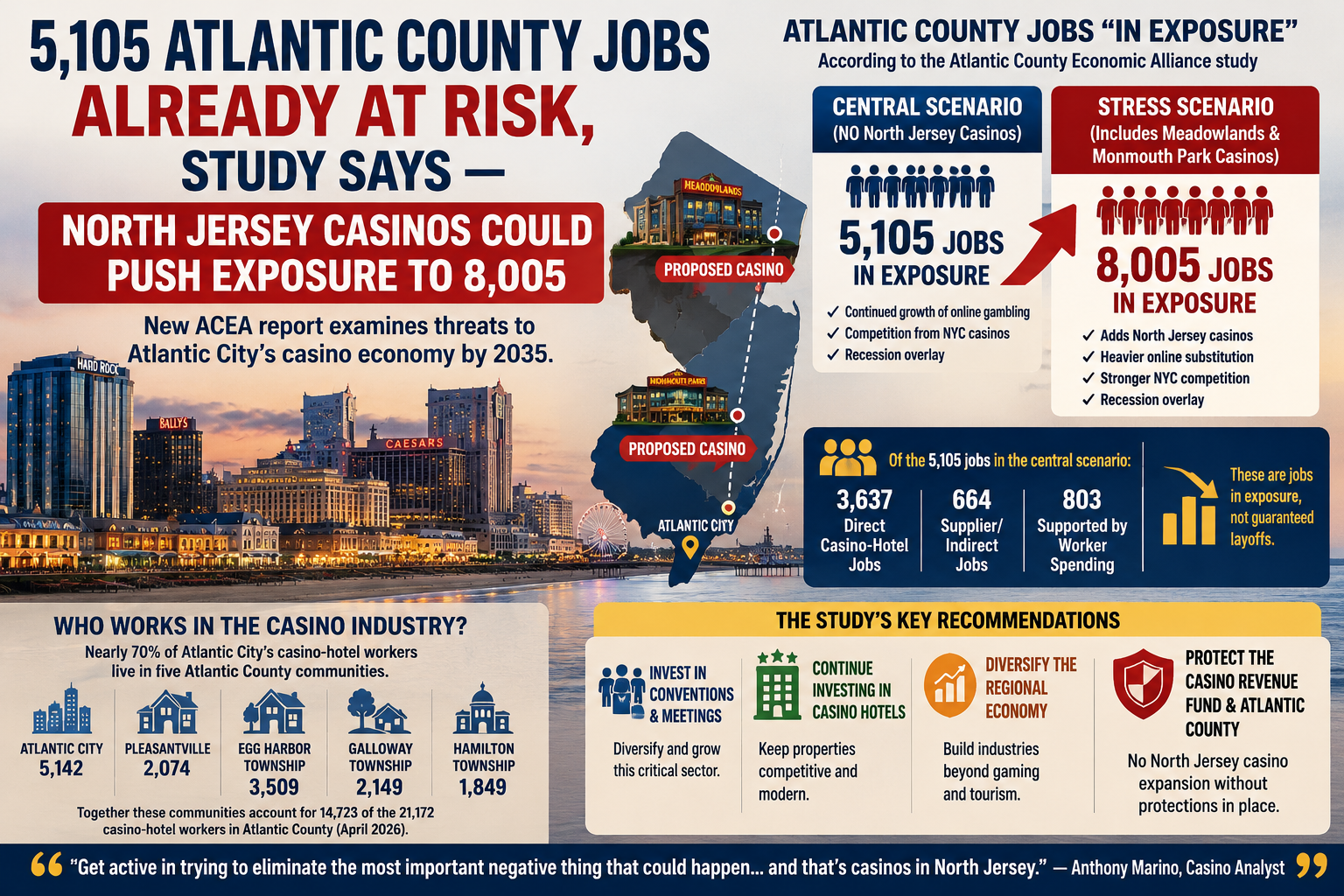
Under the report's adopted central scenario, 5,105 Atlantic County jobs are placed in exposure.
Significantly, that scenario does not assume casinos will open in North Jersey.
Instead, it models the continuing shift toward online gambling, increased competition from New York City casinos and a recession overlay.
The study estimates $814.6 million in Atlantic City brick-and-mortar gaming revenue could be exposed under that scenario.
Of the 5,105 jobs potentially affected, approximately 3,637 are direct casino-hotel jobs, with another 664 jobs tied to suppliers and 803 supported by spending from workers.
Marino said the report should be viewed as a planning document rather than a prediction of inevitable collapse.
The question, he said, is what South Jersey does with the warning.
North Jersey Raises the Stakes
The study's stress scenario adds another major threat: casinos at the Meadowlands and Monmouth Park.
Under that scenario, the number of Atlantic County jobs in exposure increases to 8,005, representing about $401.8 million in worker earnings and $1.8 billion in economic output.
“We can't control what's happening in New York,” Marino said. “That's happening. That's going to have an impact.”
North Jersey, however, is another matter.
“We can control the possibility of casinos in North Jersey,” Marino said.
He argues South Jersey chambers of commerce, elected officials, casino interests and other business organizations should present a united front in Trenton.
“They all have to be on the same page,” Marino said.
The analyst rejected the idea that the ACEA report is unnecessarily alarmist.
“Not only did he say, here are the alternatives, he gives you a lot of data to show why he thinks his conclusions are accurate,” Marino said of report author Max Slusher, ACEA's director of business development. “And I think his conclusions are accurate.”
But Marino emphasized an important qualification.
He isn't saying every scenario in the report will occur.
“If this happens, this will certainly happen,” Marino said, describing the report as the type of analysis businesses use to identify potential external threats.
Atlantic City's Online Gambling Paradox
Underlying the report is a dramatic transformation in New Jersey gambling.
Internet casino gaming generated approximately $2.91 billion in 2025, surpassing the approximately $2.89 billion generated on Atlantic City's physical casino floors for the first time.
For New Jersey, that's a significant source of tax revenue.
For Atlantic City's employment base, the implications are more complicated.
Online gambling doesn't require the same workforce as a casino hotel filled with table games, slot machines, restaurants, hotel rooms and entertainment venues.
Direct Atlantic City casino-hotel employment stood at 21,172 in April 2026, according to the ACEA study — the lowest level in the report's nine-year April employment series.
Marino said the rapid growth of iGaming is increasingly difficult to ignore.
“iGaming continues to grow almost every month at double digits, while regular gaming, in-person brick-and-mortar gaming, land-based, no matter what you call it, it's the same thing,” Marino said.
To generate that traditional casino-floor revenue, he added, “You have to come here to Atlantic City to play the slot machine or a table game.”
Why a North Jersey Convention Center Could Matter Just as Much
Marino is particularly concerned about proposals that could pair a North Jersey casino with expanded convention facilities.
“Casinos in North Jersey would hurt the business,” Marino said. “More importantly, if they also have a convention center, that's even worse.”
That's because conventions and meetings are one of the areas the ACEA study identifies as an opportunity for Atlantic City to diversify its economy and protect hospitality employment as gambling increasingly moves online.
Convention business still requires hotel workers, banquet employees, food-service workers, transportation, audiovisual services and other jobs similar to those already supporting Atlantic City's casino resorts.
A major casino and convention complex in North Jersey could therefore compete with Atlantic City not only for gamblers but for the nongaming business the resort is counting on to diversify.
“You already have a functioning operation down here, a functioning convention center here,” Marino said. “Keep supporting that.”
Five Communities Have Much at Stake
The potential economic impact is heavily concentrated within Atlantic County.
According to the ACEA study, nearly 70% of Atlantic City's casino-hotel employees live in five communities: Atlantic City, Pleasantville, Egg Harbor Township, Galloway Township and Hamilton Township.
Together, those municipalities account for 14,723 of the 21,172 casino-hotel workers counted in the report.
Atlantic City and Pleasantville alone account for roughly one-third of the industry's workforce.
That means a significant contraction in casino employment would extend well beyond the Boardwalk and Marina District.
Marino called the casino industry the dominant economic engine not only for Atlantic City but for Atlantic County and much of South Jersey because of its connection to the broader tourism economy.
Warning, Not Prediction
The ACEA report examines four scenarios.
Its most favorable scenario puts 1,490 Atlantic County jobs in exposure. A moderate scenario raises the figure to 4,647.
The central scenario places 5,105 jobs in exposure.
And the stress scenario, including potential North Jersey casino expansion, pushes the figure to 8,005.
The authors repeatedly caution that those numbers should not be interpreted as forecasts of actual layoffs.
They are intended to help policymakers understand the scale of employment that could be vulnerable if various threats materialize.
The report recommends strengthening Atlantic City's meetings and convention business, continued investment in casino-hotel properties, greater diversification of the regional economy and protections for Atlantic County and the Casino Revenue Fund before any North Jersey casino expansion moves forward.
Marino says South Jersey should take the analysis seriously before those threats become realities.
“Get active in trying to eliminate the most important negative thing that could happen according to that ACEA report,” Marino said, “and that's casinos in North Jersey.”
For a region where thousands of families remain directly or indirectly tied to the casino economy, Marino's message is that the time to prepare isn't after those jobs disappear.
It's now.

About the Author
Peter Killeen
A 25-year radio news veteran, Peter covers South Jersey for NewsTalk 1400 & 92.3 WOND radio. Known for his concise and impactful delivery, he ensures listeners and readers stay informed without unnecessary filler.