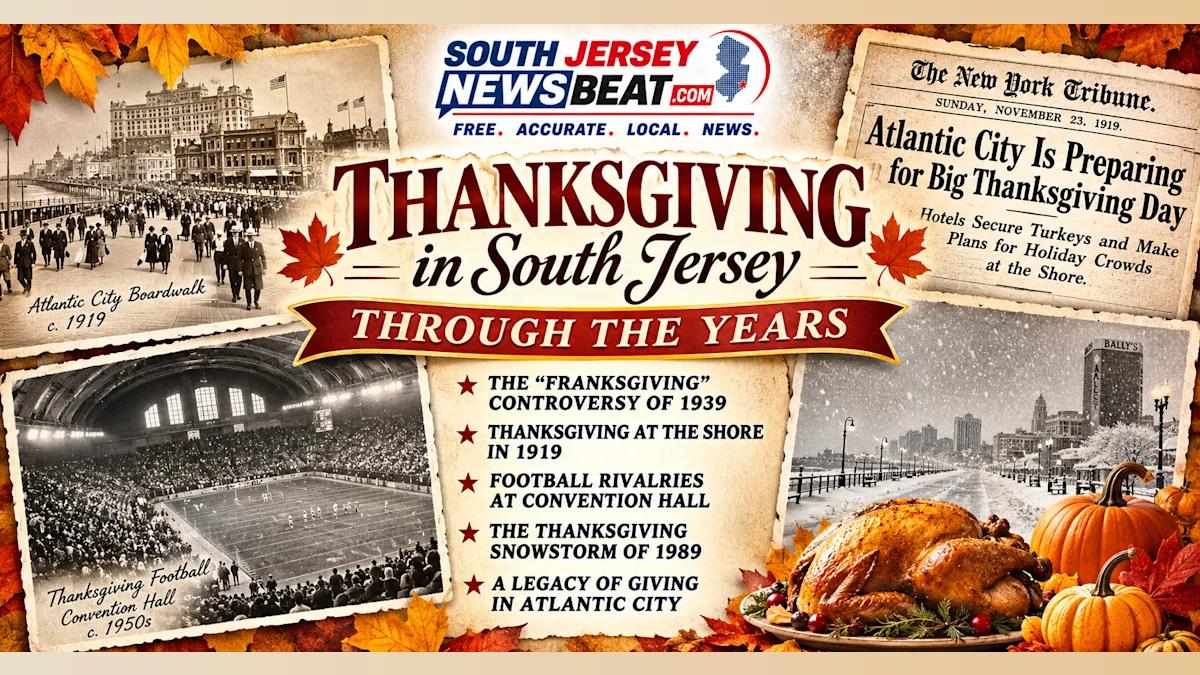
From crowded Atlantic City hotels in 1919 and the infamous “Franksgiving” controversy of 1939 to football games inside Convention Hall and a memorable Thanksgiving snowstorm, South Jersey has a rich holiday history all its own.
As South Jersey families gather around their Thanksgiving tables today, they are continuing a tradition that has brought generations of local residents together through good times, economic hardships, fierce football rivalries and memorable storms.
But Thanksgiving in South Jersey has not always looked quite the way it does today.
More than a century ago, Atlantic City was already a popular destination for Thanksgiving travelers. In 1939, the resort became part of a national controversy over when Americans should celebrate the holiday. For decades, thousands of football fans packed Atlantic City's Convention Hall to cheer on their favorite high school teams.
And 37 years ago, South Jersey residents woke up to a Thanksgiving morning covered in snow.
A look back through historical newspaper accounts and local archives reveals some fascinating chapters in South Jersey's Thanksgiving history.
When Atlantic City Was a Thanksgiving Vacation Destination in 1919
Long before casino gambling arrived in Atlantic City, the resort was attracting visitors from across the Northeast for the Thanksgiving holiday.
An article published in the New York Tribune on Nov. 23, 1919, and preserved by the Library of Congress, carried the headline “Atlantic City Is Preparing for Big Thanksgiving Day.”
At the time, Thanksgiving dinner was already big business along the Boardwalk.
Despite rising turkey prices, hotel managers and restaurant operators had made arrangements to ensure they would have enough food for the anticipated holiday crowds.
Some had secured their turkeys directly from farms, while others had placed orders in advance of the holiday rush.
The newspaper reported that Atlantic City was expecting an exceptionally large Thanksgiving crowd, with families from New York and other cities reserving tables for holiday gatherings.
For some visitors, dining at the shore offered an appealing alternative to the expense and work associated with preparing a large Thanksgiving dinner at home.
The holiday was also an opportunity to enjoy South Jersey's relatively mild coastal weather. Golfers were hoping for favorable conditions for special holiday events in Northfield and at Seaview, while warmer November temperatures had encouraged recreational boating.
The report offers a glimpse into Atlantic City's tourism industry more than a century ago, when Thanksgiving visitors were drawn to the resort's hotels, restaurants, recreation and ocean air.
Many of those same attractions continue to bring holiday visitors to the Jersey Shore today.
Atlantic City's Connection to the Great Thanksgiving Controversy of 1939
Imagine waking up one November and discovering that the president had moved Thanksgiving.
That is essentially what happened in 1939, when President Franklin D. Roosevelt decided to celebrate Thanksgiving one week earlier than Americans had traditionally expected.
At the time, Thanksgiving was customarily observed on the last Thursday in November, following a tradition established by President Abraham Lincoln in 1863.
In 1939, that placed Thanksgiving on Nov. 30, leaving retailers with a relatively short Christmas shopping season.
With the country still recovering from the Great Depression, Roosevelt moved the holiday to Nov. 23 in hopes that additional shopping days would stimulate the economy.
The decision was not universally welcomed.
Football schedules had already been established. Calendars had been printed. Schools, businesses and families had made plans around the traditional holiday date.
Atlantic City had its own concerns.
According to historical research published by the National Archives, New Jersey's hotel association publicly raised concerns in August 1939 about the impact of the change on conventions already scheduled in Atlantic City.
The resort's mayor at the time, Charles D. White, is associated with a nickname that became part of the national Thanksgiving controversy.
Historical accounts credit Atlantic City's mayor with calling Roosevelt's revised holiday “Franksgiving,” combining the president's first name with Thanksgiving.
The country was divided over which date to observe.
According to the National Archives, 32 states followed Roosevelt's proclamation in 1939, while 16 retained the traditional last-Thursday observance.
The controversy continued into subsequent years until Congress intervened in 1941, establishing Thanksgiving as the fourth Thursday in November.
Roosevelt signed the legislation on Dec. 26, 1941.
Today, Americans celebrate Thanksgiving on a date established following a national dispute in which Atlantic City played a small but memorable role.
When Thanksgiving Football Packed Atlantic City's Convention Hall
For generations of South Jersey residents, Thanksgiving was about more than turkey, stuffing and pumpkin pie.
It was also about football.
This year marks 100 years since Atlantic City High School and Holy Spirit High School first met on the football field in 1926.
Atlantic City won that inaugural meeting, 28-18, beginning a rivalry that would become one of the region's most recognizable sporting traditions.
But one of the most remarkable chapters in the rivalry's history took place indoors.
For roughly three decades, beginning in the 1940s and continuing through 1975, the Vikings and Spartans played on Thanksgiving Eve inside Atlantic City's Convention Hall, now known as Jim Whelan Boardwalk Hall.
According to longtime South Jersey sportswriter David Weinberg, the games regularly attracted more than 10,000 spectators.
A 2015 retrospective published by The Philadelphia Inquirer recalled that the indoor playing field required shortened end zones because a full-length regulation field could not fit inside the building.
It was an unusual setting for high school football, but the rivalry had become one of Atlantic City's biggest sporting events.
Families, former classmates, alumni and neighbors gathered to cheer for their respective schools, creating lasting memories that extended well beyond the final score.
Other communities throughout South Jersey developed Thanksgiving football traditions of their own.
Ocean City and Pleasantville first met in 1917 and played on Thanksgiving for the first time in 1921, with Pleasantville winning 7-0.
In Cumberland County, the historic Millville-Vineland rivalry produced a memorable Thanksgiving matchup in 1955.
An estimated 12,000 spectators crowded around Millville's Wheaton Field, with some finding viewing spots on nearby rooftops.
For many South Jersey families, the Thanksgiving football game became an annual reunion, bringing former residents back to their hometowns and connecting generations of graduates.
While schedules and traditions have changed over the years, memories of those holiday games remain an important part of South Jersey's sporting history.
The Thanksgiving Snowstorm of 1989
While South Jersey residents contend with a coastal storm this Thanksgiving, longtime residents may remember a holiday when the region was dealing with a different kind of weather emergency.
On Nov. 23, 1989, a late-November snowstorm delivered a rare white Thanksgiving to much of the Northeast, including the Jersey Shore.
According to a United Press International report published on Thanksgiving Day, Atlantic City received six inches of snow, while Mays Landing recorded eight inches.
The storm disrupted holiday travel and forced the postponement of high school football games.
Former Atlantic City High School athletic director Frank Campo shared his memories of the storm in a 2021 retrospective published by WPG Talk Radio.
Determined to keep the annual Atlantic City-Holy Spirit Thanksgiving football game on schedule, Campo visited Bader Field on Thanksgiving Eve to assess the conditions.
“About 9 p.m. I walked onto the field and was in snow drifts above my knees,” Campo recalled.
Campo ultimately decided to postpone the game until Saturday, leaving school personnel with the difficult task of preparing the snow-covered field.
Holy Spirit went on to win the rescheduled game, 7-6.
For South Jersey residents who experienced the storm, the Thanksgiving of 1989 remains a reminder of how unpredictable November weather can be along the Jersey Shore.
Sister Jean and the Tradition of Feeding Atlantic City's Hungry
Some of South Jersey's most meaningful Thanksgiving traditions have little to do with tourism, football or holiday shopping.
They instead reflect the generosity of people who have dedicated themselves to helping their neighbors.
Few individuals embodied that spirit more than Atlantic City's Sister Jean Webster.
According to the Atlantic City Free Public Library's historical records, Webster moved to Atlantic City as a young child and eventually established a career in the hospitality industry.
She became the first woman hired as a cook at the historic Marlborough-Blenheim Hotel and later the first female chef at Caesars.
While working at the Playboy Casino, Webster used money she had intended to spend on a Jitney ride to purchase food for a person experiencing homelessness.
She walked to work instead.
That simple act of kindness grew into a much larger mission. Webster began preparing meals for people in need from her own home, paying for food herself.
Her operation eventually relocated to Victory First Presbyterian Church, where an annual Thanksgiving dinner became one of its cherished traditions.
At times of particularly high demand, the kitchen served as many as 800 people in a single day.
Webster died in January 2011 at the age of 76, leaving behind a legacy of community service that continues to inspire Atlantic City.
Her story is particularly relevant today, as local food banks, churches, charitable organizations, businesses and volunteers continue working to ensure South Jersey families have enough to eat during the holidays and throughout the year.
A South Jersey Statesman's Role in Establishing Thanksgiving
New Jersey's connection to the national Thanksgiving holiday stretches back even further than Atlantic City's Boardwalk or the controversy surrounding Roosevelt's decision in 1939.
In fact, one of the nation's earliest Thanksgiving proclamations can be traced in part to a New Jersey congressman with ties to Burlington County.
Elias Boudinot, a Revolutionary War-era statesman who later served in the United States House of Representatives, introduced a resolution on Sept. 25, 1789, calling for the president to designate a national day of thanksgiving.
Boudinot wanted Americans to express gratitude for the peaceful establishment of their new government and Constitution.
Congress approved a resolution requesting a presidential proclamation, and President George Washington subsequently designated Thursday, Nov. 26, 1789, as a national day of thanksgiving.
It was the first national Thanksgiving observance under the United States Constitution.
Boudinot later served as director of the United States Mint and spent his final years in Burlington, where he died in 1821.
There is also an interesting historical coincidence this Thanksgiving.
Today's date, Thursday, Nov. 26, 2026, is exactly 237 years after the Thanksgiving observance designated by Washington in 1789.
More Than Two Centuries of Thanksgiving Memories
South Jersey has changed dramatically over the years.
Many of Atlantic City's grand historic hotels have disappeared. Thanksgiving football games are no longer played inside Convention Hall. The national debate over which Thursday should mark the holiday has long since been settled.
But the traditions of gathering with family, welcoming visitors, renewing old friendships and helping neighbors in need have endured.
From the hotel chefs preparing Thanksgiving feasts along the Boardwalk in 1919 to the thousands of football fans cheering inside Convention Hall, the volunteers serving meals to those in need and the families digging out from the snow in 1989, each generation has added its own chapter to South Jersey's Thanksgiving story.
And today, another generation will create memories of its own.
Perhaps decades from now, South Jersey residents will be looking back at Thanksgiving 2026, recalling the powerful coastal storm, how they celebrated and the people with whom they shared the holiday.
What are your favorite South Jersey Thanksgiving memories? Whether it's attending a high school football game, enjoying dinner at one of Atlantic City's historic hotels or celebrating a family tradition that has been passed down through generations, we invite you to share your memories with South Jersey NewsBeat.
From all of us at South Jersey NewsBeat, have a happy and safe Thanksgiving.

About the Author
Karen Johnson
With over 30 years of news experience in major markets like Los Angeles, Denver, and Columbus, Karen now covers our area for South Jersey NewsBeat. She also brings her articulate and conversational news delivery to WOND radio listeners every weekday. Her background includes work with the NBC Radio Network, and she thrives in fast-paced news environments.