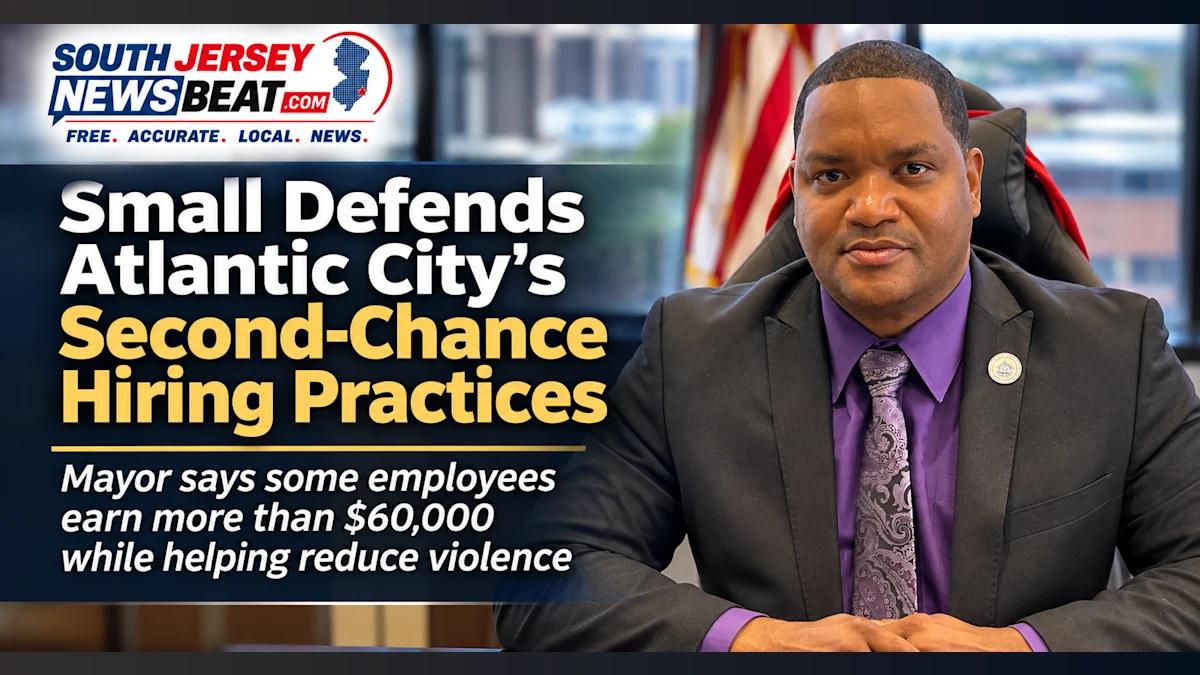
Mayor credits formerly incarcerated individuals working for the city with helping reduce violence, rejects claims that they are paid more than police officers.
ATLANTIC CITY — Mayor Marty Small Sr. is defending his administration's practice of employing individuals with criminal histories, acknowledging that some earn more than $60,000 annually while maintaining that their work has contributed to improved public safety throughout Atlantic City.
During a Tuesday, November 24, interview on The Don Williams Show on News Talk 1400 & 92.3 WOND, Small faced direct questions regarding the number of individuals hired, their responsibilities, their compensation and how their salaries compare with those of Atlantic City police officers.
Small defended the employment opportunities as part of a broader effort to address violence, unemployment and repeat criminal offenses in a community where formerly incarcerated individuals can face significant barriers to finding work.
The mayor also indicated that his administration may have hired substantially more individuals with criminal histories than previously disclosed.
Small Rejects Characterization of Employees as His 'Posse'
Williams asked Small about a group of municipal employees sometimes referred to by others as the mayor's "posse."
Williams questioned whether some members of the group earn between $60,000 and $70,000 annually and whether those salaries exceed the compensation of some veteran Atlantic City police officers.
Small rejected the characterization of the employees as his personal entourage.
"A posse is a street terminology, and it could be taken in many different ways," Small said. "So, everyone has a posse."
Small added, "There are no city employees called a posse."
The mayor said Atlantic City's willingness to provide employment opportunities to people with criminal histories should be viewed as an effort to address longstanding challenges within the community.
He referenced a panel discussion on reentry that he recently moderated at the New Jersey League of Municipalities conference.
"I'm proud that, and the state recognizes that Atlantic City is a second chance city, and I say sometimes in our community, people need a second, third, and fourth chance," Small said.
Mayor Suggests Number of Hires Could Exceed 100
Small recalled a conversation with the mayor of East Orange regarding employment opportunities for individuals with criminal histories.
According to Small, the East Orange mayor indicated that his administration had hired 31 individuals.
"I was joking with him. I said, well, I think I doubled you up. I got 62, but it's probably double that amount, and I wear that with a badge of honor," Small said.
The mayor's remarks suggest the number could be approximately 124, although Small did not provide a precise count, a timeframe for the hires or a breakdown of the positions involved.
It also remains unclear how many of those individuals are currently employed by the city and how many work specifically in violence prevention or community outreach.
Small argued that providing employment opportunities can help break a cycle in which individuals repeatedly return to prison because they struggle to find legitimate employment following their release.
"Atlantic City is an urban community, and we deal with urban problems," Small said.
The mayor cited violence and recidivism as challenges that can have lasting consequences for families and neighborhoods.
Some Employees Earn More Than $60,000
When Williams pressed Small for details regarding compensation and job responsibilities, the mayor confirmed that some of the employees earn more than $60,000 annually.
"Some of them make more than $60,000, which is great," Small said.
"They do not make more than police officers."
Small did not disclose the employees' individual salaries, job classifications, qualifications or funding sources.
The mayor also did not specify whether his comparison with police compensation referred to base salaries, overtime earnings or total annual compensation.
The discussion comes amid broader questions regarding municipal employee compensation and unresolved labor contracts.
Small acknowledged that the police department is not the only municipal bargaining unit whose contract has expired.
"Yes, we got the best police department in the world, but the police department isn't the only union whose contract is up," Small said. "So is the fire department, so is every other employee in the great city of Atlantic City."
In May, Atlantic City announced a 2026 municipal budget totaling approximately $283.8 million, including grants.
City officials also announced that the minimum annual salary for municipal employees would increase from $31,200 to $35,000 effective July 1.
The administration announced one-time payments of $3,500 for municipal employees in place of annual raises, along with a proposed $5,000 payment for police officers, contingent upon acceptance of the offer.
Those figures provide some context for the city's compensation policies, although they do not establish whether the salaries discussed by Small are comparable to those of individual police officers.
Small Says Employees Work With Police to Reduce Violence
Small argued that individuals with established relationships in Atlantic City's neighborhoods can help address situations that traditional law enforcement may have difficulty resolving.
"This group works with the police to deal with issues that the police can't touch, and that's because of their relationships in the streets," Small said.
The mayor maintained that the combination of community-based intervention and traditional policing has contributed to a safer Atlantic City.
Small pointed to what he described as a significant reduction in deadly gun violence, although he did not identify the specific reporting period or provide supporting crime statistics during the interview.
"So, it's working. It's working," Small said.
Williams asked whether the mayor believed those employees were helping keep the city safe.
"Oh, absolutely, and everybody in the know knows that," Small responded.
The extent to which the employment initiative has independently contributed to changes in crime rates has not been established.
Atlantic City Has Established Reentry and Violence Prevention Programs
Atlantic City operates a formal program known as Atlantic City Reentry Services through its Department of Health and Human Services.
The program provides assistance to incarcerated and formerly incarcerated individuals, including employment preparation, reentry planning and connections to housing, treatment and other support services.
The city's stated objectives include reducing repeat offenses, facilitating successful reintegration and improving public safety.
Atlantic City also operates the One Neighborhood Evolution Anti-Violence Division, which has organized employment initiatives intended to connect residents with economic opportunities.
In March 2025, the city reported that a job fair organized by the division connected more than 600 job seekers with approximately 40 employers and organizations.
The event involved partnerships with probation officials, the court system and Volunteers of America, with some participants receiving immediate employment offers.
However, participation in those programs does not necessarily mean an individual is employed directly by the municipal government.
Small did not specify during Tuesday's interview whether all the employees he referenced work within those established programs.
Questions Remain About Costs, Responsibilities and Results
While Small defended his administration's approach, the interview left several questions unanswered regarding the size, structure and cost of the employment initiative.
Among them are the total number of individuals currently employed, their specific job responsibilities, the hiring criteria used to fill the positions and the overall cost to the municipal budget.
Additional information would also help determine how the salaries compare with similarly situated municipal employees and police officers.
The administration's public safety claims could be further evaluated through official crime statistics, program performance data and information regarding recidivism among participants.
Small made clear, however, that providing employment opportunities to individuals with criminal histories is a policy he intends to continue defending.
His administration views the practice as an investment in community stability and violence prevention rather than simply an employment initiative.
For taxpayers, questions regarding the cost, oversight and measurable results of those efforts remain central to evaluating the program's effectiveness.
Mayor Marty Small's comments were made during an interview on The Don Williams Show, heard Monday through Friday from 6 to 10 a.m. on News Talk 1400 & 92.3 WOND.

About the Author
Scott Stephens
Scott has been an on-air personality, producer and newscaster for 30+ years. He has been a mainstay in the South Jersey Community and on the air across many different area stations. Scott can currently be heard on Kool 98.3 and News Talk 1400 & 92.3 WOND.