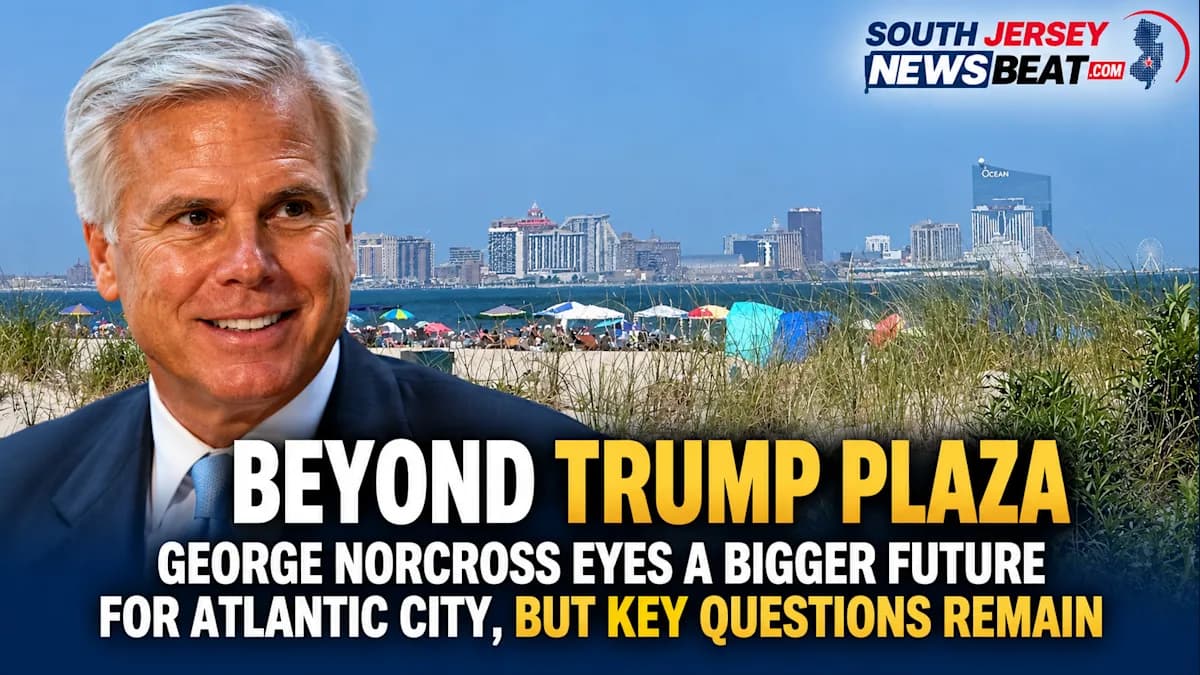
The influential South Jersey businessman’s purchase of a prime Boardwalk property is generating optimism about housing, tourism and economic development, but no specific plans have been announced.
ATLANTIC CITY, N.J. — George Norcross III's purchase of the former Trump Plaza property has sparked considerable excitement about the future of Atlantic City's Boardwalk, but the larger question may be whether the influential South Jersey businessman can help transform the resort into a more diversified, year-round destination.
The acquisition of approximately 10 acres of prime oceanfront real estate next to Boardwalk Hall represents one of the most significant redevelopment opportunities in Atlantic City in years.
Norcross, his adult children Lexie and Alex, and additional business partners purchased the former casino property from billionaire investor Carl Icahn in a transaction generally reported at approximately $5 million.
The identity of the additional investors has not been publicly disclosed, and no specific redevelopment plans have been announced.
However, the purchase is already generating discussion about potential new housing, hotels, entertainment attractions and commercial development that could help Atlantic City expand its economy beyond casino gambling.
In an interview with NJBIZ published Friday, Norcross discussed broader opportunities for Atlantic City's future, including housing, family-oriented tourism and improvements to the city's overall economic environment.
Those ideas have not been announced as a development plan for the Trump Plaza property.
Still, the acquisition has attracted attention from business leaders and development experts who believe the location could become a centerpiece of Atlantic City's next chapter.
A Prime Boardwalk Property at a Surprisingly Low Price
The former Trump Plaza occupies one of Atlantic City's most recognizable locations, directly along the Boardwalk and adjacent to historic Boardwalk Hall.
The casino opened in 1984 and closed in September 2014 as Atlantic City's gaming industry struggled with increasing regional competition.
Its main 39-story hotel tower was demolished in February 2021, leaving a large undeveloped section of Boardwalk property.
The former casino's East Tower, parking garage and operating Rainforest Cafe remain.
According to The Philadelphia Inquirer, Atlantic County property records show three transactions recorded September 3 involving the former Trump Plaza property, with amounts of approximately $5.04 million, $1.26 million and $349,541.
Those transactions total approximately $6.65 million, although the property's acquisition has generally been described as a $5 million deal.
The comparatively modest purchase price has drawn attention from real estate experts.
John Boyd Jr., principal of The Boyd Company, a corporate site-selection firm, told WHYY that the property represents an attractive investment given its oceanfront location.
“There’s single-family homes in Miami that are listed at $100 million right now. So it’s a great buy for Norcross,” Boyd said.
However, Boyd also noted that distressed properties frequently sell at substantial discounts because buyers must account for the expense of redevelopment.
The eventual cost of transforming the Trump Plaza site could be many times greater than its purchase price.
What Could Be Built There?
Although Norcross and his partners have not announced their intentions, economic development experts are already considering several possibilities.
Michael Busler, a finance professor at Stockton University, told WHYY that a hotel could help Atlantic City attract larger conventions and additional visitors.
The idea comes as the future of the Sheraton Atlantic City Convention Center Hotel remains uncertain, with proposals involving the possible conversion of hotel space into residential units.
A new hotel at the former Trump Plaza property could potentially help preserve or expand the city's convention-related room inventory.
Busler also suggested that a major entertainment destination could benefit businesses throughout Atlantic City.
“Ideally for the city, if [Norcross] built something that was a destination … that really helps because that will bring more people to the city,” Busler said.
Boyd raised the possibility of a mixed-use project combining commercial offices, condominiums and other development.
He identified aviation, film and multimedia businesses as potential industries that could support additional office development in Atlantic City.
Atlantic County Executive Dennis Levinson also sees residential development as a possibility.
In an interview with Casino.org, Levinson speculated that Norcross might consider upscale condominiums.
“I’m only guessing, but I would think he would be putting in first-class condos,” Levinson said.
For now, all of those ideas remain speculation.
There has been no announced hotel, condominium complex, entertainment attraction or mixed-use development for the site.
Local Leaders See Opportunity for Major Investment
Atlantic City Mayor Marty Small has enthusiastically welcomed the acquisition, describing it as evidence that investors increasingly recognize the resort's economic potential.
“When successful leaders like Mr. Norcross choose Atlantic City, it sends a strong message and helps attract additional investors who recognize the opportunities here,” Small said.
The mayor has previously praised Norcross's role in Camden's redevelopment and publicly encouraged him to consider additional investments in Atlantic City.
Norcross already has a business presence in the resort through his family's investment in the historic Formica Bakery, which has expanded its operations and distribution.
Levinson, a Republican who has frequently disagreed politically with prominent Democrats in Trenton, also expressed strong support for the acquisition.
“I am ecstatic about it,” Levinson told Casino.org.
“When you get a mover and a shaker like George Norcross coming into your area, it really gives it a boost. Others will follow and make Atlantic City what we believe it can be.”
Levinson pointed to Norcross's involvement in Camden's waterfront redevelopment as an example of his ability to attract investment and advance major projects.
“If George Norcross does half for Atlantic City as what he did for the waterfront in Camden, I’d be very satisfied,” Levinson said.
“He gets things done. He sees a little further than others. He believes in Atlantic City. He has told me that.”
Could Atlantic City Follow Camden's Redevelopment Model?
Norcross has been closely associated with major redevelopment initiatives in Camden, where private investment, institutional expansion and public incentives have helped reshape portions of the city's waterfront.
His business interests include the insurance brokerage Conner Strong & Buckelew, and he has been deeply involved with Cooper University Health Care.
Supporters credit his ability to assemble investors, political relationships and major institutions to advance complicated development projects.
But Camden's redevelopment history also raises questions about whether major investments translate into widespread economic improvements for longtime residents.
Alyssa Maurice, assistant director of Stockton University's William J. Hughes Center for Public Policy, told WHYY that Norcross's involvement could provide Atlantic City with considerable political and financial influence.
“We know Norcross has shown that he can bring together political relationships, private capital and these big institutions to pursue big development projects,” Maurice said.
However, she also cautioned that Camden's redevelopment produced mixed results.
“The economic gains from that redevelopment project were not evenly shared with the neighborhoods of Camden,” Maurice said.
Her observations highlight a central challenge facing Atlantic City.
While casino properties and major tourism attractions generate substantial economic activity, many residents continue to struggle with poverty, limited employment opportunities and the need for affordable housing.
Maurice said Atlantic City needs to diversify its economy and create additional opportunities for residents.
“It needs housing [and] year-round jobs,” she said.
“These are all challenges that are still to come.”
A Bigger Vision Beyond Casino Gambling
The Trump Plaza acquisition comes at a time when Atlantic City's economic future is increasingly tied to industries beyond traditional casino gambling.
Internet gaming continues to generate substantial revenue, but much of that activity does not require visitors to travel to Atlantic City.
Meanwhile, casino competition in neighboring states continues to challenge the resort's traditional gaming business.
Busler questioned whether Atlantic City could support another casino, noting that the existing market is already highly competitive.
He suggested that the city's future may depend more heavily on attracting visitors for conventions, entertainment and other experiences.
That would make the former Trump Plaza property particularly valuable.
Its location near Boardwalk Hall, existing casinos, hotels and other attractions could support a development that complements rather than competes directly with the city's gaming industry.
A major residential project could also bring additional year-round activity to a Boardwalk traditionally dependent on seasonal tourism.
But such development would raise questions about infrastructure, public services, affordability and whether the benefits would extend into Atlantic City's neighborhoods.
Five Major Questions Remain
Despite the enthusiasm surrounding the purchase, several important questions remain unanswered.
First, what will actually be built? Norcross and his partners have not disclosed whether they envision a hotel, residential development, entertainment attraction, commercial complex or some combination of uses.
Second, who are the additional investors? The identities of the undisclosed business partners could provide clues about the project's financial resources and potential direction.
Third, will public funding or tax incentives be involved? No specific request for government financial assistance has been announced. However, large redevelopment projects can involve infrastructure investments, financing incentives and multiple layers of government approval.
Fourth, how many jobs could the project create? Construction employment, permanent positions and opportunities for Atlantic City residents will likely become important measures of the development's economic value.
Finally, when could construction begin? No timetable has been released, and there is no publicly announced construction schedule.
Norcross spokesman Daniel Fee has said that additional details about the property will be announced in the future.
A Potential Turning Point for Atlantic City
The former Trump Plaza property has remained a prominent reminder of Atlantic City's struggles since the casino closed more than a decade ago.
Its demolition in 2021 created an opportunity to reimagine one of the resort's most valuable stretches of oceanfront real estate.
Now, the involvement of Norcross and his partners has renewed hopes that the long-idle property could finally return to productive use.
But the significance of the purchase will ultimately depend on what happens next.
A major investment could bring new visitors, residents, jobs and economic activity to the center of Atlantic City's Boardwalk.
Whether those benefits extend beyond the immediate development site and into the surrounding community will be an equally important question.
For now, the city has a prominent new investor, a valuable development site and considerable optimism about what might come next.
What it does not yet have is a publicly announced plan.
And until Norcross and his partners reveal their intentions, the future of the former Trump Plaza property remains one of Atlantic City's biggest unanswered redevelopment questions.

About the Author
Peter Killeen
A 25-year radio news veteran, Peter covers South Jersey for NewsTalk 1400 & 92.3 WOND radio. Known for his concise and impactful delivery, he ensures listeners and readers stay informed without unnecessary filler.