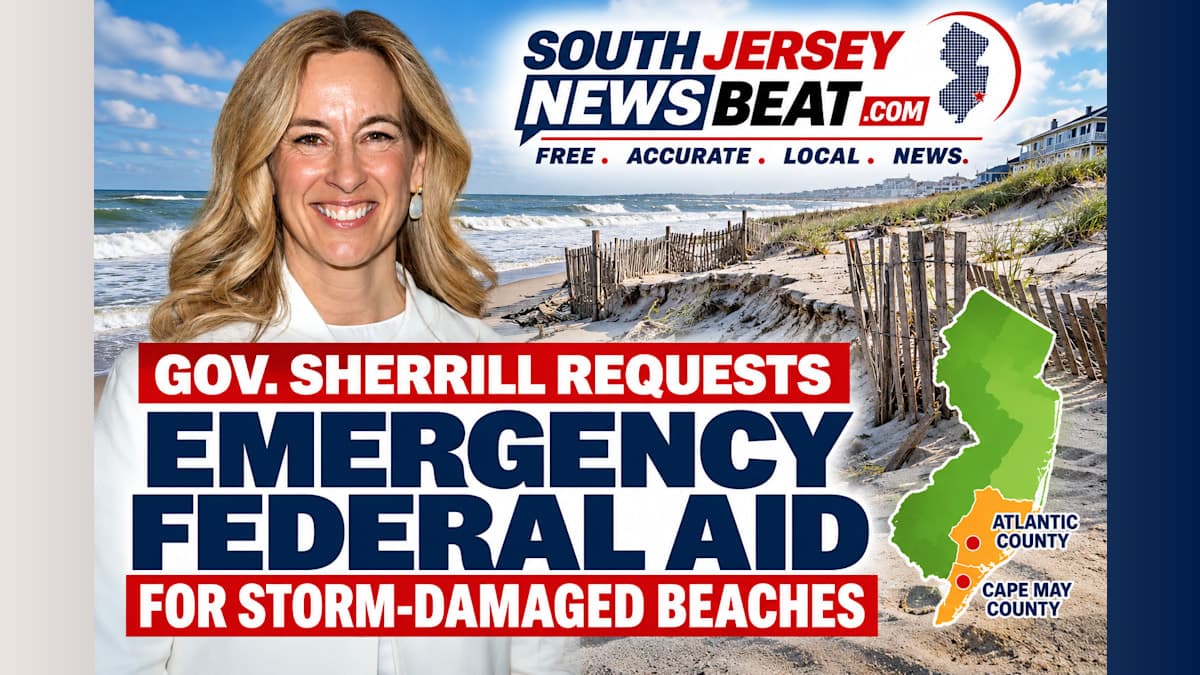
Governor Mikie Sherrill's October 16 request advances Cape May County's earlier appeal, with eight coastal protection projects statewide identified as needing urgent repairs.
ATLANTIC CITY, N.J. — New Jersey has formally requested emergency federal assistance to repair beaches and dunes damaged by September's powerful nor'easter, marking a significant new step in efforts to restore coastal protection systems throughout Atlantic and Cape May counties.
Governor Mikie Sherrill's administration announced Friday, October 16, that it has asked the U.S. Army Corps of Engineers to expedite assistance for eight federal coastal storm protection project areas across New Jersey.
Five of those project areas directly involve Atlantic and Cape May counties, including the shorelines of Brigantine, Atlantic City, Ventnor, Margate, Longport, Ocean City, Strathmere, Sea Isle City, Avalon and Stone Harbor.
The announcement follows an appeal earlier in the week from the Cape May County Board of County Commissioners, which approved a resolution urging the governor to seek federal help.
Friday's action represents a meaningful development: The state has now submitted the emergency assistance request.
However, federal funding has not yet been approved, and officials have not announced how much money may be available or when repairs could begin.
State Warns of Vulnerable Beaches and Dunes
The New Jersey Department of Environmental Protection conducted a post-storm assessment following the late-September nor'easter, which battered coastal communities with powerful waves, flooding and prolonged erosion.
The department's Office of Coastal Engineering found that some beaches withstood the storm relatively well, while others sustained significant damage.
In affected locations, inspectors documented steeply eroded beaches, exposed coastal protection structures and increased wave activity reaching upper beaches, seawalls and dunes.
The assessment determined that eight federal coastal protection projects sustained significant damage and face the possibility of additional serious deterioration without prompt repairs.
"We are working to get our coastal communities every resource they need to recover from the recent nor'easter and replenish the beaches and dunes that protect residents, homes, and businesses," Sherrill said in Friday's announcement.
She thanked DEP for completing its damage assessment and said her administration would continue working with coastal communities to obtain assistance.
DEP Commissioner Ed Potosnak emphasized the urgency of restoring protective sand before additional winter storms.
"In many communities, beaches maintained by the Army Corps of Engineers that provide important storm protection sustained extensive erosion and are now extremely vulnerable heading into the winter season," Potosnak said.
Which Atlantic County Beaches Are Included?
Three communities along Absecon Island, along with Longport, and the neighboring barrier island of Brigantine fall within federal project areas named in the state's request.
The Atlantic County projects are:
Brigantine Island: The federal Brigantine Inlet to Great Egg Harbor Inlet coastal storm risk management project includes Brigantine's oceanfront shoreline.
Absecon Island: The federal coastal protection project covers Atlantic City, Ventnor, Margate and Longport.
These projects are designed to reduce damage from coastal storms through beach replenishment, dunes and other protective infrastructure.
The Absecon Island project has received periodic federal beach nourishment, including work in Atlantic City and Ventnor completed in April 2025.
The latest emergency request addresses damage associated with September's storm rather than automatically authorizing another scheduled replenishment project.
Atlantic City Mayor Marty Small Sr. said the nor'easter demonstrated that more work is needed to protect the city's coastline.
"Federal leadership and funding are essential to ensuring we have the resources and tools necessary to continue protecting our community," Small said.
Brigantine Mayor Vince Sera also emphasized the protective role of beaches and dunes.
"Federal funding for beach replenishment and coastal protection is not just about restoring our beaches," Sera said. "It is about protecting people's homes, keeping our residents safe, and preventing far more costly damage in the future."
Which Cape May County Beaches Are Included?
Three additional federal project areas identified by the state involve Cape May County.
Ocean City: The Great Egg Harbor Inlet and Pecks Beach project covers a portion of Ocean City's shoreline.
Ocean City, Strathmere and Sea Isle City: The Great Egg Harbor Inlet to Townsend Inlet project includes southern Ocean City, Strathmere and Sea Isle City.
Avalon and Stone Harbor: The Townsend Inlet to Cape May Inlet project includes the Seven Mile Island shoreline.
These are established federal coastal protection project areas, some of which have been undergoing previously scheduled beach replenishment work.
The state's emergency request does not establish that every beach within each project area sustained the same degree of damage or will receive the same repairs.
It also does not mean that every beach in Cape May County is included.
North Wildwood, which experienced significant coastal impacts during the September storm, is not separately identified among the eight federal project areas in Friday's announcement.
Likewise, the state's list does not specifically identify Wildwood, Wildwood Crest or Cape May City as part of the newly requested emergency assistance.
Those distinctions matter because the emergency program is tied to qualifying federal coastal protection projects rather than automatically covering every storm-damaged shoreline.
Sea Isle City Mayor Leonard Desiderio welcomed the prospect of additional federal investment.
"Flood mitigation and storm risk reduction are critical to the long-term resilience of Sea Isle City and coastal communities throughout our region," Desiderio said.
He said partnerships among local, state and federal officials are important for protecting residents, businesses and infrastructure.
From County Appeal to State Action
The latest announcement follows several weeks of efforts by South Jersey officials to document storm damage and secure additional federal assistance.
The September nor'easter caused extensive beach erosion and coastal flooding, particularly in vulnerable barrier-island communities.
Sherrill declared a state of emergency affecting Atlantic, Cape May and several other counties beginning September 25. The declaration was lifted September 29, although shoreline recovery efforts continued.
On October 1, federal, state and local officials toured damaged areas in Atlantic and Cape May counties to assess conditions and discuss recovery needs.
The Cape May County Board of County Commissioners subsequently approved a resolution on October 13 asking Sherrill to seek emergency assistance from the Army Corps.
At that stage, the county was formally requesting action by the governor.
The October 16 announcement confirms that the administration has taken the next step by submitting the request to federal authorities.
The development does not mean the Army Corps has approved the projects or committed funding.
How Would Federal Emergency Assistance Work?
New Jersey is requesting assistance under Public Law 84-99, which authorizes the Army Corps of Engineers to provide certain emergency preparedness, response and recovery services.
The law can support rehabilitation of eligible flood-control and coastal storm protection projects damaged by qualifying events.
However, federal assistance is subject to eligibility requirements, engineering assessments, available funding and other applicable conditions.
The Army Corps must determine which projects qualify and what work may be performed.
The state's request identifies seven projects administered by the Corps' Philadelphia District and one administered by its New York District.
In addition to the five Atlantic and Cape May County project areas, the request includes coastal protection projects along Long Beach Island, the northern Ocean County shoreline and portions of Monmouth County.
The state has not announced an estimated total cost for the requested emergency repairs.
It also has not provided a schedule for federal decisions, construction contracts or the placement of additional sand.
Why the Timing Matters
For South Jersey's coastal communities, the immediate concern is protecting homes, roads, businesses and public infrastructure from additional storms.
Beaches and dunes serve as buffers against powerful waves and storm surge.
When a storm removes substantial amounts of sand, protective structures can become more vulnerable to subsequent storms, particularly if erosion leaves dunes exposed.
The potential consequences extend beyond beachfront properties.
Atlantic and Cape May counties rely heavily on tourism, and beach conditions can affect businesses, public access and the overall appeal of Shore destinations.
State Sen. Vince Polistina, who represents Atlantic County's 2nd Legislative District, said beach protection is essential to both public safety and the local economy.
"Atlantic County's beaches are one of our State's greatest assets that draw visitors from across the country and are integral to our way of life in South Jersey's shore communities," Polistina said.
"But our beaches are more than a destination. They are a critical line of defense that helps protect homes, businesses, and infrastructure from devastating erosion and coastal flooding."
State Sen. Michael Testa, whose district includes Cape May County, said the storm demonstrated the importance of beach replenishment while also exposing the need for additional repairs.
He called for state and federal officials to work together to restore damaged coastal defenses.
What Happens Next?
The next major step is a federal determination of eligibility and assistance for the eight project areas.
Questions still to be answered include how much restoration work is needed, the estimated cost of repairs, which locations would receive priority and how quickly construction could begin.
Officials also will need to clarify how the emergency request interacts with beach replenishment projects that were already funded or underway before September's storm.
For Atlantic and Cape May County residents, Friday's announcement provides evidence that the state's effort to obtain emergency federal assistance has advanced beyond local requests and preliminary discussions.
But the outcome remains uncertain.
Until the Army Corps approves assistance and establishes a repair schedule, South Jersey's storm-damaged beaches and dunes remain a pressing concern as the region heads toward winter.
South Jersey NewsBeat will continue following the federal assistance request, including decisions affecting individual Atlantic and Cape May County communities.

About the Author
Peter Killeen
A 25-year radio news veteran, Peter covers South Jersey for NewsTalk 1400 & 92.3 WOND radio. Known for his concise and impactful delivery, he ensures listeners and readers stay informed without unnecessary filler.