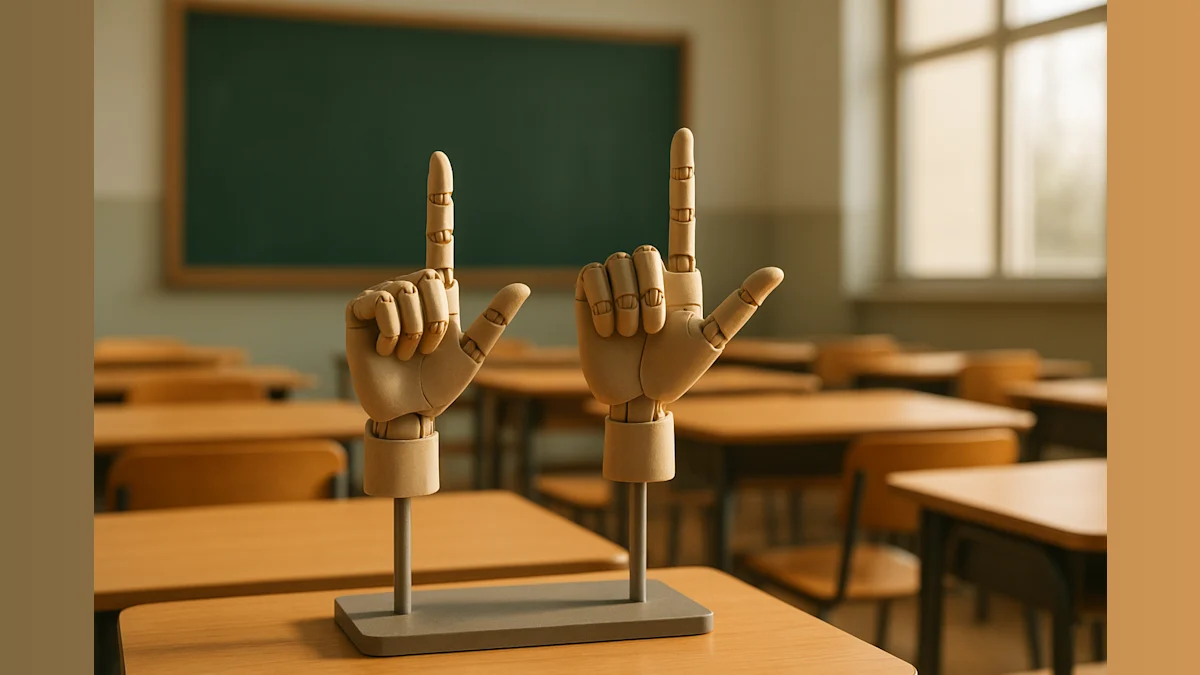
A groundbreaking assistive technology developed in Kenya is transforming educational access for deaf students across the country. Norah Kimathi, a 22-year-old entrepreneur, has created robotic hands capable of translating spoken instruction into sign language in real time, enabling teachers without signing skills to communicate effectively with hearing-impaired students.
The innovation addresses a severe educational crisis. Approximately 300,000 children in Kenya are deaf or hearing impaired, yet only a small fraction attend school. The challenge extends beyond enrollment numbers: Kenya lacks a standardized sign language system, creating particular difficulties in teaching technical subjects such as mathematics and science.
Kimathi founded ZeroBionic to bridge this communication divide. Her company manufactures the robotic hands using 3D-printing technology and recycled plastic waste, selling each unit for $350. The devices demonstrate remarkable durability, operating for three years without requiring maintenance. To date, ZeroBionic has sold 78 units.
The robotic hands achieve a 92 percent speech-to-sign accuracy rating, according to Kimathi. However, engineering the mechanical components represented only part of the development challenge. When the ZeroBionic team began programming the translation algorithms, they discovered a fundamental obstacle: no unified Kenyan or African sign language dataset existed.
"No one else had built this on the continent … We had to start from scratch," Kimathi told AFP from the company's laboratory in Nairobi. The team collaborated with deaf educators and experienced signers, recording their movements and signing patterns using an imported bodysuit equipped with electrodes to capture precise gestural data.
Despite the technical and logistical hurdles, Kimathi maintains the effort has proven worthwhile. "We know we're going to put a smile on someone else's face," she said in the AFP interview.
The current robotic hands represent the initial phase of ZeroBionic's vision. The company plans to develop Africa One, a robotic upper torso designed to significantly enhance both the accuracy and vocabulary range of African sign language translation. This expanded system would provide more nuanced communication capabilities, potentially including facial expressions and upper-body movements that convey meaning in sign language.
The technology's impact extends beyond individual classrooms. By enabling any teacher to communicate with deaf students, ZeroBionic's innovation could dramatically expand educational opportunities throughout Kenya and potentially across the African continent, where similar challenges exist in deaf education infrastructure and standardized sign language systems.