
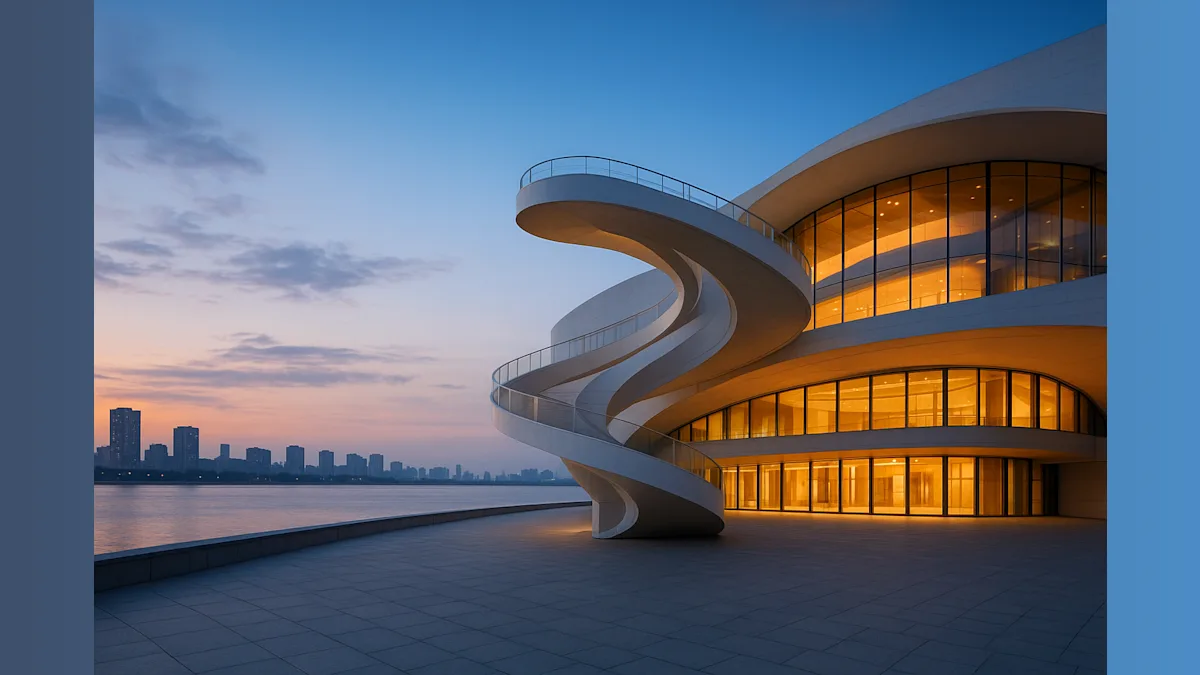
A striking new cultural landmark has risen along the banks of the Huangpu River in Shanghai, and its most talked-about feature is not inside the performance halls but on the exterior. The Grand Opera House, designed by the Norwegian architecture firm Snøhetta, has drawn international attention for a spiral staircase that appears to defy gravity, drawing visitors upward toward the heart of the building's crescent-shaped floor plan.
The commission for the project was awarded to Snøhetta 10 years ago. The firm's design team set out to address what they saw as a common shortcoming of opera houses: the many thresholds that can keep the general public at a distance from the architecture. Their goal was to eliminate those barriers wherever possible and to foster a closer relationship between the building and the civic environment surrounding it.
The exterior staircase embodies that ambition. Positioned along the network of riverside thoroughfares, it is open to anyone, whether or not they hold a ticket, and its Chinese fan-inspired form leads to an observation platform with an unobstructed view of the central business district. In a statement, the firm described movement as both an architectural and a social connector at the opera house, shaping how people approach, enter, and pass through the building — much as a symphony is divided into movements.
The scale of the venue is considerable. The opera house encompasses 1.6 million square feet, or 146,786 square meters, and contains three auditoriums with a total seating capacity of 4,200. Under a single roof, it brings together performance, rehearsal, production, education, exhibition, and hospitality functions. Its programming is intended to span a wide range of work, from traditional opera and classical music to experimental productions designed for new and diverse audiences.
The largest of the three halls, the Harmony auditorium, is dominated by red and features 5 levels and 3 terraces, with seating for 2,000 people. Design partner Nagata Acoustics contributed to the hall's acoustic profile, which pairs modern theatre systems with precisely tuned sound. The second space, the Soar Theater, seats 1,200 and provides a more intimate environment for smaller-scale productions. It is especially well matched to baroque and classical opera, operetta, regional production, and theatre, and is expected to host many performances of traditional Chinese opera known as Xiqu.
The third auditorium, the 1,000-seat Open Stage, is built for experimental and flexible formats, with stage and seating arrangements that can be reconfigured as needed. It accommodates both traditional and non-traditional productions, and its stage is set against floor-to-ceiling windows that frame the river and the city beyond while allowing daylight to fill the hall.
The opening took place last weekend with a performance of Tosca, the Italian classic by Giacomo Puccini. This weekend the venue presents Verdi's Aida, and in just 3 weeks the American Ballet Company will make its debut there with Swan Lake.