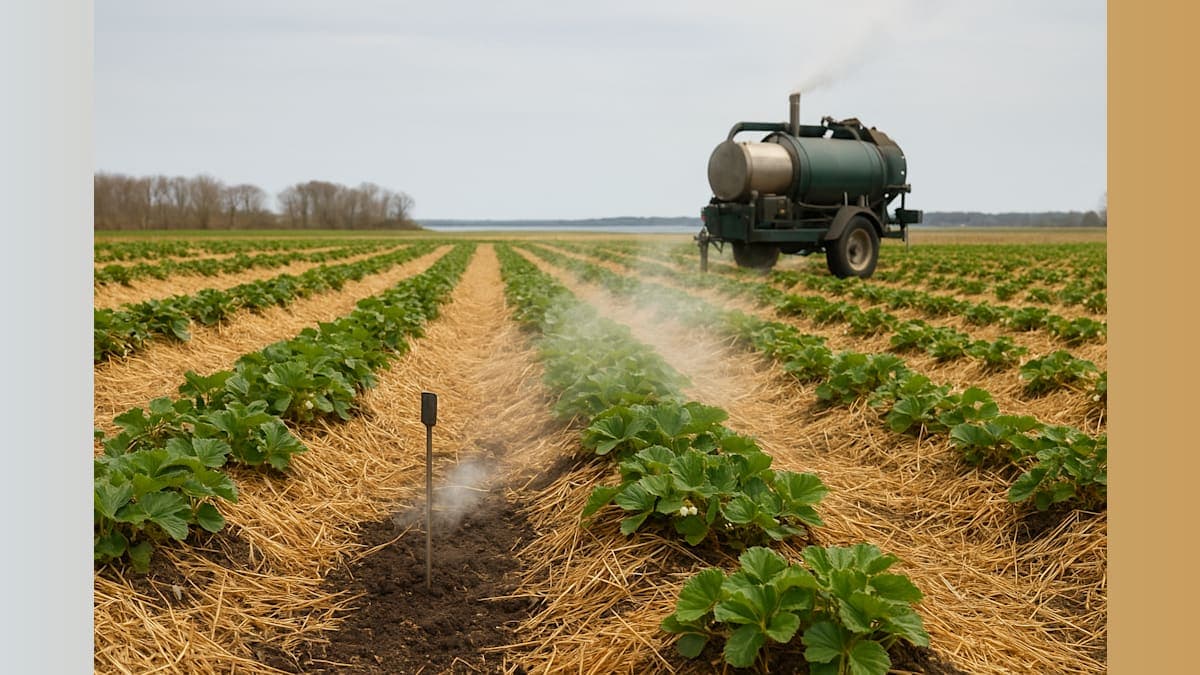
A burst of steam may offer California strawberry growers a way out of a difficult bind, according to research underway at the University of California Santa Cruz (UCSC). Scientists there are testing boiling water vapor as a substitute for the chemical fumigants commonly used to sterilize strawberry beds — substances that are believed to damage the environment, harm other animals, and pose risks to the growers themselves.
The UCSC team recently enlisted four organic strawberry growers for a trial in which specialized machines injected steam into the growing beds before planting. Among the participants was Rod Koda, a longtime strawberry farmer, who told the LA Times that the treated fields produced bigger plants, healthier plants, and more strawberries.
The steam works by killing soil bacteria, fungi, and weeds that can harm, kill, or delay strawberry plants. For years, growers lacked any alternative to chemical fumigants short of gambling on losing an entire harvest to soil-borne diseases such as fusarium wilt. Because certified organic produce cannot be grown with such toxins, organic growers faced a choice between taking bankruptcy-level risks and turning to hydroponics. Steam fumigation now appears to provide a viable third option.
The underlying concept is not new. Greenhouses have relied on steam as a pesticide for decades; applying it directly to soil is a fresh twist on a familiar practice. Jenny Broome, a UCSC researcher involved in the project, described the approach as a return to older methods combined with modern engineering, saying, "We're going back to the future, where we're looking back at an older technology but we're finding more ways to engineer more efficiently and use it."
The stakes are substantial. Strawberries rank among California's most valuable and largest crops, with roughly 35,000 acres devoted to their cultivation. The fruit grows close to the ground, thrives in shade, and bruises easily, making it a prime target for pests of every kind. That vulnerability helps explain why agricultural researchers continue to pursue yield improvements through hydroponics, indoor growing systems, and other innovations.
Steam is not the only novel tool under investigation. Good News Network recently reported on a 3D textile originally developed as insect-proof lining for United States military body armor. When draped over fields, the material tripled strawberry yields in North Carolina by excluding insects while allowing breeze, moisture, and sunlight to reach the plants.
For organic growers, the appeal of steam lies in its simplicity and its compatibility with certification standards. If the trial results hold, the technique could reduce reliance on fumigants while stabilizing harvests — a meaningful development for a crop that occupies tens of thousands of acres across the state.