
New survey finds voters pessimistic about the economy, Democrats favored for control of Congress and declining confidence in election results.
GALLOWAY, N.J. — Nearly two-thirds of New Jersey voters disapprove of President Donald Trump's job performance, while a majority believe the economy has gotten worse over the past year, according to a new Stockton University poll released Thursday, October 22.
The survey, conducted by Stockton University's William J. Hughes Center for Public Policy, paints a pessimistic picture of voter sentiment less than two weeks before the November 3 midterm elections.
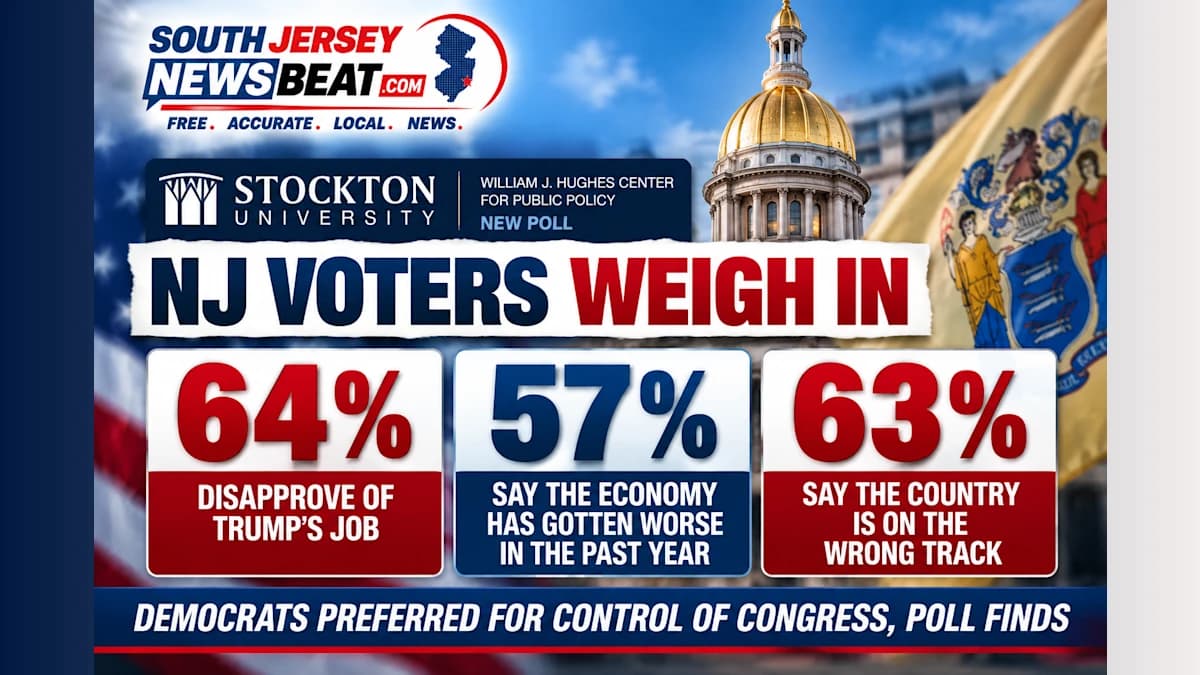
According to the poll, 64% of registered New Jersey voters disapprove of Trump's performance, compared with 31% who approve.
The findings also reveal widespread concern about the direction of the country, with 63% saying the United States is on the wrong track and just 24% believing it is headed in the right direction.
Economic Concerns Dominate
Economic dissatisfaction emerged as one of the survey's most significant findings.
Nearly half of respondents, 49%, rated the economy as poor, while another 25% described it as fair.
Only 23% gave the economy a positive rating, including 18% who called it good and 5% who considered it excellent.
When asked whether economic conditions have changed over the past year, 57% said the economy has gotten worse, compared with 13% who said it has improved and 26% who believe conditions have remained about the same.
The responses reveal substantial differences along party lines.
Among Democrats, 85% said the economy has worsened. That view was shared by 53% of independent voters and 16% of Republicans.
Despite strong Republican support for Trump, fewer than half of Republican respondents, 45%, said the economy is better than it was a year ago.
The findings suggest that even among voters who support the president, economic optimism is far from universal.
Democrats Favored to Control Congress
With control of Congress at stake in November, the Stockton survey found Democrats holding a substantial advantage among New Jersey voters.
A majority, 55%, said they would prefer Democrats to control Congress following the midterm elections, compared with 31% who favored Republican control.
Trump's approval rating remains deeply divided by political affiliation.
Among Republicans, 85% approve of his job performance.
That compares with 31% of independents and just 4% of Democrats.
The findings underscore the partisan divide in New Jersey, where attitudes toward the president differ sharply depending on political affiliation.
However, statewide preferences do not necessarily predict the outcome of individual congressional races, particularly in competitive districts where local candidates and issues can influence voting.
Democrats Lead on Health Care, Cost of Living and Foreign Policy
The Stockton poll also asked voters which political party they trust more to handle five major policy issues.
Democrats held an advantage on every issue tested.
The largest gap came on health care, where 58% trusted Democrats more, compared with 25% who preferred Republicans.
On the cost of living, Democrats led 55% to 29%.
Foreign policy, including the war with Iran, produced a 53% to 29% advantage for Democrats.
Immigration was the closest issue, with Democrats leading Republicans 49% to 36%.
Artificial intelligence generated the greatest uncertainty.
While 39% trusted Democrats more to handle AI compared with 25% who preferred Republicans, 34% said they trusted neither party or were unsure.
Independent Voters Could Play an Important Role
One of the more revealing findings involved New Jersey's independent voters.
Although independents generally leaned toward Democrats on most issues, their support was not overwhelming.
Immigration was the only issue tested on which independent voters favored Republicans.
Among independents, 43% trusted Republicans more on immigration, compared with 35% who favored Democrats.
On artificial intelligence, 42% of independents either trusted neither party or were uncertain.
Alyssa Maurice, assistant director of Stockton's Hughes Center, said the results demonstrate the importance of looking beyond partisan voters.
"We expect partisans to trust their own party on these key policy issues, but it was notable to see where Independents landed," Maurice said.
"Although they favored the Democratic party on most of the issues we asked about, it was not by a majority."
The findings suggest that neither party can necessarily assume independent voters will support its candidates across all issues.
Confidence in Election Results Declines
Another significant finding involves public confidence in the accuracy of election results.
The survey found that 58% of New Jersey voters are very or somewhat confident that the November midterm election results will be accurate.
However, 37% said they are not too confident or not at all confident.
That represents a notable decline from September 2024, when 68% expressed confidence in the accuracy of election results and 31% expressed little or no confidence.
The decrease was particularly pronounced among Democrats.
According to Stockton, confidence in election results declined by 27 percentage points among Democratic voters and 13 points among independents.
Among Republicans, confidence increased by 11 percentage points.
In the latest survey, 69% of Democrats expressed confidence in election results, compared with 54% of independents and 48% of Republicans.
Maurice said those shifts suggest that attitudes about election integrity are closely connected to the political environment.
"These shifts suggest that confidence in elections is closely tied to national politics and which party is in power," she said.
The survey measured voters' confidence in election results. It did not establish that election systems are inaccurate or that voting irregularities have occurred.
What the Findings Mean for South Jersey
The statewide survey offers insight into the political climate facing voters across New Jersey, including Atlantic and Cape May counties.
Economic issues such as housing costs, transportation, food prices, health care and employment remain important concerns for many South Jersey households.
The poll suggests those concerns could influence how voters evaluate candidates in the November midterms.
The results also provide context for political contests in South Jersey, where voters may weigh national economic conditions alongside local issues such as casino employment, tourism, development and property taxes.
However, the Stockton survey was conducted statewide and does not provide separate results for Atlantic or Cape May counties.
It should therefore not be interpreted as a measurement of voter sentiment specifically within either county or an individual congressional district.
About the Poll
The Stockton Polling Institute surveyed 662 registered New Jersey voters from October 13 through October 19, 2026.
Participants were contacted using a New Jersey voter-list sample and interviewed by telephone or online.
Approximately 76% completed live-interviewer telephone surveys, while 24% responded through a text-to-web survey.
The data were weighted to reflect demographic characteristics of New Jersey's voting-eligible population, including age, race and ethnicity, education, region and sex.
The poll has a margin of error of plus or minus 3.8 percentage points at a 95% confidence level. Margins of error are larger for smaller subgroups, including political party breakdowns.
The survey was sponsored and conducted by the Stockton Polling Institute at the William J. Hughes Center for Public Policy.
Complete poll results are available through Stockton University's Hughes Center website.
With Election Day approaching, the findings show a New Jersey electorate concerned about economic conditions, divided sharply over the president and less confident in election results than it was two years ago.
Whether those attitudes translate into changes in congressional representation will be determined when voters head to the polls November 3.
Source: Stockton University William J. Hughes Center for Public Policy, October 22, 2026 polling release.