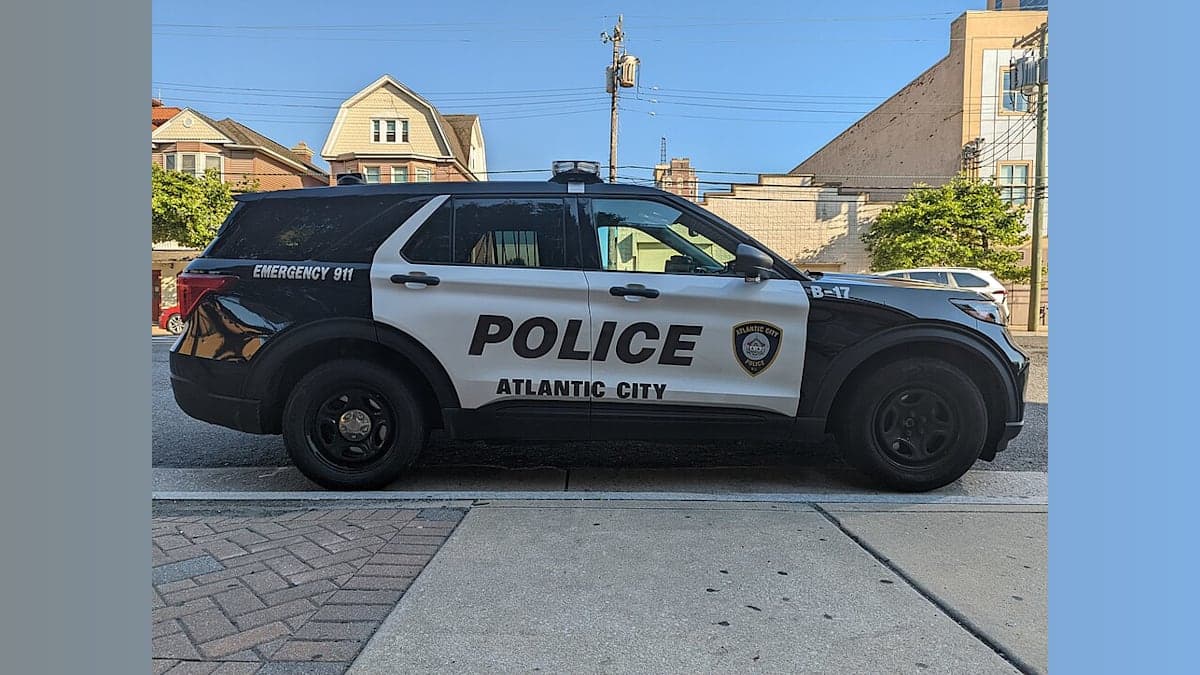
ATLANTIC CITY, N.J. — Police officers are increasingly being asked to solve problems involving homelessness, addiction, mental illness and changing technology without always having the legal authority or resources necessary to solve them, Atlantic City Public Safety Director Sean Riggin says.
“What we're expecting from them and the tools that we're giving them just don't match anymore,” Riggin said Tuesday during an appearance on The Don Williams Show on WOND.

Riggin, who is also the Democratic candidate for Atlantic County sheriff, used his current role overseeing public safety in Atlantic City to describe what he sees as a fundamental change in policing.
Residents still expect police to resolve visible quality-of-life problems, he said, even when officers can't legally make someone leave a public place simply because that person is homeless, struggling with addiction or experiencing mental-health problems.
Riggin said the answer will require both enforcement and services.
“We need to be honest about the fact that what we're doing isn't quite working,” Riggin said. “It's going to be a combination of strict enforcement — and I mean it, I mean strict enforcement — but also matching services to the people that need them.”
Homelessness Can't Be Solved by Arrests Alone
Riggin said the dilemma becomes apparent when residents see people who appear to be homeless, addicted or experiencing mental-health problems and expect police to clear an area.
Years ago, Riggin said, the public expectation may have been simply to call police and have officers move people along.
That isn't necessarily legally possible today.
“At the same time that we've increased our officer accountability, which we all understand that we need to do, we've never changed our expectation of law enforcement on the back end,” Riggin said.
His comments are consistent with what he told the Atlantic City NAACP in August when responding to complaints about unhoused people in city parks.
Riggin said then that services are available, but police have limited options when someone isn't committing a crime and refuses assistance. He described much of the issue as involving mental health and social services rather than law enforcement alone.
On Tuesday, Riggin said different parts of the system need to work together more effectively.
“We need to figure out ways to make those systems work together,” he said.
Riggin was careful not to blame prosecutors, judges or any particular institution.
“There's no bad guy in that story,” he said. “There's nobody that's not doing their best.”
Instead of judging success solely by arrests or summonses, Riggin said officials should ask a more basic question.
“Did we actually solve the problem?”
Social Media and Pop-Up Beach Parties
Riggin also provided new details about how Atlantic City has responded to another relatively new policing challenge: large gatherings organized through social media.
He said authorities have monitored social media to identify planned pop-up beach parties before they happen.
The city's legal team can then send cease-and-desist notices to organizers, Riggin said.
“They actually go on to social media, find out where their parties are going to be and send cease and desist letters,” Riggin said.
The approach, he said, has had “a really positive effect.”
The strategy is intended to prevent the kind of large, quickly organized youth gatherings that have challenged police departments in Shore communities.
“People have figured out that if you put 500 kids in one place, it's very difficult to control them,” Riggin said. “And so that's part of the thrill.”
Riggin said Atlantic City has also benefited from its partnership with the Casino Reinvestment Development Authority, which helps provide additional police staffing in the Tourism District during the busy summer season.
The city confirmed earlier this summer that the seasonal initiative again placed additional officers in high-traffic areas during peak tourism months.
‘Terrible Job’ on E-Bike Law
Riggin also took aim at New Jersey's attempt to regulate increasingly powerful electric bicycles and similar vehicles.
He credited state lawmakers with recognizing that faster motorized bikes had become a public-safety problem but sharply criticized how the resulting requirements were implemented.
“The state did a really good job in the idea of recognizing that there was a problem with these motorized bicycles, but did, I mean not to pull punches, a terrible job with the legislation to fix it,” Riggin said.
The problem, he said, is complexity.
“They basically said all these things have to be registered. They have to be insured,” Riggin said, “but no clear process on how it is people are supposed to do that.”
Atlantic City held a public town hall in May specifically to explain New Jersey's new e-bike requirements, including which riders and vehicles are affected, how enforcement works and what residents must do to comply.
Riggin said the issue is particularly complicated in Atlantic City because electric bikes and scooters aren't exclusively recreational.
For some residents without cars, they're transportation to work or a way to take children to school.
“In one case, you just need them to slow down and put on a helmet,” Riggin said. “In the other, we need to find ways to get them to merge into traffic or something, because these are people that are going back and forth to work.”
Riggin said he believes lawmakers need to revisit the issue.
“We need to go back and take another look at it and figure out what's really going to work for individual communities,” he said.
Trying to Prevent Problems Before They Happen
Riggin said Atlantic City's summer public-safety strategy has benefited from additional police staffing on the Boardwalk and in the Tourism District.
But he said policing increasingly requires agencies to adapt to problems that may not have existed — or existed in the same form — just a few years earlier.
Social media can bring hundreds of young people to one location with little warning. Electric bicycles can travel at speeds traditional bicycles couldn't. Police are frequently called to situations rooted in addiction, homelessness and mental illness.
“It's always an asymmetric threat,” Riggin said. “It's never coming from where you thought it was.”
That, he said, makes leadership and adaptability as important as any individual policing strategy.
“Whatever the problem is that you're looking at right now,” Riggin said, “it's not going to be the problem you have tomorrow.”

About the Author
Scott Stephens
Scott has been an on-air personality, producer and newscaster for 30+ years. He has been a mainstay in the South Jersey Community and on the air across many different area stations. Scott can currently be heard on Kool 98.3 and News Talk 1400 & 92.3 WOND.