City has authorized $35,000 for engineering and permits, but construction funding and a start date remain unconfirmed. The project is separate from New Jersey's new request for federal beach-restoration assistance.
BRIGANTINE, N.J. — With winter storm season approaching and severe beach erosion threatening homes and public infrastructure, Brigantine officials are moving forward with plans for an estimated $400,000 emergency stone barrier at the northern end of the city's beachfront Promenade.
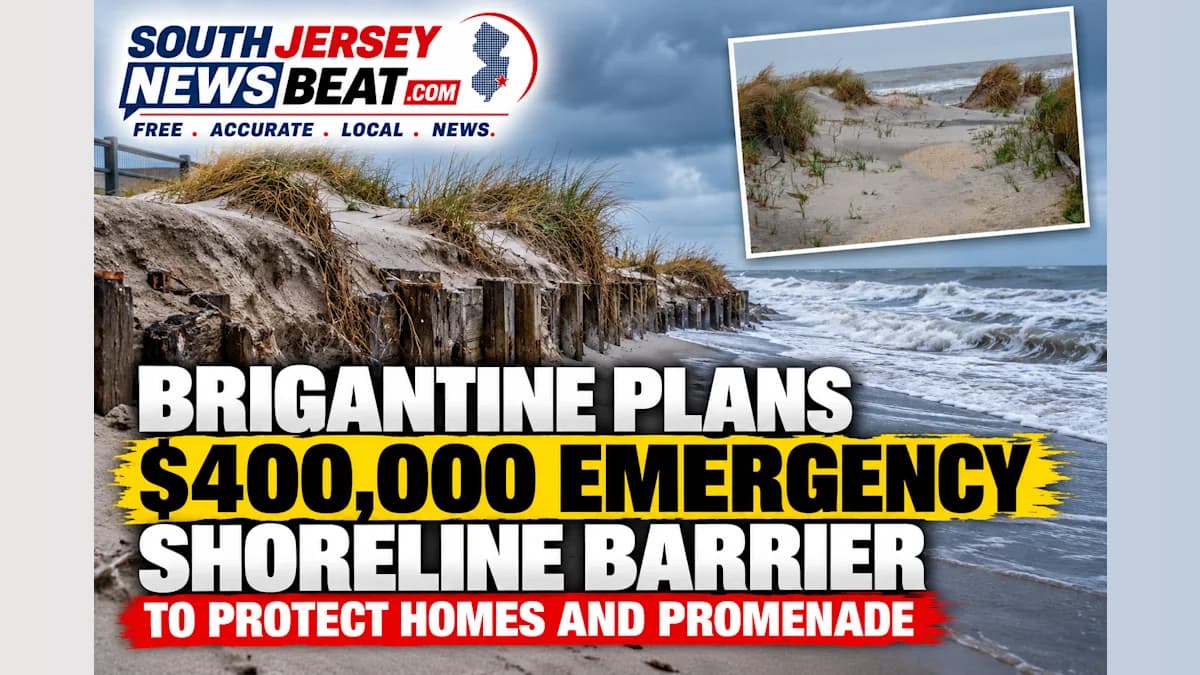
The proposed project would reinforce an exposed timber bulkhead and a section of badly eroded dunes following September's powerful nor'easter, which stripped away significant amounts of sand along Brigantine's northern shoreline.
City Council has authorized approximately $35,000 for engineering design and permitting, but the larger construction project has not yet received all required approvals or a publicly confirmed funding arrangement.
The city is pursuing the temporary protection while continuing to work with state and federal officials on more extensive shoreline improvements.
The local initiative comes as Governor Mikie Sherrill's administration formally requested emergency federal assistance on October 16 to restore storm-damaged beaches in eight coastal project areas across New Jersey, including Brigantine Island.
Although both efforts address the same storm damage, they are separate projects with different funding and approval processes.
Erosion Exposes Aging Bulkhead
According to an October 7 announcement from Mayor Vince Sera, erosion at the northern end of the Promenade has removed approximately 40 feet of the dune system beyond the walkway's endpoint.
The damage has exposed an older timber bulkhead that is currently helping hold back further erosion.
City officials fear that if the bulkhead fails, additional wave action could threaten nearby private homes, the public right-of-way along Brigantine Boulevard and the Promenade itself.
Erosion reaching the landward side of the walkway could also undermine the structure.
"We know we cannot wait for the long-term solution to protect the homeowners and infrastructure at the end of the Promenade," Sera said in the October 7 announcement.
"The erosion has progressed significantly, and we need to take action now."
The mayor said City Council authorized design and permitting for an emergency stone revetment intended to provide temporary protection in the area where officials fear a possible breach.
A revetment is a sloping protective structure, typically built from large rocks or other durable materials, designed to absorb wave energy and limit further shoreline erosion.
Unlike beach replenishment, which restores protective sand, a stone revetment provides a more rigid defense against waves.
Massive Stones Proposed Along Vulnerable Shoreline
The city's engineer has recommended installing large stones weighing approximately four to six tons each.
The proposed barrier would begin at the corner of the Promenade, follow the exposed timber bulkhead and extend approximately 50 feet along the eroded dune face.
The objective is to reinforce the vulnerable area before additional storms cause further damage.
Brigantine has retained Arthur Chew Consulting to prepare the engineering design and obtain the necessary permits.
Shore Local News reported October 15 that City Council approved approximately $35,000 for the engineering and permitting work.
The estimated construction cost is approximately $400,000, according to reporting originally attributed to The Press of Atlantic City.
That figure is a preliminary estimate, not an awarded construction contract.
The final cost could depend on the approved design, contractor pricing, site conditions and other project requirements.
Construction Funding Remains an Open Question
While Brigantine has authorized the initial engineering and permitting work, publicly available information does not establish precisely how the estimated $400,000 construction cost will be financed.
It has not been confirmed whether the city intends to pay entirely from municipal funds, seek reimbursement from another government agency or use a combination of funding sources.
There also has been no verified announcement that the full construction amount has been appropriated.
That distinction matters because authorization to design a project does not necessarily mean the city has secured the money or approvals needed to build it.
After the engineering work is completed and permits are obtained, Brigantine plans to request quotes from contractors experienced in coastal construction.
A contractor has not yet been publicly identified for the installation.
State and Federal Permits Still Required
The proposed revetment must receive approvals from both the New Jersey Department of Environmental Protection and the U.S. Army Corps of Engineers before construction can proceed.
Coastal construction projects are subject to environmental and shoreline-protection regulations because permanent or temporary structures can affect beaches, dunes, wave patterns and neighboring properties.
Even emergency projects must satisfy applicable permitting requirements unless a specific emergency authorization or exemption is granted.
Sera said the city wants to move quickly but recognizes that the work must be properly designed and permitted.
"We are moving as quickly as we can, but we also need to make sure the work is properly designed and permitted so we can get it done the right way," he said.
As of October 19, the city had not publicly announced that the required state and federal approvals had been issued.
No confirmed construction start date or completion schedule was available.
That leaves a critical question as Brigantine approaches the winter storm season: How quickly can the temporary barrier be installed?
How the Project Differs From Governor Sherrill's Federal Aid Request
The emergency revetment is distinct from the statewide beach-restoration effort announced October 16.
Sherrill's administration formally requested expedited assistance from the Army Corps of Engineers under Public Law 84-99, which authorizes certain federal emergency preparedness, response and recovery activities.
The request covers eight existing federal coastal storm risk management project areas damaged by September's nor'easter.
Seven fall under the Army Corps' Philadelphia District, including the Brigantine Island Coastal Storm Risk Management Project.
The eighth is administered by the New York District.
The state Department of Environmental Protection determined that the eight project areas sustained significant erosion and could face additional damage without near-term repairs.
The requested federal assistance is intended to help restore protective beaches and dunes and address other eligible storm damage within those federal project areas.
Brigantine's proposed $400,000 stone revetment, by contrast, is a city-initiated emergency measure focused on a specific vulnerable location at the northern Promenade.
The federal request does not establish that the Army Corps has approved funding for the local stone barrier.
Nor does inclusion of Brigantine Island in the statewide request mean every damaged location in the city has been approved for federal repairs.
As of October 19, the federal government had not announced an approved funding amount or construction schedule in response to New Jersey's request.
Governor Visited Brigantine After Storm
Sherrill visited Brigantine on September 29 to inspect storm damage and discuss shoreline protection with local officials.
Sera said he had contacted the governor's office during the nor'easter to explain the severity of the situation.
According to local reporting, state officials responded quickly and helped connect Brigantine with specialists who could evaluate possible solutions.
In the state's October 16 announcement, Sera emphasized the importance of both immediate repairs and long-term coastal protection.
"Federal funding for beach replenishment and coastal protection is not just about restoring our beaches," Sera said. "It is about protecting people's homes, keeping our residents safe, and preventing far more costly damage in the future."
He also warned that communities cannot afford to wait until another major storm to address existing damage.
Temporary Protection While Permanent Solution Is Developed
Brigantine officials have emphasized that the stone revetment is not intended to replace a permanent coastal protection project.
The city continues to pursue an extension of the seawall at the northern end of the Promenade, along with broader beach and dune protection improvements.
"This is not the permanent solution," Sera said.
"It is something we can put in place to help protect the area while we continue working on the extension of the seawall at the end of the Promenade and the larger coastal protection projects we have been discussing with NJDEP and the Army Corps."
The city is coordinating with county, state and federal partners on those longer-term efforts.
However, no final construction schedule or complete funding plan has been publicly established for the proposed seawall extension.
The emergency revetment is intended to reduce the immediate risk while those larger projects advance.
Questions Remain Before Construction
The most pressing issues now involve money, permits and timing.
Brigantine has taken the initial step of authorizing design and permitting, but several important questions remain unanswered:
Has the city identified and appropriated the full construction funding?
When will NJDEP and the Army Corps decide on the required permits?
Will contractors be able to complete the work before another major coastal storm?
Could state or federal funding eventually offset some of the local expense?
What is the projected cost and timetable for a permanent seawall extension?
The answers will determine how quickly the city can provide additional protection for the vulnerable northern shoreline.
For now, Brigantine is pursuing two parallel strategies: a locally initiated emergency stone barrier to address an immediate threat and broader coastal restoration efforts involving state and federal agencies.
Both are aimed at protecting residents, homes and public infrastructure, but neither has yet produced a confirmed construction start date for the threatened section of the Promenade.
With erosion already exposing an aging bulkhead, the urgency is clear.
South Jersey NewsBeat will continue monitoring the permitting process, construction funding and the federal government's response to New Jersey's emergency beach-restoration request.

About the Author
Peter Killeen
A 25-year radio news veteran, Peter covers South Jersey for NewsTalk 1400 & 92.3 WOND radio. Known for his concise and impactful delivery, he ensures listeners and readers stay informed without unnecessary filler.