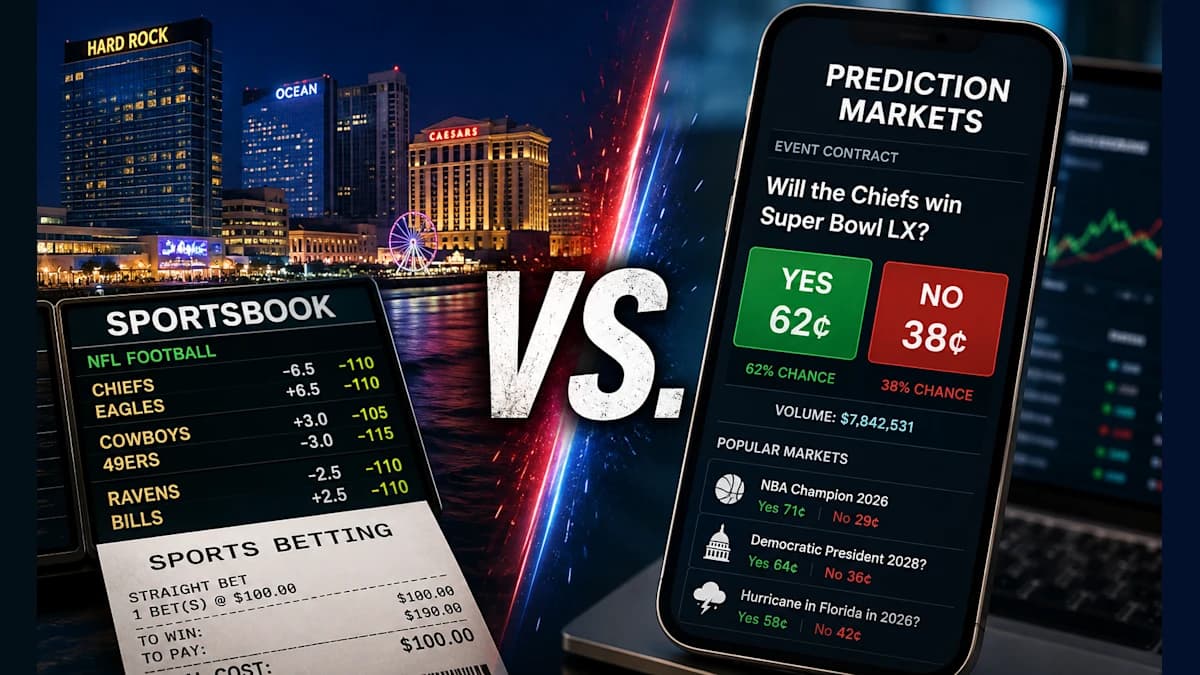
ATLANTIC CITY — Two weeks after Atlantic City’s casino industry called on federal regulators to rein in sports prediction markets, the battle over who controls — and profits from — sports wagering is becoming increasingly complicated.
Courts around the country are reaching different conclusions about whether states can regulate prediction-market companies. Traditional sportsbook giants DraftKings and FanDuel are moving into prediction markets themselves. And casino analyst Anthony Marino says the rapidly developing dispute could eventually require Congress or the U.S. Supreme Court to settle it.

“It’s an ongoing battle,” Marino said Friday on The Don Williams Show on WOND. “It’s a federal versus state issue.”
For Atlantic City, the stakes could be significant.
“As someone who analyzes the casinos, anything that has the potential of reducing the revenue of our local casino industry is not a good thing,” Marino said.
Atlantic City Casinos Already Joined the Fight
As South Jersey NewsBeat previously reported, the Casino Association of New Jersey, which represents Atlantic City’s casino industry, recently urged the Commodity Futures Trading Commission to prevent federally regulated prediction markets from offering sports contracts in states where doing so conflicts with state gaming laws.
The casino industry argues that companies offering sports-event contracts are effectively providing sports betting while bypassing the licensing, taxation and consumer-protection systems imposed on traditional sportsbooks.
Prediction-market operators dispute that characterization.
Companies such as Kalshi contend they operate federally regulated exchanges where customers buy and sell event contracts rather than place conventional sportsbook wagers.
That distinction has created the regulatory battle Marino described Friday.
States traditionally control gambling within their borders. Prediction markets, however, contend the federal Commodity Exchange Act gives the CFTC exclusive jurisdiction over their products.
“Each state levies its own taxes,” Marino said of traditional sports wagering. “Each state sets up a very close monitoring system, a regulatory system.”
With prediction markets, he said, the regulatory structure is fundamentally different.
Courts Creating a Patchwork of Rules
The legal picture has become even murkier.
New Jersey attempted to stop Kalshi from offering sports-event contracts without complying with state gambling laws. But Kalshi successfully obtained federal court protection preventing New Jersey from enforcing those laws while the litigation proceeds.
Other states have recently had greater success challenging the company.
A federal judge last week allowed Utah to enforce its anti-gambling laws against Kalshi, adding to an increasingly fragmented legal landscape in which prediction markets can face dramatically different rules depending on the state and the court hearing the case.
That is essentially the situation Marino described on WOND.
“We have a mishmash of laws,” Marino said. “We have federal versus states.”
Marino said lawsuits are being filed around the country, with some judges allowing states to act against prediction markets while others have sided with the companies.
He doesn't expect a quick resolution.
“It may take a year or two,” Marino said.
Could It Reach the Supreme Court?
Marino sees two potential ways the uncertainty could eventually be resolved.
One is through Congress establishing clearer federal rules governing prediction markets and sports-event contracts.
The other is through the courts.
With cases proceeding in multiple jurisdictions, Marino said one could eventually make its way to the U.S. Supreme Court, although the justices would have discretion over whether to hear it.
“Sooner or later one of those cases will be appealed to the Supreme Court,” Marino said.
Until then, states, gaming regulators, casino companies and prediction-market operators are likely to continue fighting over where federal commodities regulation ends and state gambling authority begins.
The American Gaming Association, which represents the commercial casino industry, argues sports-event contracts offered through prediction markets amount to sports betting conducted outside state and tribal regulatory systems.
DraftKings and FanDuel Join the Other Side of the Business
Perhaps the most striking development is the response from two companies that dominate conventional online sports betting.
DraftKings and FanDuel aren't simply watching prediction markets take off.
They're entering the business themselves.
“DraftKings and FanDuel dominate the legal sports books,” Marino said.
But with prediction markets continuing to operate and expand, Marino said both companies have created prediction-market operations of their own.
Recent reporting confirms both companies are pivoting toward prediction products as competition intensifies. Prediction-market companies such as Kalshi and Polymarket have soared in popularity and valuation, creating a potentially disruptive competitor to the state-regulated sportsbook model.
Marino said DraftKings has reported attracting about 600,000 customers to its prediction-market operation.
The development creates an unusual dynamic: major sportsbook operators that have built enormous businesses under state-regulated sports wagering are simultaneously positioning themselves to compete under the prediction-market model.
A Rapidly Growing Competitor
The amount of money flowing into prediction markets helps explain the urgency.
Prediction markets allow customers to take positions on the outcomes of future events — everything from elections and economic indicators to entertainment, weather and sports.
Industry estimates cited this week project prediction-market trading could reach approximately $240 billion during 2026.
That doesn't mean $240 billion is being diverted from sportsbooks. Prediction-market volume includes many categories unrelated to sports and isn't directly comparable to conventional sportsbook revenue or wagering handle.
Marino made that distinction himself Friday.
He discussed reports suggesting prediction-market activity has grown enormously but cautioned against assuming every dollar represents competition with sportsbooks.
“Remember, the prediction markets have a lot of money being bet on political events, on weather events, on all kinds of events,” Marino said.
“So, it’s unclear whether that’s an apple-to-an-apple comparison.”
Nevertheless, sports have become a major part of the prediction-market business. One recent analysis estimated prediction markets were already accounting for roughly 27% of combined sports-betting activity during this summer's World Cup surge.
From Warning to Full-Scale Fight
Marino has been warning about the issue for months.
In an earlier WOND interview reported by NewsBeat, he described the rapidly changing regulatory environment surrounding prediction markets as “almost total chaos in American gambling” and warned that their expansion could threaten Atlantic City's gaming industry.
Since then, the issue has moved beyond a theoretical threat.
Atlantic City's casino industry has formally asked federal regulators to intervene. States are battling prediction-market companies in court. Traditional sportsbook operators are entering the prediction business themselves. And the amount of money flowing through event contracts continues to grow.
For New Jersey, there is also a financial component.
Traditional sportsbooks operate through the state's regulated gaming industry, paying taxes and operating under rules enforced by New Jersey gaming regulators. The casino industry argues that allowing competing sports products to operate outside that framework puts licensed operators at a disadvantage.
Marino believes that makes the outcome relevant far beyond the companies directly involved in the lawsuits.
“The prediction markets are collecting a lot of money,” Marino said. “They want to protect that revenue flow.”
For Atlantic City, the question is increasingly whether some of that rapidly growing business will come at the expense of the regulated sports-wagering industry that has become an important part of New Jersey gaming.
And for now, Marino sees no quick answer.
The courts are divided. The states aren't backing down. The prediction markets are growing. And even the country's biggest sportsbooks are now trying to make sure they have a place in whichever system ultimately prevails.

About the Author
Scott Stephens
Scott has been an on-air personality, producer and newscaster for 30+ years. He has been a mainstay in the South Jersey Community and on the air across many different area stations. Scott can currently be heard on Kool 98.3 and News Talk 1400 & 92.3 WOND.